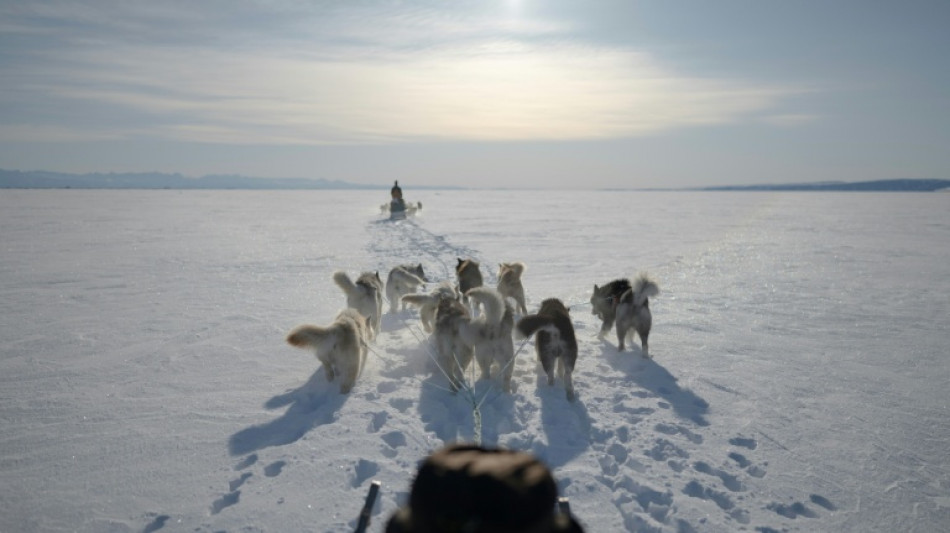
Greenland's elite dogsled unit patrols desolate, icy Arctic / Photo: Olivier MORIN - AFP

 US media outlets to sue Trump administration after White House ban

 Global stocks rally on lower oil prices, US-China hopes

 EU proposes energy rating for data centres

 Schoolgirl Yu scorches to second gold as doping case rocks Games

 Putin's party secures record score in Russia election

 Haupt Koleksiyonu: Paranın Biz İnsanlar Hakkında Anlattıkları

 Spanish PM says unregulated AI could be 'devastating'

 Yu, 13, smashes record again with second Asian Games gold

 Switzerland to play without Xhaka over fake Covid certificate

 From Korean Chipmakers to Leveraged Semiconductor ETFs: STARTRADER Launches 49 New 24/7 Stock and ETF CFDs

 Thai badminton player first doping case at Asian Games: testers

 Колекція Гаупта: Що гроші розповідають про нас, людей
 German far-right AfD poll winner says Merz 'twilight' has begun

 Flights scrapped, evacuations urged as Typhoon Dujuan nears Japan

 China confirms Xi to visit US this week for Trump talks

 مجموعة هاوبت: ما يكشفه المال عنا نحن البشر

 Colecția Haupt: Ce ne dezvăluie banii despre noi, oamenii

 Sisters of jailed Pakistan ex-PM Imran Khan arrested

 African players in Europe: Semenyo brace helps City top table

 'For my family': India boxer beats hardship, injury to go for Games gold

 Indonesia doing 'everything' but still struggling to curb fires
 Once decried as 'human cockfighting', MMA wants Olympic spot
 China's Yu, 13, great for swimming says multiple Olympic medallist

 Putin's party set to retain power after Russia vote hit by cyberattacks, drones
 Germany's Merz under pressure after bruising state election losses

Donald Trump has ridiculed Denmark's defence of Greenland as amounting to "two dogsleds", but the Sirius Dogsled Patrol is no joke: the elite navy unit works in extreme conditions where only the toughest survive.
Denmark has allocated billions to beef up security of its vast Arctic island, but when it comes to policing the frozen wilderness of northern and eastern Greenland in winter, it relies on six low-tech two-man teams with a dozen dogs each.
Between January and June, when the sun begins to reappear after falling below the horizon for two months, the dogsled patrols set off for four to five months, in temperatures that can drop to -40C (-40F) and where they may not encounter another soul.
They ski alongside the dogs, covering around 30 kilometres (19 miles) a day.
The dogs pull a 500-kilo (1,100-pound) sled packed with tents specially designed for the harsh weather, food supplies, fuel and other provisions to last them to the nearest of the 50 or so supply depots dotted around the region, typically located 7-10 days' journey apart.
The patrol monitors an area measuring 160,000 square kilometres (60,000 square miles) -- the size of France and Spain.
"The reason we use a dog sled, rather than a snowmobile, is that the sled and dogs are durable. We can operate for a very, very long time over enormous distances in extremely isolated environments," Sebastian Ravn Rasmussen, a former member of the Sirius patrol told AFP.
"A snowmobile would quickly break down under these conditions," the 55-year-old Dane said.
"When a snowmobile breaks down -- really breaks down -– you can't go any further. And we are very, very far from home."
"A dog sled can break down, but we can repair it. And we may lose a dog, or we may lose two or three dogs on a patrol, but we can still continue at reduced speed," he added.
In a dire emergency, the patrols are prepared to eat the dogs to survive, though "the likelihood of that happening is very small".
- 'See, feel, sense' -
The US president has repeatedly threatened to seize the mineral-rich island, an autonomous territory of Denmark, and argued that Copenhagen is not doing enough to protect it from Russia and China.
But Ravn Rasmussen said dogsled patrols are more effective than high-tech helicopters, satellites and planes.
"This area is huge, really huge," he said.
"In winter, everything is white, and if you are flying in a helicopter, for example, and have to monitor an area, you cannot see if a snowmobile has been driven down to a fjord."
"You simply have to get down on the ground to be able to see, feel and sense whether there have been others in the area who should not be there."
Shorter patrols run through November and December, while in the summer, once the ice has broken up, the area is patrolled by ships.
Ravn Rasmussen said much of the military work the patrols do is classified and can't be disclosed to the public.
They have helped cruise ships, including one grounded in 2023, and stopped a Russian expedition from entering the Northeast Greenland National Park without the necessary permits.
- Tough selection process -
The patrolmen are equipped with rifles and handguns, to be used as a last resort against angry polar bears and musk ox.
"We have to be able to cope with any situation that may occur," Ravn Rasmussen said.
It takes the patrol three to four years to cover Greenland's entire northern and eastern area.
Ravn Rasmussen said his feathers weren't ruffled by Trump's mockery.
"American presidents come and go, but the Sirius patrol will remain. This is because it is the most effective way of doing things," he said.
Around 80 to 100 people apply to join the Sirius patrol each year, with the only prerequisite being completion of Denmark's basic military training.
Around 30 or 35 of those are selected for rigorous physical and mental tests, and in the end, only five or six are asked to join the patrol.
They'll be sent to Greenland for a 26-month deployment with no visits home.
Most of the members are Danes, though a handful over the years have been Greenlanders. No woman has yet applied.
The first dog sled patrols began in eastern Greenland during World War II, when they discovered and helped destroy German weather stations, denying the Germans crucial information for their U-boat campaign in the Atlantic.
The Danish military created a permanent dog sled presence in 1950.
Th.Gonzalez--AT