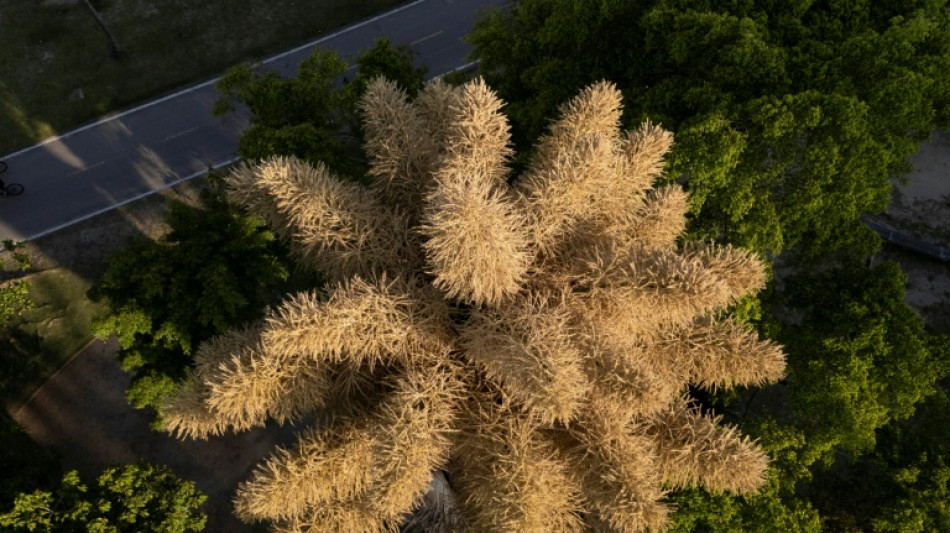
'In her prime': Rare blooming of palm trees in Rio / Photo: Pablo PORCIUNCULA - AFP

 Bardot auction in Paris fetches nearly one million euros

 No timeline on Daniels injury return, says Commanders coach

 British Columbia sues OpenAI in US court over Canada school shooting

 French star Batum retires after 18-year NBA career

 Zidane leads first France training session
 Man shot by ICE agent in Texas detained with bullet inside him: lawyer

 California declares state of emergency ahead of El Nino
 South Africa arrests three more suspects, after nine women murdered

 Carse needs time away from England, says captain Brook

 NOWPayments Releases Cross-Chain Payout Data Revealing Key Performance Benchmarks Across TRON, BNB Chain, and Solana

 British Museum bans photos of Bayeux Tapestry as crowds linger

 COP31 host says AI climate footprint to be a summit priority

 Berlin's far-left vote winners reject anti-semitism charges

 Mancini eager for 'new adventure' on Italy return

 Mbappe says having Zidane as France coach 'like a film'

 Palmer, Rice out of England Nations League squad

 German auto workers stage mass protests in bid to save jobs

 Embattled Merz vows to keep ruling for 'democratic future' of Germany

 Merz vows to keep ruling coalition together for 'democratic future' of Germany

 Spain coach De la Fuente gets new deal after World Cup success

 Pressure grows on Germany's Merz after election defeats

 China's Zhang beats Japan rivals to Asian Games gymnastics gold

 Samlingen Haupt: Vad pengar avslöjar om oss människor

 Tens of thousands of German auto workers protest to save jobs

 हॉप्त् कलेक्शन: पैसा हमारे बारे में एक इंसान के रूप में क्या प्रकट करता है

An extraordinary botanical spectacle is drawing crowds in Rio de Janeiro: several talipot palm trees, planted more than six decades ago, are blooming for the first -- and last -- time in their lives.
The trees, growing in Rio's Aterro do Flamengo park and the Botanical Garden, were planted in the 1960s by the legendary landscape architect Roberto Burle Marx.
Now, some six decades later, these giants have reached the peak of their existence in the Brazilian seaside city.
The talipot palm (Corypha umbraculifera), native to southern India and Sri Lanka, is one of the largest palm species on the planet, some reaching more than 30 meters (98 feet) tall.
It flowers only once in its entire life, if it reaches between 40 and 70 years of age.
"The talipot palm only fruits once in its lifetime, and can produce up to five million fruits," Marcus Nadruz, from the Research Institute of the Rio de Janeiro Botanical Garden, told AFP.
The inflorescences, or flower clusters on stems, began to unfurl in October, forming enormous crowns atop the palm trees that teem with millions of tiny yellowish blossoms.
The entire process, from the opening of the first flowers to the ripening of the fruit, will take about a year, explained Nadruz.
But this splendor has an inevitable end. Once the fruit falls, the palm trees will slowly begin to die.
"I was born in 1961, so she's my age and in her prime," said Deborah Faride, who traveled to see the trees from Sao Paulo and was taking pictures of them with a friend.
"We're the same age and we're blooming together. Just one detail: the talipot is going to die. And I'm going to continue, God willing."
The Botanical Garden plans to collect the seeds to cultivate new seedlings to replace these older plants, and will also distribute them for landscaping projects in public spaces.
W.Stewart--AT