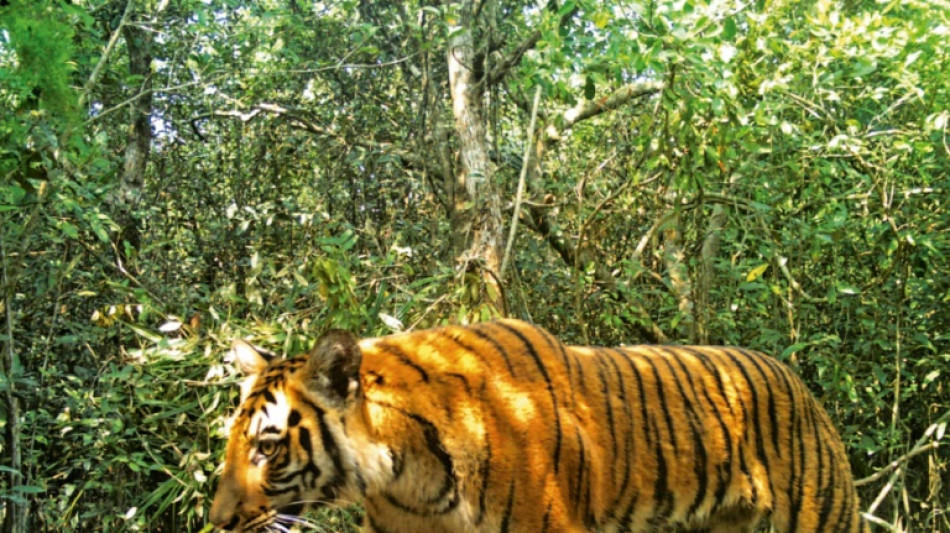
Wild tiger numbers higher than previously thought / Photo: Handout - BANGLADESH FOREST DEPARTMENT/AFP

 Missing passengers likely went down with sunken ferry: N.Cyprus official

 Premier League clubs splash cash to smash transfer record

 Melting glaciers an 'immediate' climate risk: author of UN report

 Folarin Balogun's move to Everton collapses

 Pacific islands to face food shortages over global warming: scientists
 Venice jury head Maggie Gyllenhaal questions lack of women directors

 Stocks drop, bond yields rally on Mideast flare-up
 China expands Egypt investments in first Xi visit in a decade

 Messi departure leaves Argentina facing rebuild after golden era

 Ourbit SuperCEX Launches "Cosmic Wheel Season 3. Oracle Realm" on September 2 with 3M USDT Prize Pool

 Ebola death toll passes 3,000 in DR Congo: official data

 Hong Kong democracy activist Wong pleads guilty to foreign collusion

 World record prize winner Romantic Warrior retires from horse racing

 5,000 US sailors arrive in Thailand after months at sea

 Joshua Wong, Hong Kong's pro-democracy poster child

 Nepal tunnel rescuers seek trapped workers but hit dead ends

 Zverev wins wild five-setter, Rybakina and Gauff ease through at US Open

 US energy secretary arrives in Venezuela to discuss oil deal

 Meloni government becomes Italy's longest-lasting

 Funerals in Nepal for missing, a week after deadly floods

 US aircraft carrier arrives in Thailand after months at sea

 US aircraft carrier approaches Thai port after months at sea

 Nepal's young PM faces gravest test after flood catastrophe

 What rainbow? LGBTQ Indonesians on edge as hostility mounts

 O'Connor eyes Wallabies World Cup swansong after Force return

There are 40 percent more tigers in the wild than previously thought, but with a maximum of 5,578 on the prowl, they remain an endangered species, conservationists said Thursday.
The jump in numbers is due to improved monitoring, with the population thought to be stable or increasing, said the International Union for Conservation of Nature, but habitat protection projects showed that "recovery is possible".
The tiger reassessment came as the IUCN updated its Red List of Threatened Species -- the world's most comprehensive information source on the global conservation status of plants, animals and fungi, assessing their risk of extinction.
The migratory monarch butterfly is now classified as an endangered species on the Red List due to climate change and habitat destruction.
And all surviving sturgeon species are now at risk of extinction due to dams and poaching.
"Today's Red List update highlights the fragility of nature's wonders, such as the unique spectacle of monarch butterflies migrating across thousands of kilometres," said IUCN director general Bruno Oberle.
"To preserve the rich diversity of nature we need effective, fairly governed, protected and conserved areas, alongside decisive action to tackle climate change and restore ecosystems."
- Tiger poaching threat -
The Red List assigns species to one of eight categories of threat.
A total of 147,517 were assessed in the latest version, with 41,459 species deemed as being threatened with extinction.
Of those, 9,065 are critically endangered, 16,094 are endangered and 16,300 are deemed vulnerable.
Established in 1964, the Red List counts 902 species that are now extinct, and 82 which are extinct in the wild.
There are thought to be between 3,726 and 5,578 wild tigers -- 40 percent more than at the last assessment in 2015.
The increase was chiefly put down to better monitoring.
While the tiger remains endangered, the population trend indicates that projects such as the IUCN's Integrated Tiger Habitat Conservation Programme "are succeeding and recovery is possible as long as conservation efforts continue", the organisation said.
Major threats include poaching of tigers themselves, poaching and hunting of their prey, and habitat destruction due to agriculture and human settlement, said the IUCN.
"Expanding and connecting protected areas, ensuring they are effectively managed, and working with local communities living in and around tiger habitats, are critical to protect the species," it said.
- Hope for butterflies -
The migratory monarch butterfly, a monarch subspecies, is well known for its migrations from Mexico and California to summer breeding grounds throughout the United States and Canada.
The native population has shrunk by between 22 and 72 percent over the past decade, the IUCN said, with logging and deforestation having destroyed substantial areas of their winter shelter.
Meanwhile pesticides and herbicides used in intensive agriculture kill butterflies and milkweed -- the host plant that their larvae feed on.
Climate change is also a fast-growing threat, with drought, wildfires, extreme temperatures and severe weather having a significant impact.
"It is difficult to watch monarch butterflies and their extraordinary migration teeter on the edge of collapse, but there are signs of hope," said Anna Walker, who led the assessment of monarchs.
"From planting native milkweed and reducing pesticide use to supporting the protection of overwintering sites and contributing to community science, we all have a role to play in making sure this iconic insect makes a full recovery."
The western population is at greatest risk of extinction, the IUCN said, having declined by an estimated 99.9 percent, from as many as 10 million to 1,914 butterflies between the 1980s and 2021.
The larger eastern population also shrank by 84 percent from 1996 to 2014.
"Concern remains as to whether enough butterflies survive to maintain the populations and prevent extinction," the IUCN said.
- Sturgeon on the brink -
The global sturgeon reassessment found that all remaining 26 sturgeon species are now at risk of extinction, up from 85 percent in 2009.
Their decline over the past three generations is steeper than previously thought.
The Yangtze sturgeon has moved from critically endangered to extinct in the wild, while 17 species are now critically endangered.
The reassessment confirmed the extinction of the Chinese paddlefish.
"Sturgeons have been overfished for their meat and caviar for centuries," the IUCN said.
It called for reinforcement of protections under international law, with poaching affecting more than half of sturgeon species.
Dams affect their migration, while warmer rivers due to climate change disrupt their reproduction.
Established in 1948 and based in Gland in western Switzerland, the IUCN says it is the world's largest and most diverse environmental network.
M.O.Allen--AT