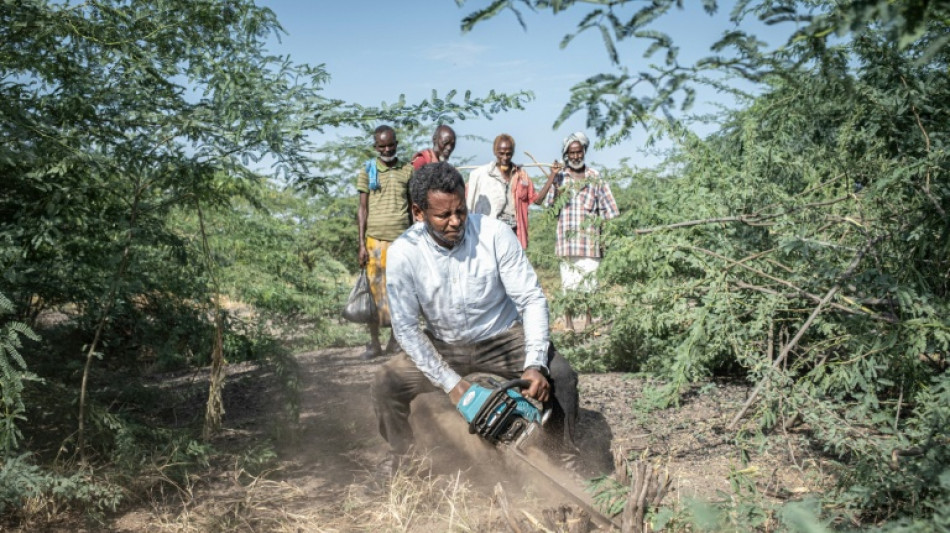
Ethiopia's invasive prosopis tree chokes livelihoods and land / Photo: Marco Simoncelli - AFP

 In Bangladesh, Pakistan's Jinnah photo stirs anger

 Two New Zealand naval ships transit Taiwan Strait

 Zidane gets down to work as France start new era

 Inside the Venezuelan prison meant to 'drive you insane'

 UK king braces as memoir by Diana's brother goes on sale
 No green light to lift EU sanctions on Russian oligarchs, talks to resume

 UK agrees support for Saudi in struggle with Houthis: reports

 EU foreign policy chief calls for continued sanctions on Russia

 Flights scrapped, evacuations urged as Typhoon Dujuan wallops Japan

 Fonseca to take break from tennis

 A Cuban zoo, and its animals, in epic battle for survival

 Infantino proposes consulting federations to reform FIFA

 El Nino weather pattern enters record territory: scientist

 OpenAI calls for US to lead global effort on AI standards

 South African ostriches plucked alive for luxury fashion: report

 US networks halt Trump coverage in revolt over White House ban

 Paramount settles with US states to clear Warner Bros. mega-merger

 Climate crisis a job for world leaders, not just activists: UK FM

 US networks halt Trump coverage over White House ban

 French singer accuses Miley Cyrus of plagiarism

 EU fines Google 403 mn euros for location data breach

 'Best is yet to come,' says De la Fuente after Spain extension

 Why diesel prices are rising more than crude oil

 COP31 host says AI's climate footprint to be a summit priority

 Renewables hit record in 2025, but world must move faster: report

Once hailed as a solution to Ethiopia's creeping desertification, a foreign tree is now spreading uncontrollably across the east African nation, threatening fragile ecosystems and the very survival of local communities.
Native to Latin America, the prosopis shrub-like tree was first planted in Ethiopia's northeastern Afar region in the 1970s.
It has become a nightmare for locals like livestock farmer Khadija Humed.
"Because of this plant, we have become poor," she told AFP.
Heat-resistant and fast-growing, prosopis initially promised to curb soil erosion and provide shade to cool the local micro-climate in Afar's arid lowlands.
But today it has overrun the region's vast plains -- its thorny, drooping branches rising up to 10 metres (33 feet) high.
Each tree can draw up to seven litres of water a day through its deep roots, drying out the soil and crippling agriculture.
The prosopis also harms livestock, local pastoralists say.
"The plant has turned against us," Hailu Shiferaw, a researcher at the Ethiopian Water and Land Resources Centre, told AFP.
"No one could have foreseen its harmful effects."
- 'Everything has changed' -
In Khadija's village, some 200 kilometres (124 miles) northeast of the capital Addis Ababa, she said the tree's pods make their cows sick, blocking their mouths and stomachs and killing some -- losses that have driven the community into deep poverty.
"I personally have 10 cows and more than 20 goats and sheep. But before prosopis, people here used to have 50 to 100 cattle shesaid.
"Everything has changed," said 76-year-old local Yusuf Mohammed, adding that the tree's dense foliage attracted wild animals that attack their livestock.
"We never had wild animal attacks before... after prosopis spread, lions, hyenas, wild cats and foxes invaded our villages," Mohammed said.
Its poisonous thorns also injure livestock, leaving them too weak to roam for food, he added.
Worldwide, there are some 3,500 invasive species introduced by humans, many of which have damaged local ecosystems.
They cost local economies a total of $423 billion, according to a 2023 report by the Intergovernmental Science-Policy Platform on Biodiversity and Ecosystem Services -- equivalent to the entire GDP of Denmark.
Ketema Bekele, associate professor of environmental economics at Ethiopia's Haramaya University, estimates that prosopis has cost Afar $602 million over the past three decades -- nearly four times its annual budget.
- Out of control -
Some 20,000 square-kilometres of Afar is now invaded by the plant, which is "out of control" and spreading into Amhara and Oromia, he said.
It covered 8.61 percent of Ethiopia in 2023, according to the Journal of Environmental Management published last year, up from 2.16 percent in 2003, while overall pastureland shrank by more than a quarter.
The report said prosopis could occupy 22 percent of Ethiopia's 1.1 million square kilometres by 2060.
Camels help it spread by eating the pods and excreting them far and wide.
CARE International, an NGO, has attempted to stop the spread since 2022 by encouraging locals to harvest the plant.
Supported by Danish fund Danida, it also removes the trees to plant fruit orchards.
It is controllable, said Mohammed, but more support is needed.
"We can't tackle it alone," he said.
W.Stewart--AT