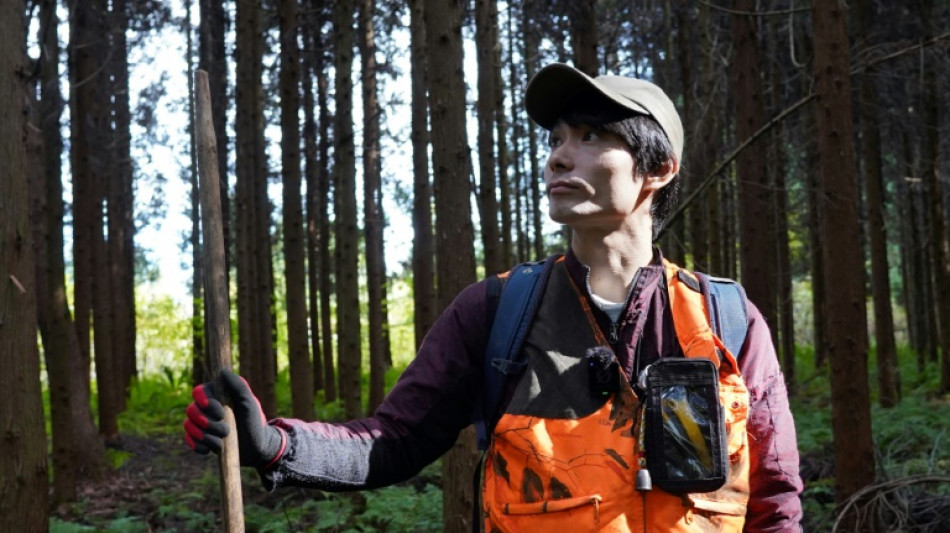
'Almost every day': Japan battles spike in bear attacks / Photo: Caroline GARDIN - AFP

 Swimming prodigy Yu, 13, says 'interviews way harder than racing'

 Star coaches make their bows as Nations League returns

 Rams bounce back as Giants reel from Dart injury

 In Bangladesh, Pakistan's Jinnah photo stirs anger

 Two New Zealand naval ships transit Taiwan Strait

 Zidane gets down to work as France start new era

 Inside the Venezuelan prison meant to 'drive you insane'

 UK king braces as memoir by Diana's brother goes on sale

 Akkodis and Hamburg Public Transport Association Showcase hvv mia at InnoTrans 2026, Demonstrating the Future of AI-Powered Mobility

 Macron says talks with Trump on Red Sea, Ukraine 'constructive'

 Green policies just good politics, says UK minister

 Bardot auction in Paris fetches nearly one million euros
 No timeline on Daniels injury return, says Commanders coach

 British Columbia sues OpenAI in US court over Canada school shooting
 French star Batum retires after 18-year NBA career

 Zidane leads first France training session
 Man shot by ICE agent in Texas detained with bullet inside him: lawyer

 California declares state of emergency ahead of El Nino
 South Africa arrests three more suspects, after nine women murdered

 Carse needs time away from England, says captain Brook

 NOWPayments Releases Cross-Chain Payout Data Revealing Key Performance Benchmarks Across TRON, BNB Chain, and Solana

 British Museum bans photos of Bayeux Tapestry as crowds linger

 COP31 host says AI climate footprint to be a summit priority

 Berlin's far-left vote winners reject anti-semitism charges

 Mancini eager for 'new adventure' on Italy return

The sense of fear is palpable in parts of northern Japan, where some locals have fastened bells to their bags hoping the noise will keep bears away, while signs warn people to be on guard.
The animals have killed a record 13 across the country since April, with a steady flow of reports of bears entering homes, roaming near schools and rampaging in supermarkets.
"We hear news almost every day about people being attacked or injured," said 28-year-old Kakeru Matsuhashi, a traditional "Matagi" hunter, as he walked through a forest clutching a knife.
"It's becoming something that feels personal, and it's simply frightening," he added in the northern prefecture of Akita, an area hit by a series of attacks.
This year, the number of fatalities is double the previous record of 2023-24, with five months of the fiscal year still to go.
Data is patchy from certain regions, but in recent years, Japan has seen among the highest number of fatal attacks globally.
Keiji Minatoya, also from Akita, knows this too well -- a bear leapt from his garage, pinned him to the ground and sank its teeth into his face in 2023.
"I was thinking: 'This is how I die'", said 68-year-old Minatoya, who managed to escape and take refuge inside his home.
The government is now scrambling to deal with the surge in attacks, which scientists say is being driven by a fast-growing bear population combined with this year's bad acorn harvest, leaving some mountains "overcrowded" with hungry bears.
Troops have been deployed to provide logistical help for trapping and hunting bears, while riot police will be allowed to use rifles to shoot the animals, which can weigh half a tonne and outrun a human.
The victims include a 67-year-old man in Iwate, a region next to Akita, whose body was found outside his home, with animal bite marks and scars.
Hunters were called to the scene and shot a bear near the house.
Also in Iwate, a 60-year-old man is thought to have been attacked while cleaning an outdoor bath at a remote hot spring resort. His body was discovered in nearby woods.
Official data show the number of wounded is also on course to be a record, tallying over 100 people in the six months to September.
- 'Overcrowded' with bears -
A major issue is the expanding bear population, which is growing fast due to an abundance of food -- including acorns, deer and boars -- under the influence of a warming climate, experts say.
Japan's brown bear population has doubled in three decades, and now stands at around 12,000, while the number of Asian black bears has climbed on the country's main Honshu island, reaching 42,000, according to a recent government report.
Some mountains have become "overcrowded", according to Naoki Ohnishi, researcher at the Forestry and Forest Products Research Institute.
"Put simply, the size of the bear population has gone beyond the capacity of the mountains to hold them," he said.
Although rising temperatures have led to more frequent bumper crops of acorns, the nuts still produce good and bad harvests every two to five years as part of their normal crop cycle.
This year, as well as in 2023 -- the year Minatoya was attacked -- there is a poor supply.
While most bears still stay in the mountains, recent bad harvests have led some -- together with their cubs -- to wander into towns to look for food, said Shinsuke Koike, professor at the Tokyo University of Agriculture and Technology.
With exposure to humans, cubs in particular become less fearful and develop a taste for farmed produce and common fruits such as persimmon, Koike added.
Steady rural depopulation due to a chronically low birthrate and young people moving to cities has also reduced the human presence at the edges of forests and mountains, blurring the traditional boundaries between people and bears.
"Bear habitats inched closer to human habitats in 2023," Ohnishi said. "This year, they are coming a step further because they are starting from where they left off."
- 'Witnessing a disaster' -
Hajime Nakae, professor of emergency and critical medicine at the Akita University Hospital, said the frequent bear sightings made him feel like he was "living inside... a safari park for bears".
The doctor, who has treated bear injuries for three decades, explained the nature of wounds was changing as bears become less afraid of humans.
In encounters years ago, a startled bear may have struck a human in the face before fleeing but now "they charge at you from about 10 metres and then leap at you".
He said that without meaningful intervention he expected bear injuries to increase and spread to other parts of the nation, adding: "We are witnessing a disaster."
"Thorough culling" to reduce the number of bears is the only effective way to reduce the risk for local people, researcher Ohnishi said.
Last year, the government added bears to the list of animals subject to population control, reversing protection that had helped bears thrive.
But rural resources are stretched thin and the number of hunters is less than half of what it was in 1980.
As of 2020, the latest statistics available, there were around 220,000, mostly in their 60s or older.
Japan culled more than 9,000 bears in 2023-2024, and over 4,200 between April to September this year.
Akita has alone culled over 1,000 so far.
In the immediate future, Japan's worries should ease, if only temporarily.
Experts Koike and Ohnishi said hibernation patterns had not shifted and the bears would soon go to sleep for the winter.
H.Gonzales--AT