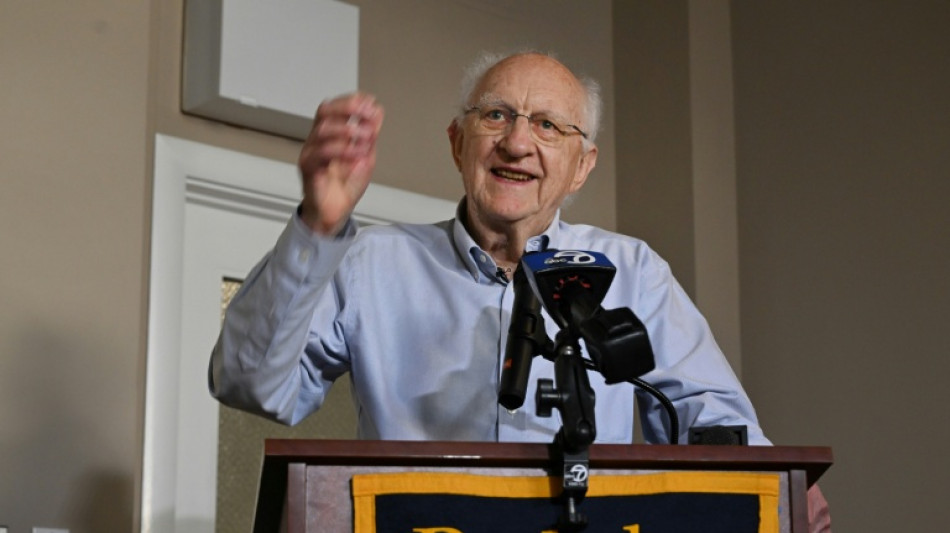
Nobel physics laureate says Trump cuts will 'cripple' US research / Photo: Karl Mondon - AFP

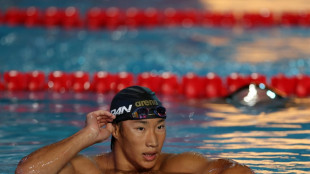
 Japan's Kojima sounds Marchand warning with Asian Games gold

 England rugby star Pollock signs new Northampton deal
 STARTRADER Expands Its Chinese Equity CFD Range with CXMT and Unitree Robotics

 MEXC Expands Opportunity Compass with Stock Trading Handbook to Help Crypto Users Build Investment Knowledge

 England paceman Wood retires from international cricket
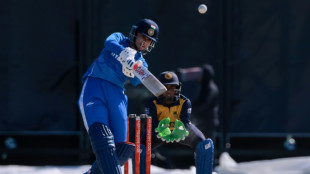 Magnificent Mandhana's 79 helps India to Asian Games cricket gold
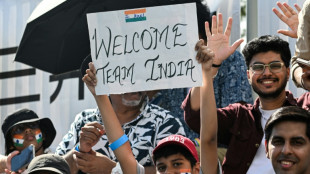
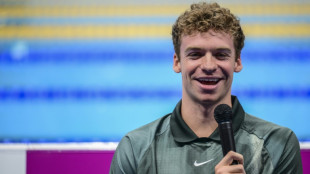 Marchand 'stressed' about racing Japanese rivals at LA Olympics
 Mobile boat clinics bring healthcare to India's remote islands
 Former India paceman Zaheer Khan named Chennai coach in IPL
 Six-year-old Chinese girl sets world record with Rubik's Cube
 Swimming prodigy Yu, 13, says 'interviews way harder than racing'

 Star coaches make their bows as Nations League returns
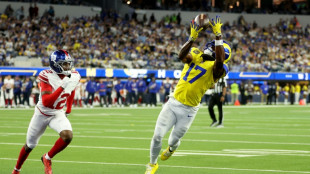 Rams bounce back as Giants reel from Dart injury
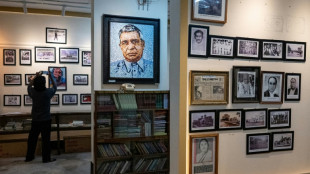 In Bangladesh, Pakistan's Jinnah photo stirs anger
 Two New Zealand naval ships transit Taiwan Strait
 Zidane gets down to work as France start new era

 Inside the Venezuelan prison meant to 'drive you insane'
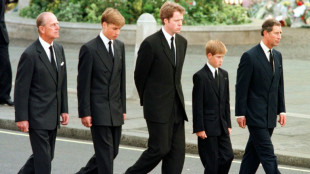 UK king braces as memoir by Diana's brother goes on sale

 Jaguar Mining Commences New Underground Drilling Program Targeting Untested High-Grade Zones at Turmalina Mine, Brazil
 Caledonia Mining Corporation PLC: Notification of Relevant Change to Significant Shareholder
 InterContinental Hotels Group PLC Announces Transaction in Own Shares - September 22
 American Critical Minerals Completes Drilling Operations at the AP-S-02 Duma Point Well Confirming Potash Mineralization and Deep Brine Aquifers
 Connecting Excellence Group PLC Announces Institutional Subscription Raising £600,000
 Kingsway to Present at Sidoti Small-Cap Virtual Conference on Wednesday, September 23 at 10:00 AM ET
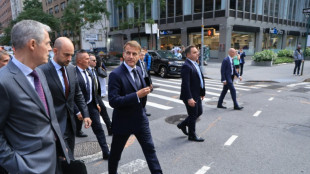 Macron says talks with Trump on Red Sea, Ukraine 'constructive'
It was just past 2:00 am when a mysterious number rang Nobel laureate John Clarke, what he deemed "obviously a joke call" that grew increasingly surreal when he heard "a voice from Sweden."
"It soon became clear that it was real," Clarke told journalists Tuesday after he and two colleagues had won the Nobel Prize in physics for their door-opening work in quantum mechanics.
"I was just sitting there feeling completely stunned," Clarke said. "It had never occurred to me in my entire life that anything like this would ever happen."
The University of California, Berkeley professor said his phone kept ringing, emails began pouring in, and people started "banging on my door" seeking interviews at 3:00 am (1000 GMT).
"I said no thank you, not at this time of night," the British 83-year-old said with a chuckle.
Clarke shared the coveted prize with two fellow physicists who worked in his Berkeley lab at the time of the trio's research, Frenchman Michel Devoret and American John Martinis. All three scientists are researchers at American universities.
The physicist noted the significant resources he was afforded at the time of their work some four decades ago, including lab space, graduate assistants and equipment.
And he called US President Donald Trump's efforts to reshape American science and health policy -- including mass firings to government scientists and steep slashes to research budgets -- an "immensely serious problem."
"This will cripple much of United States science research," he told AFP, adding that he knew people who have taken enormous funding hits.
"It is going to be disastrous if this continues," Clarke said. "Assuming that the present administration finally comes to an end, it may take a decade to get back to where we were, say, half a year ago."
"It's a huge problem" that's "entirely beyond any understanding of anyone who is a scientist," he said.
- 'Basic science' -
Nobel laureate Mary Brunkow, among Monday's winners for medicine, had similarly emphasized to journalists the importance of US public financing to scientific research.
This year's physics laureates carried out their experiments in the 1980s, research that enabled real-world applications of the quantum realm.
Quantum mechanics takes over when things get tiny -- think subatomic -- and the rules of traditional physics no longer apply.
For example, when a normal ball hits a wall, it bounces back. But on the quantum scale, a particle will actually pass straight through a comparable wall -- a phenomenon called "tunneling."
Clarke and his fellow winners demonstrated tunneling on a scale the public can grasp.
As the Nobel committee put it, their work showed "the bizarre properties of the quantum world can be made concrete in a system big enough to be held in the hand."
That research made possible technologies like the cell phone, and also proved foundational in the race to develop powerful quantum computers.
Clarke noted Tuesday that it is "vital" to keep conducting -- and funding -- work that might seem like "basic science" but results in "crucial applications" down the line.
"Michel and John and I had no way of understanding the importance" their work would have, he said.
"If you'd asked us 40 years ago, we would have said, 'Well yeah, it's an interesting thing.'"
He emphasized that researchers who lay the groundwork "are not that people who actually use that effect to do something that is vitally important."
"It's so important to do this basic science, because you don't know what the outcome is going to be."
D.Johnson--AT