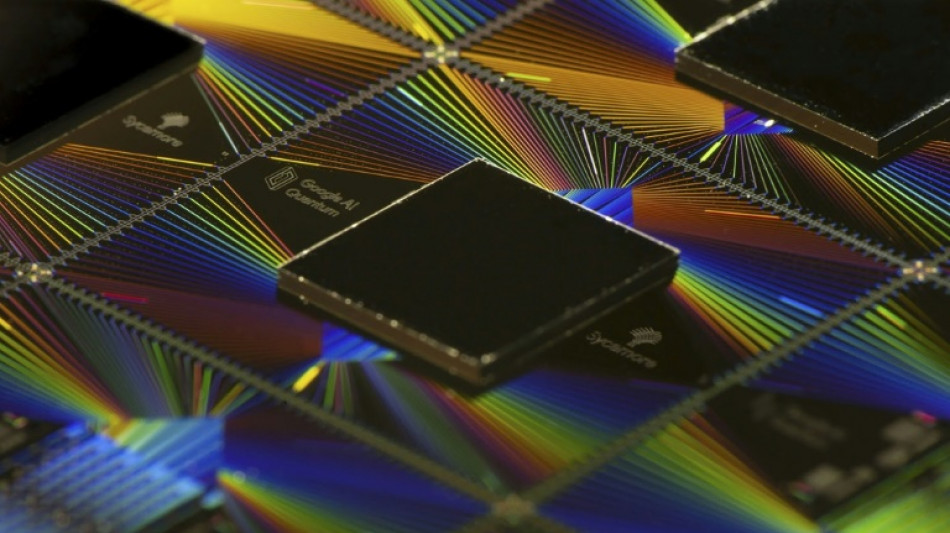
Observing quantum weirdness in our world: Nobel physics explained / Photo: HO - GOOGLE/AFP/File

 Japan's Kojima sounds Marchand warning with Asian Games gold

 England rugby star Pollock signs new Northampton deal

 STARTRADER Expands Its Chinese Equity CFD Range with CXMT and Unitree Robotics

 MEXC Expands Opportunity Compass with Stock Trading Handbook to Help Crypto Users Build Investment Knowledge

 England paceman Wood retires from international cricket

 Magnificent Mandhana's 79 helps India to Asian Games cricket gold

 Marchand 'stressed' about racing Japanese rivals at LA Olympics

 Mobile boat clinics bring healthcare to India's remote islands

 Former India paceman Zaheer Khan named Chennai coach in IPL

 Six-year-old Chinese girl sets world record with Rubik's Cube

 Swimming prodigy Yu, 13, says 'interviews way harder than racing'

 Star coaches make their bows as Nations League returns

 Rams bounce back as Giants reel from Dart injury

 In Bangladesh, Pakistan's Jinnah photo stirs anger

 Two New Zealand naval ships transit Taiwan Strait
 Zidane gets down to work as France start new era

 Inside the Venezuelan prison meant to 'drive you insane'

 UK king braces as memoir by Diana's brother goes on sale

 Jaguar Mining Commences New Underground Drilling Program Targeting Untested High-Grade Zones at Turmalina Mine, Brazil
 Caledonia Mining Corporation PLC: Notification of Relevant Change to Significant Shareholder
 InterContinental Hotels Group PLC Announces Transaction in Own Shares - September 22
 American Critical Minerals Completes Drilling Operations at the AP-S-02 Duma Point Well Confirming Potash Mineralization and Deep Brine Aquifers

 Connecting Excellence Group PLC Announces Institutional Subscription Raising £600,000
 Kingsway to Present at Sidoti Small-Cap Virtual Conference on Wednesday, September 23 at 10:00 AM ET

 Macron says talks with Trump on Red Sea, Ukraine 'constructive'

The Nobel Prize in Physics was awarded to three scientists on Tuesday for discovering that a bizarre barrier-defying phenomenon in the quantum realm could be observed on an electrical circuit in our classical world.
The discovery, which involved an effect called quantum tunnelling, laid the foundations for technology now being used by Google and IBM aiming to build the quantum computers of the future.
Here is what you need to know about the Nobel-winning work by John Clarke of the UK, Frenchman Michel Devoret and American John Martinis.
- What is the quantum world? -
In the classical or "macroscopic" world -- which includes everything you can see around you -- everything behaves according to the trustworthy rules of traditional physics.
But when things get extremely small, to around the scale of an atom, these laws no longer apply. That is when quantum mechanics takes over.
Just one oddity of the quantum world is called superposition, in which a particle can exist in multiple locations at once -- until it is observed, at least.
However scientists have struggled to directly observe quantum mechanics in this "microscopic" world -- which somewhat confusingly cannot be seen through a microscope.
- What is quantum tunnelling? -
Quantum tunnelling is a strange effect that physicists first theorised almost a century ago.
Imagine a man trying to climb a mountain, Eleanor Crane, a quantum physicist at King's College London, told AFP.
In the classical world, if the climber is too tired he will not make it to the other side.
But if a particle is weak in the quantum world, there is still a "a probability of finding it on the other side of the mountain," Crane said.
Because the particle is in superposition, it could have been on both sides of the mountain simultaneously. But if you then, for example, took a picture of the particle, it would then have to pick a side.
- What did the Nobel-winners do? -
In the mid-1980s, Clarke, Devoret and Martinis built a very small -- but not quantum-level -- electrical circuit.
They set it up with two superconductors, which are cooled to almost the lowest possible temperature so they have no electrical resistance.
They then separated the two superconductors with a thin layer of material.
This would break a normal electrical circuit, but thanks to quantum tunnelling, some electrons could appear on the other side.
- Why is that important? -
French physicist Alain Aspect, a 2022 physics Nobel laureate, told AFP that an outstanding question in the field had been whether an object in our macroscopic world could "behave in a quantum way".
By illustrating quantum effects on this "somewhat large object -- though not large on our scale", the new Nobel laureates answered that question with a resounding yes, Aspect said.
Scientists could now observe this quantum effect using a normal microscope, offering a new view of this weird world.
- What about quantum computing? -
The discovery's biggest technological legacy may be that it laid the groundwork for the development of superconducting quantum bits.
While classical computers have bits that work in ones and zeros, quantum bits, or qubits, can exist in two states at once.
This gives them massive potential to spark a range of breakthrough -- though they have yet to fully live up to the hype.
Crane estimated that quantum computers could be powerful enough to "change the course of society" in the next five to 10 years.
The new Nobel laureates "set the foundation for a lot of technology that many companies are investing millions of dollars in right now to try to realise large-scale quantum computers that can actually solve certain types of problems much faster than our classical alternatives," physicist Gregory Quiroz at Johns Hopkins University told AFP.
However there are several other leading techniques in the race to build to build a quantum computer, including neutral atoms and ion traps.
The Nobel-winning work also contributed to "extremely sensitive methods of measuring electromagnetic fields and magnetic fields that rely on these kinds of circuits," Aspect added.
R.Garcia--AT