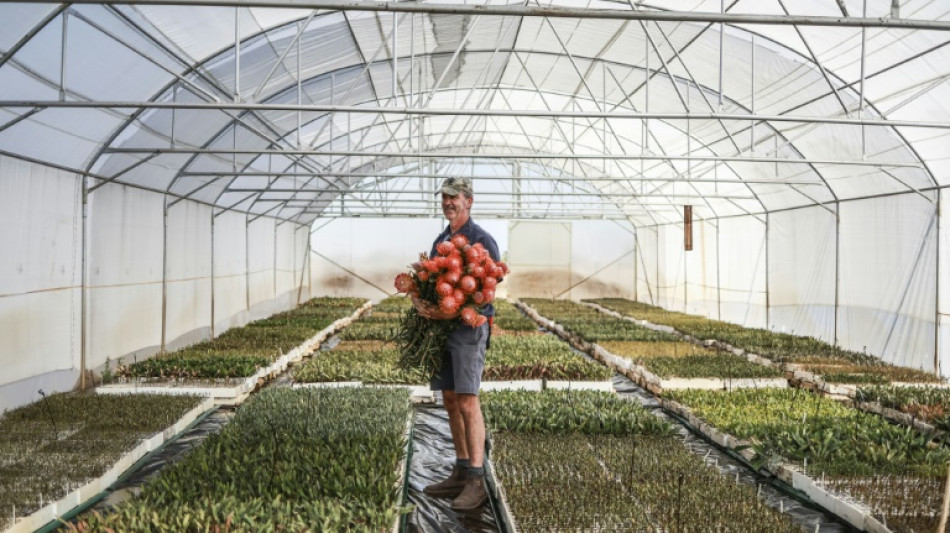
S.Africa's iconic protea flower relocates as climate warms / Photo: Phill Magakoe - AFP

 Oil prices fall after Trump hails 'good' talks with Iran

 AI political ads warp reality ahead of US midterms

 Kenneth Branagh embraces action hero role -- to get in shape

 'New one' Klopp promises fresh approach as Germany reign begins

 Milne returns to New Zealand squad for India T20 series
 US-led Americas coalition backs sanctions against crime groups

 'Star Wars' fans and art lovers line up for new Lucas museum

 Trump renames AI 'super intelligence' as leaders jostle over dangers

 Oil prices retreat as markets welcome US-Iran talks

 US refusing to give Sudan's de facto leader visa for UN: diplomatic sources, UN

 Macron urges world to choose UN over 'law of the jungle'

 All-rounder Jacks stars as England beat Sri Lanka in 1st ODI
 Man City peg back Bayern to start Women's Champions League
 Trump beats 'America first' drum at UN as allies tread carefully

 Snedeker backs Spaun for Ryder Cup after Presidents snub

 French prosecutors probe secret filming of women with smart glasses

 Trump renames AI "super intelligence," rejects international oversight

 Trump rejects international regulation of AI

 How is the EU approaching record fuel prices?

 Sri Lanka's Colombage strikes on debut as England dismissed for 265 in first ODI

 Hurricane Polo strengthens to top category 5 off Mexico

 11 hurt as teen opens fire outside school in western Turkey

 UN chief says 'Big Oil' treats atmosphere as open sewer

 Tunisia says 2026 summer hottest on record

 England's Rashid out of Sri Lanka ODIs with hand injury

On his farm two hours north of Johannesburg, Nico Thuynsma gestured towards thousands of orange, yellow and pink proteas in flower and thriving 1,500 kilometres (930 miles) from their natural home at the southern tip of Africa.
"They're all different," the 55-year-old farmer said of the assorted blooms from the diverse Proteaceae family that has more than 350 species in South Africa, from firework-like "pincushion" varieties to delicate "blushing brides".
He picked out a majestic pink and white crown, nearly the size of his head, that has taken four years to reach its impressive size. "The King Proteas are very slow to grow," Thuynsma said.
The largest of the proteas, the King Protea, is South Africa's national flower.
It has lent its name to the national cricket team and countless brands. It features on the currency and is the logo for South Africa's presidency this year of the G20 group of leading economies, which convenes a summit in November.
It is also the country's largest flower export with more than 10 million stems sent abroad last year, worth close to 275 million rand ($15 million), according to the Cape Flora industry organisation.
Its status offers the King Protea some protection but almost half of South Africa's other protea species face extinction because of pressures on their native habitats in the mountains of the Cape, according to South Africa's National Biodiversity Institute (SANBI).
These include habitat loss to agriculture, the proliferation of invasive alien species and "changes to natural fire cycles", SANBI said in a 2021 report.
- Icon -
"People come to South Africa to see proteas," Nigel Barker, a professor in plant sciences at the University of Pretoria, told AFP. "It's the plant equivalent of the elephant or the lion."
Most proteas are endemic or semi-endemic to the Cape Floral Kingdom biome of "fynbos" ("fine bush") that stretches across the southern tip of South Africa and is one of the world's richest flora biodiversity hotspots.
But climate projections predict "hotter, drier conditions", Barker said. "We'll be looking at a completely different vegetation type in the future, semi-desert almost in some places."
"Many species, because they're so range-restricted, will probably go extinct under those scenarios," he said.
"The only solution we have is to cultivate them artificially... in greenhouses or farms where you control irrigation," Barker said.
An example is Thuynsma's farm in the grasslands of the north, where he began planting proteas three decades ago.
Here, winters are dry and frosty, and the summers rainy -- conditions very different to those in the far south where the proteas are at home.
- Gel for irrigation -
Through trial and error, Thuynsma has been able to cultivate close to 200 protea varieties, including some long forgotten and abandoned by farmers in their original habitats.
In his latest experiment, he has planted 36 varieties with just two litres (four pints) of saturated gel for irrigation.
"I hope to unlock the power of some of these varieties," Thuynsma said. "They come from the Western Cape out of very harsh conditions, so they do have it in them."
"I learn from them, I learn with them. And, hopefully, in the future I can advise my nursery public -- and even estates -- how to plant this lovely fynbos without irrigation," he said.
"I don't think I have a solution for climate change," he joked, crouched over a small seedling in freshly turned soil. "But I do have a solution: to plant proteas."
A few metres (yards) away, in a warm nursery, thousands of protea sprouts awaited their turn in the soil.
"I love them, I protect them, I collect them," Thuynsma said. "The protea is part of South Africa's DNA."
T.Sanchez--AT