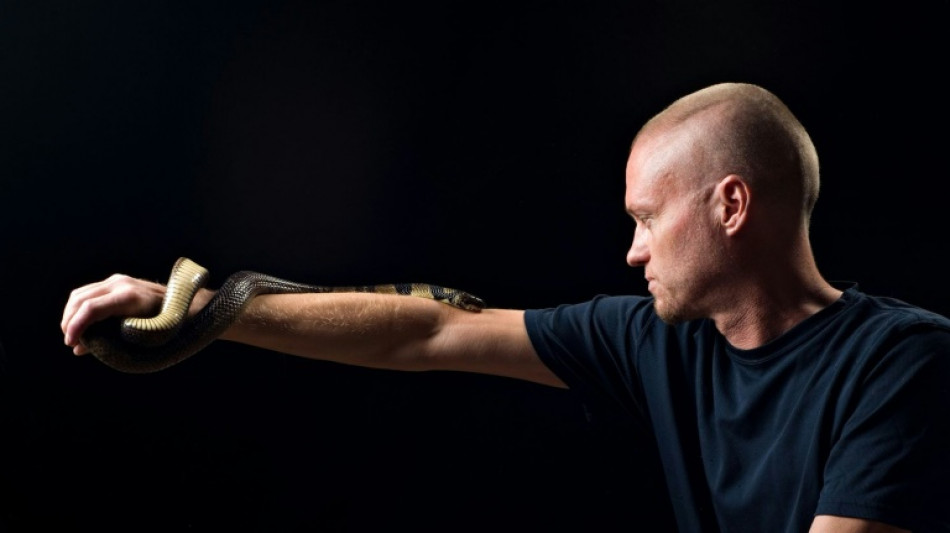
Man who let snakes bite him 200 times spurs new antivenom hope / Photo: © CENTIVAX/AFP

 Voting opens in Alaska's annual Fat Bear Week

 MLS coach axed for telling female ref 'It's a man's game'

 US refuses to give Sudan's de facto leader visa for UN

 Man City hold Bayern to start Women's Champions League, Arsenal win late

 Trump threatens Iran with 'hell' but reveals fresh talks

 Trump signs security deal with Greenland, Denmark at UN

 Trump threatens Iran with 'hell' but unveils fresh talks

 Chile's Atacama Desert blossoms with life after El Nino rains

 Sri Lanka hands 220-year jail terms to 15 convicted of Easter bombings

 Typhoon Dujuan leaves 7 dead in Japan from landslides, flooding: media

 Ganna and Borghini lead Italy to mixed relay gold at cycling worlds

 Drug cocktail killed former child star Hayden Panettiere: coroner

 Moldova declares energy, water emergency

 French Holocaust denier jailed for eight months

 Oil prices slide, AI stock buzz fades

 Trump threatens to 'annihilate' Iran in bombastic UN speech

 Prada's skirts take centre stage as Milan Fashion Week begins

 Quoin Pharmaceuticals Announces FDA Fast Track Designation for QRX003 for the Treatment of Peeling Skin Syndrome

 Brazil's Flavio Bolsonaro turns scandal into poll gains

 Republican senator seeks probe of Trump Jr Russian-funded wedding

 Memoir by Diana's brother goes on sale after rocking UK monarchy

 Newcomers South Korea face holders Italy in Davis Cup finals

 Japan's Kojima sounds Marchand warning with Asian Games gold

 England rugby star Pollock signs new Northampton deal

 STARTRADER Expands Its Chinese Equity CFD Range with CXMT and Unitree Robotics

Tim Friede was feeling particularly down on the day after the September 11 attacks, so he went to his basement and let two of the world's deadliest snakes bite him.
Four days later, he woke up from a coma.
"I know what it feels like to die from snakebite," Friede told AFP via video call from his home in the small US town of Two Rivers, Wisconsin.
This experience might put most people off snakes entirely, but Friede simply vowed to be more careful next time.
From 2000 to 2018, he allowed himself to be bitten by snakes more than 200 times. He also injected himself with their venom over 650 times.
Friede endured this pain because he wanted to achieve total immunity to venom, a practice called mithridatism which should not be tried at home.
After a couple of years, Friede started to believe he could be the basis for a better kind of antivenom. The former truck mechanic, who does not have a university degree, long struggled to be taken seriously by scientists.
But last month, a study published in the prestigious Cell journal showed that antibodies from his blood protect against a range of snake venom.
The researchers now hope Friede's hyper-immunity could even lead to the development of a universal antivenom.
This would fill a major need, because currently most antivenoms only cover one or a few of the world's 600 venomous snakes.
Up to 138,000 people are killed by snakebites a year, while 400,000 suffer amputations or other disabilities, according to the World Health Organization.
These figures are believed to be vastly underestimated because snakebite victims typically live in poorer, remote areas.
- 'Pain every time' -
Friede's first bite was from a harmless garter snake when he was five years old.
"I was afraid, I cried, I ran away," said Friede, now 57.
Then he started bringing snakes home and hiding them in pickle jars. His mother sought counselling, but his interest in snakes persisted.
Things escalated after Friede attended a class that taught him how to "milk" snakes for their venom.
How antivenom is made has changed little over the last 125 years.
Small doses of snake venom are injected into animals such as horses, which produce antibodies that can be extracted and used as antivenom.
However this antivenom usually only works for bites from that particular species of snake -- and it includes other antibodies from horse that can cause serious side-effects including anaphylactic shock.
"I thought, well, if they make antivenom in horses, why can't I just use myself as a primate?" Friede said.
He started working through the venom from all the deadly species he could get his hands on, such as cobras, taipans, black mambas and rattlesnakes.
"There is pain every time," he said.
- 'Proud' -
For years, the scientists he contacted to take advantage of his immunity refused to bite.
Then in 2017, immunologist Jacob Glanville, who previously worked on universal vaccines, turned his attention towards antivenom.
Glanville told AFP he had been looking for "a clumsy snake researcher who'd been bit accidentally a couple times," when he came across a video of Friede taking brutal back-to-back snake bites.
When they first spoke, Glanville said he told Friede: "I know this is awkward, but I would love to get my hands on some of your blood."
"I've been waiting for this call for a long time," came the response, Glanville said.
The antivenom described in the Cell paper includes two antibodies from Friede's blood, as well as a drug called varespladib.
It offered mice full protection against 13 of the 19 snake species tested, and partial protection for the remaining six.
The researchers hope a future cocktail will cover far more snakes -- particularly vipers -- with further trials planned on dogs in Australia.
Timothy Jackson of the Australian Venom Research Unit praised the immunological research, but questioned whether a human needed to be involved, pointing to synthetically developed antibodies.
Glanville said the ultimate goal of his US-based firm Centivax was to develop a universal antivenom administered by something like an EpiPen, potentially produced in India to keep the costs down.
Friede said he was "proud" to have made a "small difference" in medical history.
Now working for Centivax, Friede stopped self-inflicting himself with venom in 2018 to save the firm from liability issues.
But he hopes to get bitten by snakes again in the future.
"I do miss it," he said.
M.King--AT