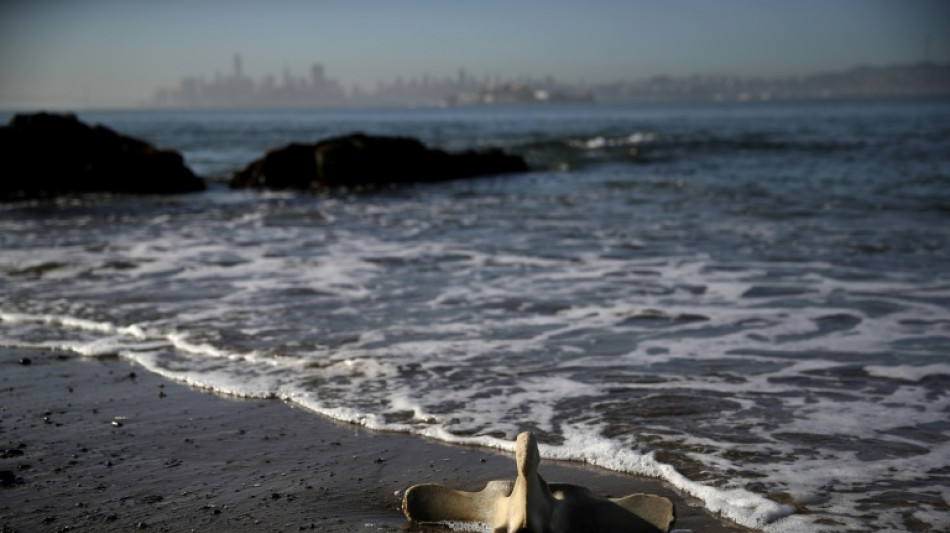
Earliest proof of humans using whale bone tools discovered / Photo: JUSTIN SULLIVAN - GETTY IMAGES NORTH AMERICA/AFP/File

 Oil prices retreat as markets welcome US-Iran talks

 US refusing to give Sudan's de facto leader visa for UN: diplomatic sources, UN

 Macron urges world to choose UN over 'law of the jungle'

 All-rounder Jacks stars as England beat Sri Lanka in 1st ODI

 Man City peg back Bayern to start Women's Champions League

 Trump beats 'America first' drum at UN as allies tread carefully

 Snedeker backs Spaun for Ryder Cup after Presidents snub

 French prosecutors probe secret filming of women with smart glasses

 Trump renames AI "super intelligence," rejects international oversight

 Trump rejects international regulation of AI

 How is the EU approaching record fuel prices?

 Sri Lanka's Colombage strikes on debut as England dismissed for 265 in first ODI

 Hurricane Polo strengthens to top category 5 off Mexico

 11 hurt as teen opens fire outside school in western Turkey

 UN chief says 'Big Oil' treats atmosphere as open sewer

 Tunisia says 2026 summer hottest on record

 England's Rashid out of Sri Lanka ODIs with hand injury

 Houthis accuse Saudi Arabia of deadly strikes as thousands flee

 Stocks climb as oil slides, AI buzz returns

 India cricketers win in style as Afghan savours 'special' Games silver

 La Liga president hits out at Real Madrid refereeing 'conspiracy' claims

 MEXC Launches “Real Stocks, Real Friends” with Rewards for Bringing Friends to Wall Street

 Mbappe continues media push for Ballon d'Or recognition

 Stocks rise on AI buzz, oil prices cool

 India narrowly survive huge scare against minnows Japan

Scientists announced Tuesday they have discovered the earliest evidence of humans using whale bones, finding weapons made from the remains of the massive mammals dating back more than 20,000 years.
The bones, found on the northern Spanish coast in the Bay of Biscay, show that we have been underestimating our prehistoric ancestors, the European-led team of scientists said.
Southwest Europe was much colder during the Upper Palaeolithic period, and the Atlantic Ocean was 120 metres (400 feet) lower than its current level.
As the seas rose over the millennia, it destroyed or buried much of the proof that these hunter-gatherers interacted with the marine world, French prehistoric archaeologist Jean-Marc Petillon told AFP.
This led to a "biased" vision that they only hunted inland beasts such as reindeer, bison and horses, the lead author of a new study in Nature Communications said.
"Fortunately for us, people at the time transported a number of marine products inland," he added.
Perched on a cliff, these humans would likely have been able to see blue, sperm, bowhead and other whales relatively near the shore, looking for food.
Among their discoveries, the researchers found more than 60 fragments of whale ribs or vertebrae. These huge bones were carried up to five kilometres (three miles) to the top of a steep cliff, possibly to extract their oil.
"These bones are very rich in fat," Petillon explained.
Most of the bone tools were parts of weapons, such as the tips of spears.
But it is "extremely unlikely" these ancient humans were able to hunt whales, the study said, adding that it was more likely that the huge animals had simply washed up on the beach.
Some of the bones were collected more than a century ago but were misidentified. The researchers used carbon-dating, as well as spectrometry analysis to determine what species the bones were from.
There was a boom in whale bones between 17,500 and 16,000 BC, when tools have been found as far away as Germany.
"Then it stopped quite abruptly" for reasons that are not clear, Petillon said.
The people of the time did not run out of bones, nor did they lose the bone-working techniques.
"It could be a choice... like a fashion that lasts a millennium or two and then, at some point, stops," Petillon said.
A.Anderson--AT