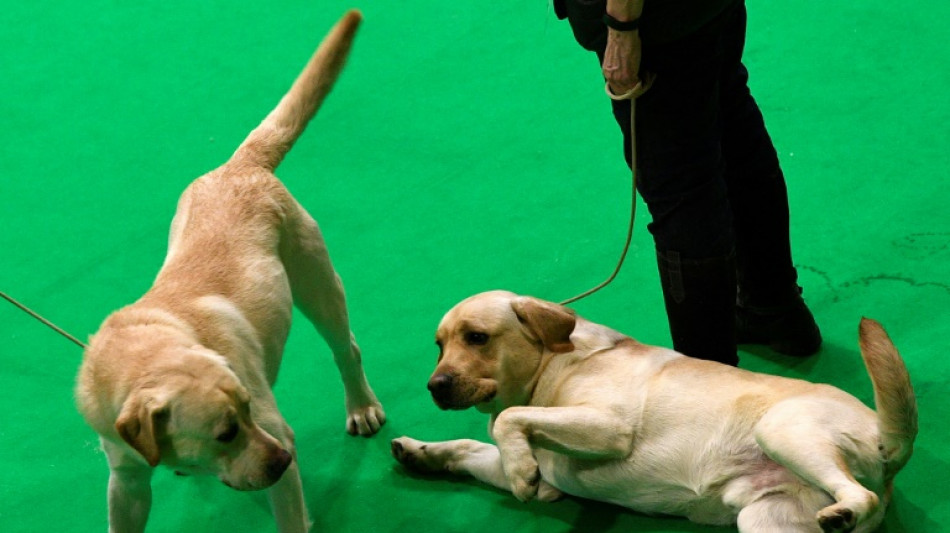
Chunky canines: Study reveals dog obesity gene shared by humans / Photo: Oli SCARFF - AFP/File

 Swimming prodigy Yu, 13, says 'interviews way harder than racing'

 Star coaches make their bows as Nations League returns

 Rams bounce back as Giants reel from Dart injury

 In Bangladesh, Pakistan's Jinnah photo stirs anger

 Two New Zealand naval ships transit Taiwan Strait

 Zidane gets down to work as France start new era

 Inside the Venezuelan prison meant to 'drive you insane'

 UK king braces as memoir by Diana's brother goes on sale

 Akkodis and Hamburg Public Transport Association Showcase hvv mia at InnoTrans 2026, Demonstrating the Future of AI-Powered Mobility

 Macron says talks with Trump on Red Sea, Ukraine 'constructive'

 Green policies just good politics, says UK minister

 Bardot auction in Paris fetches nearly one million euros

 No timeline on Daniels injury return, says Commanders coach

 British Columbia sues OpenAI in US court over Canada school shooting

 French star Batum retires after 18-year NBA career

 Zidane leads first France training session

 Man shot by ICE agent in Texas detained with bullet inside him: lawyer

 California declares state of emergency ahead of El Nino
 South Africa arrests three more suspects, after nine women murdered

 Carse needs time away from England, says captain Brook

 NOWPayments Releases Cross-Chain Payout Data Revealing Key Performance Benchmarks Across TRON, BNB Chain, and Solana

 British Museum bans photos of Bayeux Tapestry as crowds linger

 COP31 host says AI climate footprint to be a summit priority

 Berlin's far-left vote winners reject anti-semitism charges

 Mancini eager for 'new adventure' on Italy return

Obesity is on the rise not just in humans but in dogs, whose history of selective breeding makes them an ideal species for studying the balance between genetics, diet, and lifestyle in weight gain.
In a new paper published Thursday in Science, researchers identified a gene strongly linked to obesity in pet pooches -- and found it is also associated with weight gain in humans.
"The prevailing attitude towards obesity is that people are just a bit rubbish about controlling what they eat, whereas actually, our data shows that if you're a high-risk individual, it takes more effort to keep you slim," lead author Eleanor Raffan, a researcher in the University of Cambridge's Department of Physiology, Development, and Neuroscience, told AFP.
A veterinarian as well as a scientist, Raffan has long sought to study animal genetics to uncover broader biological insights that apply across species, including our own.
For this study, she and her colleagues focused on British Labrador Retrievers.
"Anyone who knows dogs will understand that starting with Labradors is a good idea because they're very prone to getting obese," she said. "They've got this reputation for being really foodie dogs, really obsessed by food."
The team collected slobber samples from 241 dogs and conducted a genome-wide association study, which examines an organism's entire set of genes to identify areas linked to a specific trait.
The top five genes were also present in humans, with the one exerting the strongest influence called DENND1B.
They also assessed how much the dogs pestered their owners for food and whether they were fussy eaters.
"Low-risk dogs tended to remain a healthy weight, irrespective of how their owners managed their food and exercise," said Raffan. "But if you were a high-genetic-risk dog, then if your owners were complacent about diet and exercise, you were likely to get really, really overweight."
For Raffan, the study has two major takeaways.
First, it sheds new light on how DENND1B affects a brain pathway responsible for regulating energy balance and appetite. Known as the leptin-melanocortin pathway, this system is a key target for some anti-obesity drugs.
"Only by understanding biology and the nuances of it can we possibly improve our treatment and management of obesity," she said.
Second, the study allowed researchers to quantify genetic risk for obesity in individual dogs -- and the level of effort required to keep them at a healthy weight. This is easier to measure in dogs than in humans, since their diet and exercise are entirely controlled by their owners.
"We shouldn't be rude to owners of overweight dogs," Raffan emphasized.
"It's not that they're hopeless individuals who don't care about their pets. It's just that they've got animals who persistently seek out opportunities to eat, and just a little bit extra every day is enough to cause weight gain over time."
R.Garcia--AT