How a 'forgotten' Minnesota monastery inspired 'The Brutalist' / Photo: Kerem YUCEL - AFP

 Sri Lanka to issue verdict in landmark Easter attack trial

 Macron says talks with Trump on Red Sea, Ukraine 'constructive'

 Green policies just good politics, says UK minister

 Bardot auction in Paris fetches nearly one million euros

 No timeline on Daniels injury return, says Commanders coach

 British Columbia sues OpenAI in US court over Canada school shooting

 French star Batum retires after 18-year NBA career

 Zidane leads first France training session

 Man shot by ICE agent in Texas detained with bullet inside him: lawyer

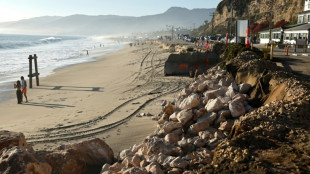 California declares state of emergency ahead of El Nino

 South Africa arrests three more suspects, after nine women murdered

 Carse needs time away from England, says captain Brook

 NOWPayments Releases Cross-Chain Payout Data Revealing Key Performance Benchmarks Across TRON, BNB Chain, and Solana

 British Museum bans photos of Bayeux Tapestry as crowds linger

 COP31 host says AI climate footprint to be a summit priority

 Berlin's far-left vote winners reject anti-semitism charges

 Mancini eager for 'new adventure' on Italy return

 Mbappe says having Zidane as France coach 'like a film'

 Palmer, Rice out of England Nations League squad

 German auto workers stage mass protests in bid to save jobs

 Embattled Merz vows to keep ruling for 'democratic future' of Germany

 Merz vows to keep ruling coalition together for 'democratic future' of Germany

 Spain coach De la Fuente gets new deal after World Cup success

 Pressure grows on Germany's Merz after election defeats

 China's Zhang beats Japan rivals to Asian Games gymnastics gold

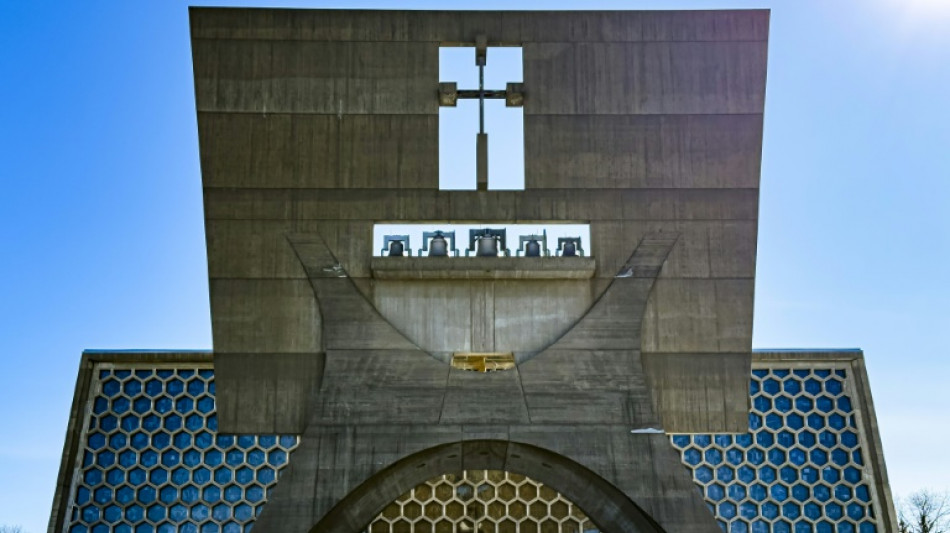
On a snowy prairie in Minnesota stands a monastery like no other. A concrete trapezoid banner encasing a bell tower looms over a giant, beehive-shaped front window composed of hundreds of gently shimmering hexagons.
For half a century, the existence of this modernist masterpiece has been mainly known to the Benedictine monks who worship there, and the hordes of architects who make pilgrimages to Saint John's Abbey Church each summer.
But these days, it is finding new fame as the basis for "The Brutalist," the epic drama about an immigrant architect, haunted by the Holocaust, that is a favorite to win best picture at the Oscars.
The tale of the church's genesis is as unlikely as the movie plot it inspired, spanning titans of architecture, ambitious monks, Vatican reform -- and an almighty row over that beehive window.
Giving tours to guests, abbey member Alan Reed begins by asking his guests: "How could this have happened?"
"That this small college at the time, in the middle of nowhere, run by a group of monks, would hire a world-famous architect... it is an amazing story," he told AFP.
- 'Extraordinary' -
It begins with Baldwin Dworschak, a 44-year-old "buttoned-down" abbot, who inherited stewardship of a monastery rapidly outgrowing its historic grounds in the post-war US boom years of the 1950s.
At a time when the Catholic Church was reforming and modernizing, Dworschak and his advisors saw an opportunity to emulate the pioneering 12th-century European monks who ushered in the then-new Gothic style.
Arranged by a monk who had studied architecture, letters inviting commissions were sent out to Richard Neutra, Walter Gropius, Eero Saarinen and Marcel Breuer -- among the world's leading modernist architects at the time.
Amazingly, several responded, and Breuer -- a Hungarian Jew who had trained at Germany's influential Bauhaus school, and invented the sleek, tubular-steel chairs that furnish trendy offices to this day -- was appointed to oversee the giant church in a far northern corner of the United States.
The design he came up with was "something nobody had ever seen before," said Victoria Young, a professor of architecture at the University of St Thomas in Minnesota, who wrote a book on Breuer's "extraordinary" creation.
Chinese American architect I.M. Pei -- a former student of Breuer -- once wrote that Saint John's Abbey Church would be considered one of the greatest examples of 20th century architecture if it were located in New York, not Minnesota.
- Almighty row -
Brady Corbet, director of "The Brutalist," cites a book written by Hilary Thimmesh, a junior member of Dworschak's committee, as a key source for his movie.
Corbet told AFP he has visited Saint John's, and stumbled upon Thimmesh's memoir while doing extensive reading for the film.
Several parallels are clear: a Jewish architect designing a colossal Christian edifice on a remote US hilltop, in a controversial modernist style.
A major source of dramatic tension in the film occurs when the client -- a millionaire tycoon in the movie, rather than an abbot -- brings in his own designer, undermining the original architect.
In real life, Breuer struck up a friendship with Dworschak, but they fell out when the monks brought in their own stained-glass window designer, spurning the work of Breuer's close friend and former teacher Joseph Albers.
In a bitter letter, Breuer calls the move a "sudden blow" and states it would be "better to do nothing" than go ahead with the monks' preference.
The new design must be "terminated immediately," says another letter -- to no avail.
The power struggle in "The Brutalist" culminates in a horrific act of sexual violence in an Italian marble quarry.
Thankfully, the real-life client and architect quickly made up.
- 'Forgotten' -
Some inevitable Hollywood hyperbole aside, an Oscar-nominated film bringing attention to their monastery's hidden treasure is a source of pride for those connected to Saint John's.
Architect Robert McCarter wrote a book on Breuer "because I felt Breuer had been forgotten, even by the profession, to some degree," he told AFP.
"There are many people who think that Saint John's is, by far, his greatest building. That includes me," he said.
"It's still a place that enough people don't know about," agreed Young.
For the monks of Saint John's today, the film could offer a more practical lifeline.
The church is badly in need of repairs, with some concrete starting to crumble, and steel beginning to rust.
Their order has shrunk, from being the world's largest male Benedictine monastery with 340 monks, to below 100. It is far too few for such a cavernous space.
"If we could raise enough money," the monks could at least heat the church in winter and cool it in summer, said Reed.
And the attention the film is getting?
"The monks certainly are quite impressed," he said.
G.P.Martin--AT