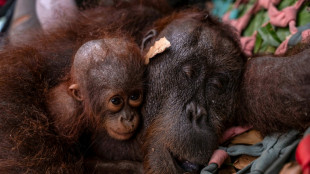
Scientists produce chimp genetic map to combat trafficking / Photo: JOHN WESSELS - AFP/File

 Inter and Roma roar back to win thrillers and share top spot

 Don't stop them now: fans party for Freddie Mercury's 80th birthday

 AFP photographer wins top prize for Madagascar protest coverage

 Keys: 'I felt like I couldn't play tennis'

 Simmonds stars as Pau upset Montpellier

 Inter roar back in five-goal thriller with Napoli

 Haaland keeps Man City perfect in Premier League, blunt Spurs held

 Hamilton worried by Ferrari pace while Antonelli prepares for a fight

 Vuelta stage 15 shortened due to extreme heat, Mas consolidates lead

 Putin meets US envoys for Ukraine war talks

 Modric available for Croatia in Nations League

 Potapova upsets 2025 US Open runner-up Anisimova

 Gasly a 'class act' says Alpine boss after Monza pole

 Athletic Bilbao crush Simeone's flat Atletico

 Stay far from battlefield, warns Japanese director in Vietnam War film

 Tens of thousands of Croatians protest over hazardous waste

 Haaland heads unconvincing Man City top of Premier League

 US envoys in Moscow as Russia and Ukraine vow not to hit capitals during talks

 Motorsport governing body rejects Alpine boss's claims of bias

 US envoy on West Bank visit says Israel has responsibility for Palestinians

 Ethiopian Miss World contestant spotlights pain of sister's murder

 'Leader' Raphinha rising to Barca striker challenge

 Oasis fans gather in Venice for band reunion film

 Two Nepal rescues revive hopes 10 days after flood

 Pogacar to miss worlds after season-ending Vuelta crash

Scientists have produced the first genetic map of chimpanzees in the wild, offering a detailed reconstruction of the endangered species' past migrations, and a new tool to combat illegal trafficking.
The genomic catalogue, which includes 828 individuals from across their vast African range, can now be used to link kidnapped chimpanzees -- or their meat and body parts -- to their place of origin within 100 kilometers.
The results of the years-long research project was published Wednesday in the journal Cell Genomics.
First author Claudia Fontsere of the Institute of Evolutionary Biology in Spain told AFP: "If we can know the genetic diversity of this endangered species, and its past demographic history...this can help design a better conservation plan."
DNA samples were collected from thousands of chimp droppings as part of the Pan African Program at 48 locations across central and western Africa.
Fecal samples are a useful way to study endangered species because they allow for extensive collection with minimal interference to the animals.
But they also present technical challenges because they contain only trace amounts of host DNA.
To overcome these constraints, the team applied a new DNA sequencing technique called "target capture" that was first used to study Neanderthals whose remains have been degraded over thousands of years.
This allowed them to discover 50 percent more variants on a particular chromosome -- number 21 -- than had previously been found, and from this infer past gene flow between chimpanzee populations, plugging gaps in scientific understanding.
Previously, only 59 whole chimpanzee genomes had been sequenced, mainly from captive animals with limited information about their origin.
- Complex migrations -
Just like humans, chimps have complex migration histories, and the new research allowed the scientists to peer back over the past 100,000 years at a new level of detail.
"There has been a lot of debate on whether the four chimpanzee subspecies truly diverged from one another or whether there has been persistent gene-flow between them," co-lead author Mimi Arandjelovic of the Max Planck Institute for Evolutionary Anthropology told AFP.
"We were able to show, using different analyses methods that look at very old and more recent variation, that the history is complex, much like that of our own species."
The team learned that the chimpanzee subspecies were separated in the past, but also experienced periods of genetic exchange -- helping explain why past studies that tried to reconstruct chimps' evolutionary history came to differing conclusions.
They found geographical barriers like lakes and rivers also created genetic barriers between subspecies as well as between communities, and discovered new insights about periods when chimps cross bred with bonobos.
Importantly, they confirmed there was a high level of connectivity between Western chimpanzees, underscoring the need to preserve connections between forests across Western Africa, said Arandjelovic.
Fontsere explained the genetic map could help pinpoint where illegally trafficked chimps had come from.
Though reintroducing the chimps to the wild is a fraught task because of the animals' complex social structure, research has shown they do better when placed in a sanctuary near their place of origin.
"It can help law enforcement to look at the more probable routes, we can trace it back," said Fontsere.
They next hope to improve the genetic map with more samples, and, having proved that fecal DNA is a viable option, extend its use to study other primates.
A.O.Scott--AT