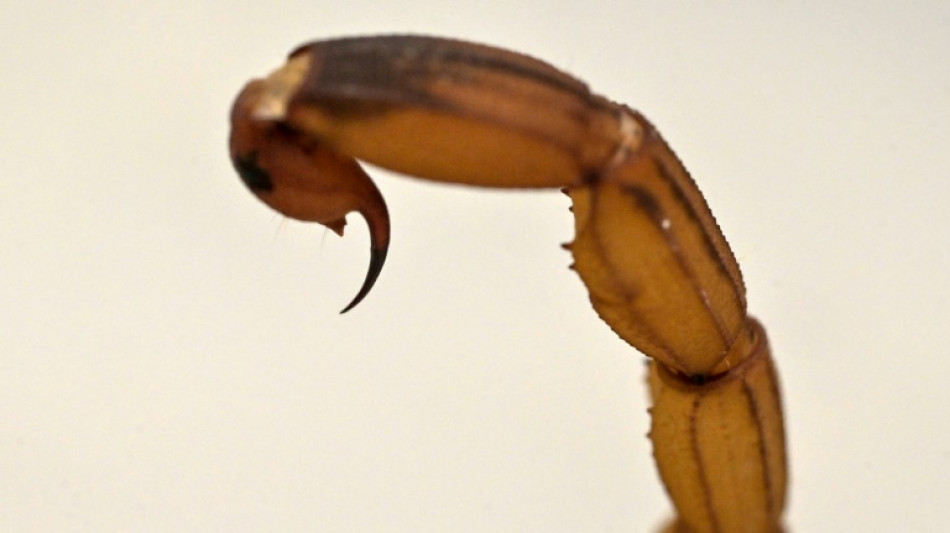
Thriving scorpion population is stinging problem for Brazil / Photo: Nelson ALMEIDA - AFP

 Officials say man shot, wounded by ICE agent in Texas

 豪普特收藏:金錢如何揭露人類的本質

 Kolekcja Haupta: Co pieniądze mówią o nas, ludziach

 The Haupt Collection: What Money Reveals About Us as Human Beings

 Barcelona enter new era aiming to retain Women's Champions League crown

 US has deported 25,000 to third countries under secretive deals: report
 Three South Korean soldiers injured in DMZ blast: military

 New Zealanders pick endangered black robin as Bird of the Year

 Asia stocks rise on AI, US-China trade talks optimism

 Malaysia's 'elephant whisperer' fights to save Borneo's endangered giants

 'I live in fear': 1.5 million Pakistani children sexually exploited online

 Cowboys beat Commanders, Vikings down Bears as star QBs injured

 EB5 United's Cormont at Deer Valley East Village Achieves $224.8 Million Target EB-5 Raise; Offering Remains Open Toward $524.8 Million Maximum Raise

 InterContinental Hotels Group PLC Announces Transaction in Own Shares - September 21

 Best Gold IRA Accounts 2026 Rankings Released: Top Precious Metals IRA Companies Compared in New Guide

 Braves clinch division title as Red Sox reach MLB playoffs

 Bordeaux-Begles hammer Stade Francais despite Jalibert injury

 Milan and Juventus end blips with home wins

 Bridgeman wins PGA Biltmore title with sizzling 61

 Williams injured as Bears shut down by Vikings

 US warns of rapid escalation in Middle East war

 Germany's far-right AfD celebrates another state election win

 Russia vows revenge for election-day attacks as poll shows ruling party win

 Spaun late shows snatches PGA Championship win

 Conceicao strikes as Juventus beat Atalanta

Forget snakes, it's scorpions Brazilians most need to worry about.
The arachnids -- feared for the toxic stinger poised atop their tails -- are proliferating thanks to urbanization and warming temperatures.
The result is that scorpions have become the most lethal poisonous animal in Brazil, posing a growing danger for people across the whole country -- and spurring demand for antivenom.
The most widely found species in the country, the Brazilian yellow scorpion, is the most dangerous scorpion in South America.
Unusually for scorpions, this all-female species also reproduces asexually, reducing population-control options.
"With a warming habitat, these animals' metabolisms are also warming, so they are more active, eating more and reproducing more," explained Thiago Chiariello, production coordinator of the scorpion antivenom lab at Brazil's Instituto Butantan in Sao Paulo.
Add to that rampant urbanization which both scares away scorpions' natural predators such as lizards and birds while boosting the number of available cockroaches -- tasty meals for the arachnids -- and the problem is evident.
"Cities are growing unchecked" and the spread of trash they bring means more food supply for scorpions, Chiariello said.
"This is leading to more contact with people, which means more accidents."
- Soaring sting numbers -
Last year -- the latest dataset available -- there were 152 deaths from scorpion stings in Brazil, compared with 140 from snakebites. That was an increase from 2019, when 95 deaths by scorpion sting were recorded.
According to Brazil's health ministry, there were more than 200,000 scorpion sting incidents registered last year -- 250 percent more than a decade earlier, and an average of nearly 550 stings per day.
Healthy adults might get mild to moderate symptoms from a Brazilian yellow scorpion sting, including pain, vomiting, profuse sweating and tremors.
But there are more severe symptoms -- including shock, fluid build-up in the lungs, cardiovascular collapse and heart failure -- that can prove deadly, especially for children and the elderly.
- Life-saving antivenom -
That makes the Butantan institute's antivenom very important.
Chiariello's team carry out their serum-making task in making that serum with extreme precision.
They first use tweezers to guide a live scorpion's stinger into a container.
The poison is then injected into horses, which are less vulnerable to the toxin's effects than humans, and which produce more antibodies.
"There is a whole purification process in the horses' blood," explained Paulo Goldoni, a biologist at the institute.
"The serum is the only way to save lives," he said.
Last year saw more than 11,000 people in Brazil receive scorpion antivenom, mostly in the country's heavily populated southeast, according to authorities.
With serum demand growing, but also the number of available scorpions, the Instituto Butantan has a steady supply of venom donors.
"If ever there was a lack of serum, we would certainly see a serious increase in the number of deaths," the biologist said.
H.Gonzales--AT