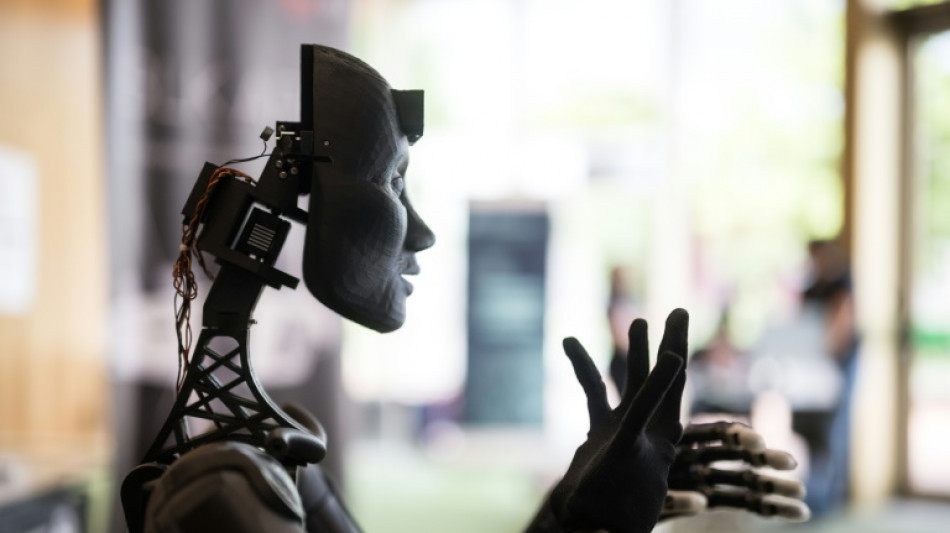
Will AI one day win a Nobel Prize? / Photo: Fabrice COFFRINI - AFP

 Sisters of jailed Pakistan ex-PM Imran Khan arrested

 African players in Europe: Semenyo brace helps City top table

 'For my family': India boxer beats hardship, injury to go for Games gold
 Indonesia doing 'everything' but still struggling to curb fires
 Once decried as 'human cockfighting', MMA wants Olympic spot
 China's Yu, 13, great for swimming says multiple Olympic medallist
 Putin's party set to retain power after Russia vote hit by cyberattacks, drones
 Germany's Merz under pressure after bruising state election losses
 Messi, Miami frustrated in 2-2 draw with San Diego
 Thousands march in France against 'licence to kill' draft law

 Guardian Metal Resources PLC Announces Positive Tempiute Tungsten Drilling Results

 Crexendo Expands AI Portfolio Through Meetric Partnership, Adding Omnichannel Conversation Intelligence for More Than 250 Platform Licensees

 EB5 United's Cormont at Deer Valley East Village Achieves $224.8 Million Target EB-5 Raise; Offering Remains Open Toward $524.8 Million Maximum Raise

 Forest fire threatens tourist town in Colombian Andes

 Torres on target again as PSG beat 10-man Marseille in Ligue 1

 Germany's Merz vows to stay course despite new election defeats

 Carrick demands Man Utd response after 'pathetic' jibes

 Liverpool boss Iraola urges Isak to raise his level

 Evenepoel wins record 4th straight world time-trial title
 France's Macron, Canada's Carney announce closer ties

 Carrick defends troubled Man Utd after Fulham escape
 Horror movie 'Resident Evil' tops N. American box office

 Germany's Merz vows to stay course despite new vote losses

 Man City outgun Sunderland despite Brobbey hat-trick, Man Utd rescue Fulham draw

 Mourinho blames ref committee for Real Madrid derby defeat
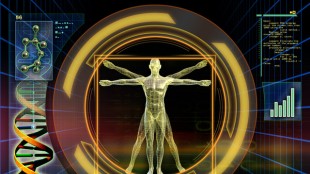
Artificial intelligence is already disrupting industries from banking and finance to film and journalism, and scientists are investigating how AI might revolutionise their field -- or even win a Nobel Prize.
In 2021, Japanese scientist Hiroaki Kitano proposed what he dubbed the "Nobel Turing Challenge", inviting researchers to create an "AI scientist" capable of autonomously carrying out research worthy of a Nobel Prize by 2050.
Some scientists are already hard at work seeking to create an AI colleague worthy of a Nobel, with this year's laureates to be announced between October 7 and 14.
And in fact, there are around 100 "robot scientists" already, according to Ross King, a professor of machine intelligence at Chalmers University in Sweden.
In 2009, King published a paper in which he and a group of colleagues presented "Robot Scientist Adam" -- the first machine to make scientific discoveries independently.
"We built a robot which discovered new science on its own, generated novel scientific ideas and tested them and confirmed that they were correct," King told AFP.
The robot was set up to form hypotheses autonomously, and then design experiments to test these out.
It would even program laboratory robots to carry out those experiments, before learning from the process and repeating.
- 'Not trivial' -
"Adam" was tasked with exploring the inner workings of yeast and discovered "functions of genes" that were previously unknown in the organism.
In the paper, the robot scientist's creators noted that while the discoveries were "modest" they were "not trivial" either.
Later, a second robot scientist -- named "Eve" -- was set up to study drug candidates for malaria and other tropical diseases.
According to King, robot scientists already have several advantages over your average human scientist.
"It costs less money to do the science, they work 24/7," he explained, adding that they are also more diligent at recording every detail of the process.
At the same time, King conceded that AI is far from being anywhere close to a Nobel-worthy scientist.
For that, they would need to be "much more intelligent" and able to "understand the bigger picture".
- 'Nowhere near' -
Inga Strumke, an associate professor at the Norwegian University of Science and Technology, said that for the time being the scientific profession is safe.
"The scientific tradition is nowhere near being taken over by machines anytime soon," she told AFP.
However, Strumke added that "doesn't mean that it's impossible", adding that it's "definitely" clear that AI is having and will have an impact on how science is conducted.
One example of how it is already in use is AlphaFold -- an AI model developed by Google DeepMind -- which is used to predict the three-dimensional structure of proteins based on their amino acid.
"We knew that there was some relation between the amino acids and the final three-dimensional shape of the proteins... and then we could use machine learning to find it," Strumke said.
She explained that the complexity of such calculations was too daunting for humans.
"We kind of have a machine that did something that no humans could do," she said.
At the same time, for Strumke, the case of AlphaFold also demonstrates one of the weaknesses of current AI models such as so-called neural networks.
They are very adept at crunching massive amounts of information and coming up with an answer, but not very good at explaining why that answer is correct.
So while the over 200 million protein structures predicted by AlphaFold are "extremely useful", they "don't teach us anything about microbiology", Strumke said.
- Aided by AI -
For her, science seeks to understand the universe and is not merely about "making the correct guess".
Still, the groundbreaking work done by AlphaFold has led to pundits putting the minds behind it as front-runners for a Nobel Prize.
Google DeepMind's director John Jumper and CEO and co-founder Demis Hassabis were already honoured with the prestigious Lasker Award in 2023.
Analytics group Clarivate, which keeps an eye on potential Nobel science laureates, places the pair among the top picks for the 2024 candidates for the Prize in Chemistry, announced on October 9.
David Pendlebury, head of the research group, admits that while a 2021 paper by Jumper and Hassabis has been cited thousands of times, it would be out of character for the Nobel jury to award work so quickly after publication -- as most discoveries that are honoured date back decades.
At the same time, he feels confident that it won't be too long before research aided by AI will win the most coveted of science prizes.
"I'm sure that within the next decade there will be Nobel Prizes that are somehow assisted by computation and computation these days is more and more AI," Pendlebury told AFP.
F.Wilson--AT