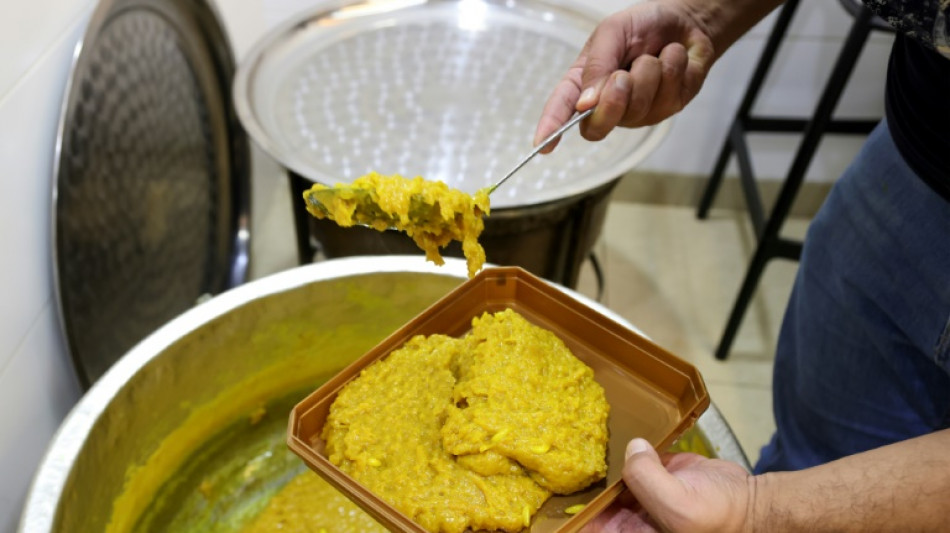
Family keeps up Beirut dessert tradition / Photo: ANWAR AMRO - AFP

 Indonesia doing 'everything' but still struggling to curb fires

 Once decried as 'human cockfighting', MMA wants Olympic spot

 China's Yu, 13, great for swimming says multiple Olympic medallist

 Putin's party set to retain power after Russia vote hit by cyberattacks, drones

 Germany's Merz under pressure after bruising state election losses

 Messi, Miami frustrated in 2-2 draw with San Diego

 Thousands march in France against 'licence to kill' draft law

 Best Gold IRA Accounts 2026 Rankings Released: Top Precious Metals IRA Companies Compared in New Guide

 Braves clinch division title as Red Sox reach MLB playoffs

 Bordeaux-Begles hammer Stade Francais despite Jalibert injury

 Milan and Juventus end blips with home wins

 Bridgeman wins PGA Biltmore title with sizzling 61

 Williams injured as Bears shut down by Vikings

 US warns of rapid escalation in Middle East war

 Germany's far-right AfD celebrates another state election win

 Russia vows revenge for election-day attacks as poll shows ruling party win

 Spaun late shows snatches PGA Championship win

 Conceicao strikes as Juventus beat Atalanta

 Britain, Zverev-inspired Germany, Spain complete Davis Cup finals

 Man Utd salvage Fulham draw as pressure mounts on Carrick

 Spanish civil war drama 'The Black Ball' wins at Toronto festival

 Germany's Merz shaken by far-right and far-left gains in state votes

 Macron welcomes Canada's Carney to French Atlantic territory

 Fiorentina frustrate Napoli with Serie A draw, Como upset

 Five-star Man City top Premier League after Sunderland thriller

At a shop nestled in a busy, crowded Beirut district, Hasan El-Makary is weighing out containers of warm, fragrant mufataka, a traditional sweet in the Lebanese capital that is rarely found in stores.
"I've been in this shop for 50 years, but we started specialising in mufataka 30 years ago," Makary said from the humble shop with its ageing decor and low ceiling.
A kind of rice pudding made with turmeric, tahini sesame paste, sugar and pine nuts, mufataka is traditional in Beirut but less known even outside the city.
Makary, 73, said he used to sell other sweets but as demand grew for mufataka, he abandoned the rest and now just makes the yellow pudding, together with his cousin, who is also his business partner.
"At the beginning you add turmeric, that's the main thing, then tahini, sugar and rice... we cook it slowly on fire," he said.
The rice must be soaked overnight, and Makary said he comes to the shop at 5:00 am to make the dish, which takes around four hours and requires regular stirring.
He said his father started making mufataka despite initially believing people would not pay money for a dish that is normally prepared at home.
Plastic containers of the pudding, which is eaten with a spoon, dotted trays and tables across the shop, waiting for customers who peered through a window to place their order from the busy street outside.
Customer Iman Chehab, 55, was picking up mufataka for her mother, who used to make it herself.
"She is elderly now and she can't stir... it takes a lot of work," said Chehab, who works in human resources management.
The dish is "something traditional for us who are from Beirut", she told AFP.
Places like Makary's shop "are the old face of Beirut that we love and always want to remember", she added.
- 'Heritage' -
A few bustling neighbourhoods away, Samir Makari, 35, is carrying on the family tradition.
At a gleaming shop also selling Arabic sweets like baklava, Makari attends to a huge copper pot of mufataka behind the counter, stirring it with a long, wooden-handled implement.
He weighs out and mixes the sugar, tahini paste and pine nuts in a second pot, later combining it all.
Mufataka used to be made just once a year on the last Wednesday in April, with families gathering by the sea at Beirut's public beach, father and son said.
The occasion was "Job's Wednesday", a reference to the biblical figure also mentioned in the Koran and who is renowned for his patience, the younger Makari said, noting the virtue is also required for making mufataka.
On the wall of his shop, which he runs with his brother, were photos of his father and his grandfather at work.
He said he sometimes makes mufataka twice a day depending on demand, with some customers taking it outside Beirut to introduce it to those who do not know the dish.
At the original store, the elder Makary said he was happy his children had kept up the tradition.
Mufataka is part of "my heritage", he said, and the family has "taken it from generation to generation".
W.Moreno--AT