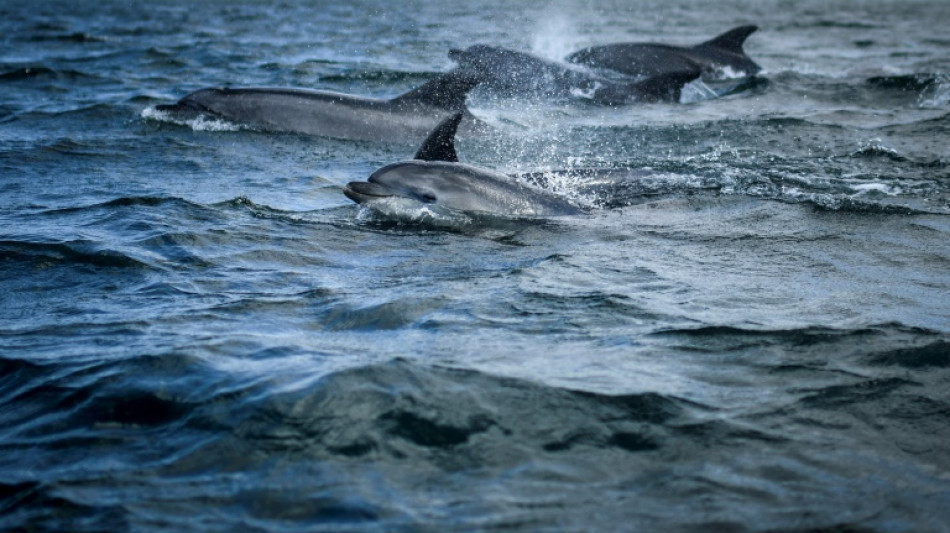
Study predicts mass marine life extinction if warming continues / Photo: PATRICIA DE MELO MOREIRA - AFP/File

 Sabalenka edges Noskova, keeps US Open treble bid alive

 Real Madrid win Champions League opener as Haaland stars for Man City

 Gambian leader vows power boost after violent blackout protests

 Newcastle battle past Millwall to reach League Cup fourth round

 Mourinho's Real Madrid make winning start against Inter Milan

 Villa take 'big step forward' with win over Brugge

 Yaya Toure hails 'new era' for African coaches ahead of Champions League bow

 Lawes and Marchant told to prove themselves in quest for England recalls

 Smithsonian secretary to retire as Trump exerts control over institution

 Atletico have work to do to reach home Champions League final: Simeone

 Villa end goal drought to beat Brugge in Champions League opener

 McIlroy says 'we'll keep our heads down and play' in event of Trump golf visit

 Sabalenka holds of Noskova to reach US Open semi-finals

 Netanyahu under fire over report UAE warned of October 7 attack

 Wasim Akram urges 'fair treatment' for jailed Imran Khan

 No. 1 in reach as Rybakina battles for US Open semi-final spot

 Putin and Trump discuss Ukraine in 'extremely frank' call

 French police hunt Renoir thieves after lightning museum heist
 World Cup final scorer Torres leads Ballon d'Or nominees

 Carney touts Canada 'pivot' away from US as tariffs rise

 Spanish stars Cruz, Bardem play strained on-screen couple in new film

 The "Everlasting Battery" Inside Your Joints:UConn Professor's Self-Powered Healing Material just Got Acquired

 Visionary or conman? Elon Musk enigmatic star of Venice documentary

 Trial opens in France over deadliest Channel migrant crossing disaster

 England skipper Root says it's wrong to accuse Pakistan of lacking fight

By the year 2300, life in the oceans faces a mass die-off rivaling the great extinctions of Earth's deep past if humanity fails to curb greenhouse gas emissions, a study said Thursday.
But limiting planetary warming to two degrees Celsius above pre-industrial levels will stave off such a catastrophe, said the paper's authors, Justin Penn and Curtis Deutsch, both affiliated with the University of Washington and Princeton University.
The authors used ecophysiological modeling to weigh species' physical limits with projected marine temperatures and depletion of oxygen levels -- a task that was particularly challenging given a lack of previous work in the area.
The results were alarming: under "business as usual" warming, marine ecosystems planetwide could experience a mass extinction comparable to that of the end-Permian extinction, known as the "Great Dying."
This occurred 250 million years ago and led to the demise of more than two-thirds of marine animals, because of warming and oxygen depletion, similar conditions that are occurring today.
While the tropical oceans would lose the most species, many from these areas would migrate to higher latitudes in order to survive.
On the other hand, polar species would disappear en masse, since their types of habitat would disappear from the planet entirely.
Limiting warming to 2C, the upper limit of goal set by the Paris agreement, "would cut the severity of extinctions by >70%, avoiding a marine mass extinction," the paper said.
The preferred goal, of limiting warming to 1.5C, is impossible to achieve with current international commitments, according to UN climate experts.
"Because marine extinctions have not progressed as far as those on land, society has time to turn the tide in favor of ocean life," wrote scientists Malin Pinsky and Alexa Fredston in an accompanying commentary.
"Exactly where the future falls between the best-case and worst-case scenarios will be determined by the choices that society makes not only about climate change, but also about habitat destruction, overfishing, and coastal pollution."
F.Wilson--AT