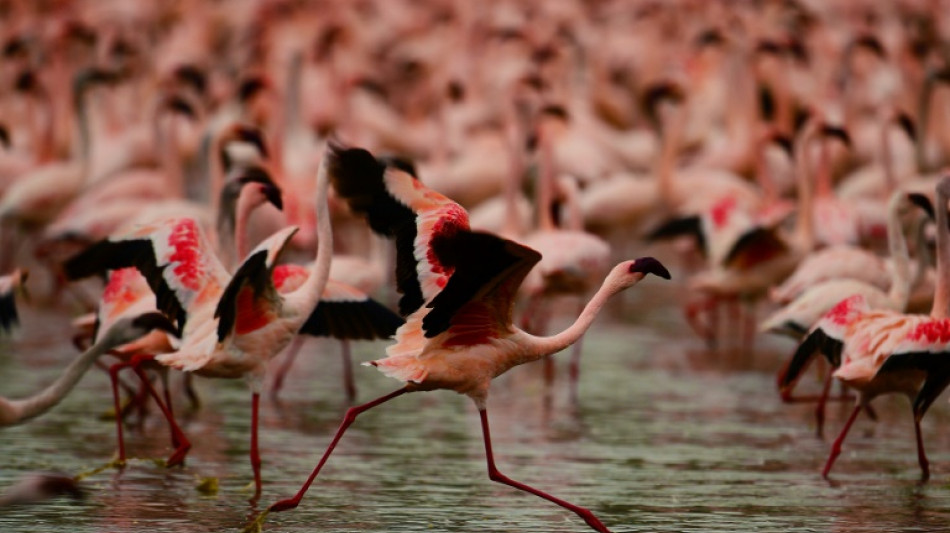
Future of Africa's flamingos threatened by rising lakes: study / Photo: CARL DE SOUZA - AFP

 'I live in fear': 1.5 million Pakistani children sexually exploited online

 Cowboys beat Commanders, Vikings down Bears as star QBs injured

 Braves clinch division title as Red Sox reach MLB playoffs
 Bordeaux-Begles hammer Stade Francais despite Jalibert injury

 Milan and Juventus end blips with home wins

 Bridgeman wins PGA Biltmore title with sizzling 61

 Williams injured as Bears shut down by Vikings

 US warns of rapid escalation in Middle East war

 Germany's far-right AfD celebrates another state election win

 Russia vows revenge for election-day attacks as poll shows ruling party win

 Spaun late shows snatches PGA Championship win

 Conceicao strikes as Juventus beat Atalanta

 Britain, Zverev-inspired Germany, Spain complete Davis Cup finals

 Man Utd salvage Fulham draw as pressure mounts on Carrick

 Spanish civil war drama 'The Black Ball' wins at Toronto festival

 Germany's Merz shaken by far-right and far-left gains in state votes

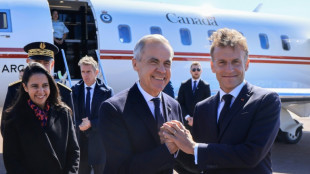 Macron welcomes Canada's Carney to French Atlantic territory

 Fiorentina frustrate Napoli with Serie A draw, Como upset

 Five-star Man City top Premier League after Sunderland thriller

 Ukrainian drones hit Moscow on last day of Russian elections

 Multi-Asset Trading Venue Monochrome Exchange Announces IEO of Its Native Token, $MCR

 South Korea break Japan hearts to win Asian Games basketball gold
 Acosta takes first victory at Austrian MotoGP

 PSG president Nasser al-Khelaifi under investigation in France for conflict of interest

 China swim sensation, 13, sets Games record after Japan win early

The lakes where Africa's flamingos congregate in spectacular numbers are producing less food for the iconic birds as their water levels rise, researchers said Friday, threatening the survival of a much-loved species.
Three-quarters of the world's lesser flamingos live in East Africa and more than a million birds at a time can gather at lakes in huge "flamboyances" for feeding and courtship.
But as these lakes expand to record highs, scientists have discovered they produce less of the unique algae upon which flamingos rely, putting at risk a species already in decline.
This is driving the distinctive, pink-plumed birds away from their usual habitats into unprotected areas in search of food, said Aidan Byrne, lead author of the research.
"They might be able to move elsewhere, but they could be lost from the region that they're currently in at these key feeding lakes," said Byrne, a PhD student jointly supervised by King's College London and the Natural History Museum.
Flamingos use their specialised beaks to feed on a particular type of algae that exists in salty, alkaline waters known as soda lakes.
These lakes are concentrated in Kenya, Tanzania and Ethiopia and despite being harsh landscapes, certain species -- including the flamingo and the algae they feast on -- have adapted to thrive there.
- 'Iconic species' -
But the lakes have risen to levels not seen in decades, driven in part by increased rainfall linked to climate change over the catchment areas.
This has greatly diluted the alkalinity and salinity of the water at these soda lakes.
Byrne and other researchers wanted to study the impact that had on biodiversity and found a "massive decline" in concentrations of the very algal blooms upon which flamingos survive.
Earlier studies had looked at the problem but its extent was not known until now, he said.
"We were surprised at the scale of the changes, and how much the flamingo habitats are threatened," he told AFP.
Erratic and extreme rainfall predicted for East Africa in future would only make the problem worse and "increase the threat to the species within the region", he added.
The study, published in the journal Current Biology, is the first to use satellite imagery to observe all 22 of the soda lakes that host flamingos across the East African region.
This was combined with climate records and bird observation data over more than 20 years.
The sharpest drops in algae concentrations were observed in Kenya, including at Nakuru, one of the most important flamingo feeding lakes in Africa known for hosting million-strong "flamboyances".
It expanded by roughly 90 percent between 2009 and 2022 while algal concentration halved.
Lake Bogoria and Lake Elmenteita, also tourist magnets for their brilliant flamingo displays, experienced steep declines as well.
And where algal blooms declined, so too did flamingo numbers, Byrne said, putting in doubt revenue from tourism as well.
Flamingo habitats in East Africa are protected whereas outside these ranges monitoring would be difficult and other threats -- including from humans -- could emerge, he said.
"They're just such an iconic species that are unique to these environments. If they're lost, it would be devastating," Byrne said.
T.Sanchez--AT