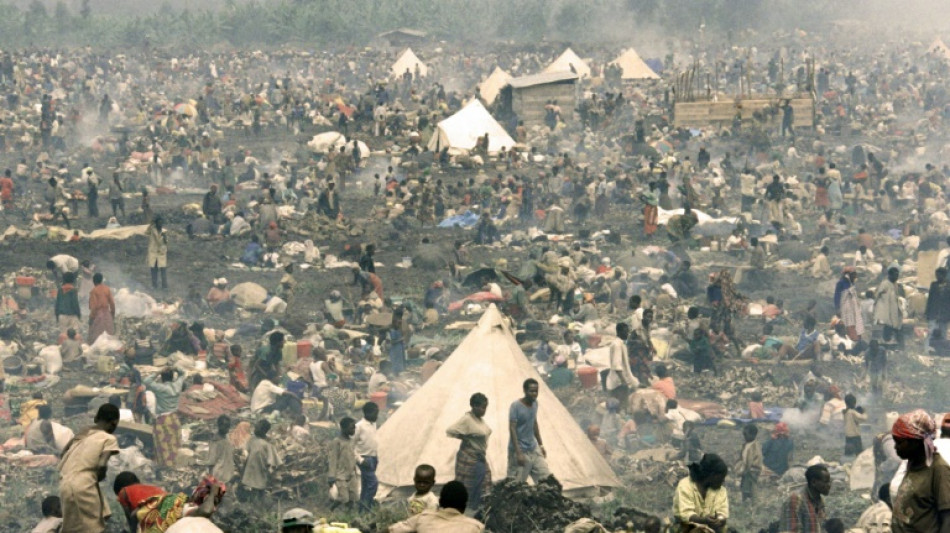
Peace still elusive for east DR Congo 30 years after genocide in Rwanda / Photo: Pascal GUYOT - AFP/File

 'I live in fear': 1.5 million Pakistani children sexually exploited online

 Cowboys beat Commanders, Vikings down Bears as star QBs injured
 Braves clinch division title as Red Sox reach MLB playoffs
 Bordeaux-Begles hammer Stade Francais despite Jalibert injury

 Milan and Juventus end blips with home wins
 Bridgeman wins PGA Biltmore title with sizzling 61
 Williams injured as Bears shut down by Vikings

 US warns of rapid escalation in Middle East war

 Germany's far-right AfD celebrates another state election win
 Russia vows revenge for election-day attacks as poll shows ruling party win

 Spaun late shows snatches PGA Championship win
 Conceicao strikes as Juventus beat Atalanta
 Britain, Zverev-inspired Germany, Spain complete Davis Cup finals
 Man Utd salvage Fulham draw as pressure mounts on Carrick
 Spanish civil war drama 'The Black Ball' wins at Toronto festival

 Germany's Merz shaken by far-right and far-left gains in state votes

 Macron welcomes Canada's Carney to French Atlantic territory
 Fiorentina frustrate Napoli with Serie A draw, Como upset
 Five-star Man City top Premier League after Sunderland thriller
 Ukrainian drones hit Moscow on last day of Russian elections
 Multi-Asset Trading Venue Monochrome Exchange Announces IEO of Its Native Token, $MCR
 South Korea break Japan hearts to win Asian Games basketball gold
 Acosta takes first victory at Austrian MotoGP
 PSG president Nasser al-Khelaifi under investigation in France for conflict of interest

 China swim sensation, 13, sets Games record after Japan win early

Sitting at home in Goma in the volatile east of the Democratic Republic of Congo, Rachel Sematumba describes herself as "a child of war".
As the 30th anniversary of the genocide in Rwanda approaches, she reflects on how peace remains as elusive now in the city as when she was born.
"Since my birth at the time of the genocide in Rwanda until now with the M23 (rebel militia), there's only been that in Goma -- war," Sematumba said.
In summer 1994, nearly one million Rwandan Hutu refugees fled across the border into Goma, the capital of DRC's North Kivu province.
Fearing reprisals by the new Kigali authorities, they had left a country riven and traumatised by genocide.
Rachel was born in August that year when "all the hospitals in the city were packed with corpses and the sick", her father Onesphore Sematumba recalled emotionally.
Cholera was rife, claiming the lives of tens of thousands of refugees and residents.
Today, a few months shy of turning 30, Rachel is due to have her own child at the end of the week, around the time commemorations begin in Rwanda for the genocide.
In just 100 days between April and July 1994, some 800,000 minority Tutsis and moderate members of the Hutu majority were slaughtered, in massacres orchestrated and inflamed by the authorities.
Around 30 years old at the time, Onesphore was a French literature teacher in Rwanda when president Juvenal Habyarimana's plane was shot down on April 6.
Hutu extremists went on the rampage, unleashing the 20th century's last genocide.
"We were on Easter holidays in Congo," he said. "The school year was abruptly halted, from one day to the next I found myself unemployed in Goma," he said, bitterly.
- Armed incursions -
Onesphore spoke of the "human tide" which three months later flooded from Rwanda into Goma.
"Children, elderly people, cattle, battle tanks, trucks, all the army, the government... it was half a country that poured into the city, without any accommodation or supervision.
"Without anything," he said.
Goma had fewer than 300,000 inhabitants then and "looked like a big village", he said.
Open spaces such as football pitches, churches, schools and roundabouts quickly filled up, he recalled.
Due to the cholera epidemic, "we began seeing bodies pile up".
"Refugees were cooking alongside the dying in general indifference. We even would see babies suckling the dead body of their mother."
He said "huge mass graves" appeared behind the airport and refugee camps "became like towns" around Goma.
Onesphore would bump into former pupils who would talk of wanting to retake power in Kigali and of carrying out armed incursions into Rwanda.
But it was Paul Kagame and his Rwandan Patriotic Front rebel army who stopped the Hutu extremists, entered Kigali in July 1994 and came to power where he has remained ever since.
- Same uncertain future -
For 30 years, the Rwandan regime has argued that the presence of Hutu extremists in North Kivu poses a threat that justifies military intervention in DRC, directly or via rebel groups.
Wars and conflicts have gone on since 1996, with the mostly-Tutsi M23 currently controlling large swathes of North Kivu, including around Goma, with the Rwandan army's backing.
The rebels claim to be defending Congo's Tutsi population, as the genocide continues to cast a long shadow over relations between countries of the Great Lakes region.
Rachel remembered as a young child running home when shooting in the city interrupted her games with neighbours.
It did not abate as she grew older, although she described her teens as "normal", before adding: "Growing up, you do wonder what's the reason for all that."
At the age of 19, she left Goma for the Kenyan capital Nairobi and studied for a master's in diplomacy, development and international security.
After graduating, Rachel returned to Goma in late 2021, married two years later and moved into a small house near the centre.
From the first week, shots rang out near their home. "We said 'OK, welcome to the neighbourhood!'" she joked.
Rachel wants to be a diplomat to represent her country and also fight exploitation and violence against women. "Instead of women being brought up, here they are killed, raped," she said.
In eastern DRC "it's difficult to move on from the past," her father said.
Thirty years on, the scenes he witnessed in Goma are back again with the M23 conflict having forced more than 1.5 million people from their homes.
A.Clark--AT