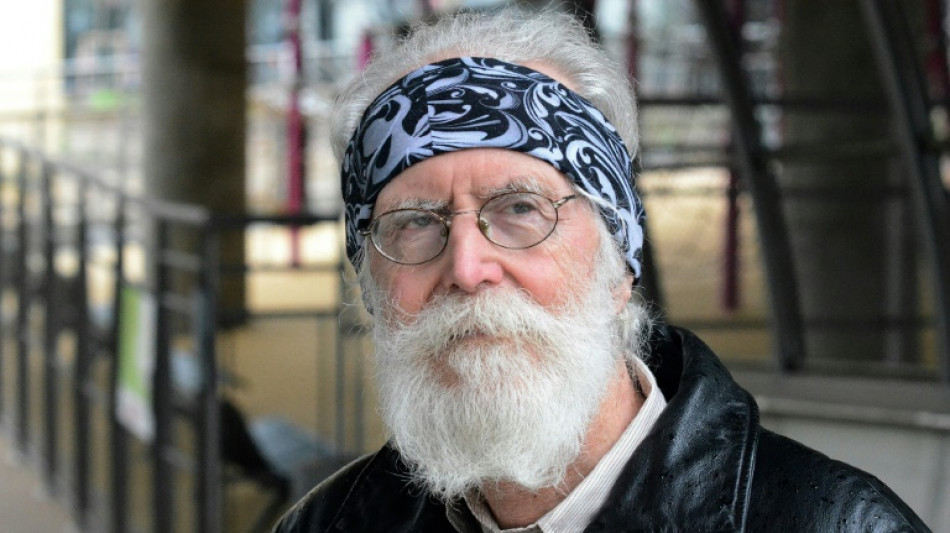
'I had such fun!', says winner of top maths prize / Photo: Peter BADGE - NTB/AFP/File

 'I live in fear': 1.5 million Pakistani children sexually exploited online
 Cowboys beat Commanders, Vikings down Bears as star QBs injured
 Braves clinch division title as Red Sox reach MLB playoffs

 Bordeaux-Begles hammer Stade Francais despite Jalibert injury
 Milan and Juventus end blips with home wins
 Bridgeman wins PGA Biltmore title with sizzling 61
 Williams injured as Bears shut down by Vikings

 US warns of rapid escalation in Middle East war
 Germany's far-right AfD celebrates another state election win
 Russia vows revenge for election-day attacks as poll shows ruling party win

 Spaun late shows snatches PGA Championship win
 Conceicao strikes as Juventus beat Atalanta
 Britain, Zverev-inspired Germany, Spain complete Davis Cup finals
 Man Utd salvage Fulham draw as pressure mounts on Carrick
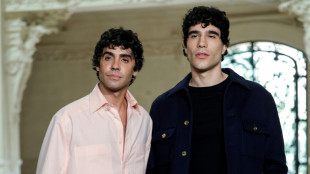 Spanish civil war drama 'The Black Ball' wins at Toronto festival
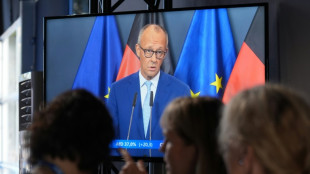 Germany's Merz shaken by far-right and far-left gains in state votes
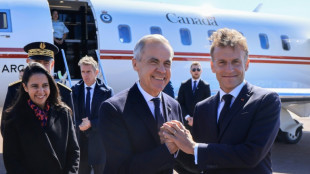 Macron welcomes Canada's Carney to French Atlantic territory
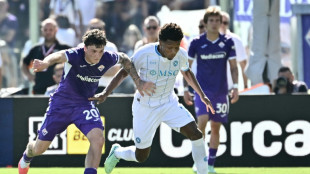 Fiorentina frustrate Napoli with Serie A draw, Como upset
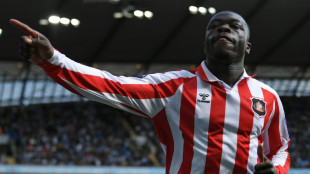
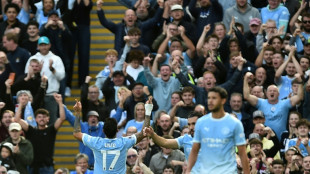 Five-star Man City top Premier League after Sunderland thriller
 Ukrainian drones hit Moscow on last day of Russian elections
 Multi-Asset Trading Venue Monochrome Exchange Announces IEO of Its Native Token, $MCR

 South Korea break Japan hearts to win Asian Games basketball gold
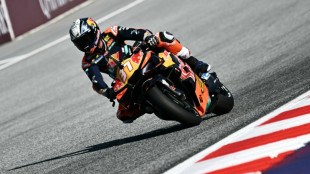 Acosta takes first victory at Austrian MotoGP

 PSG president Nasser al-Khelaifi under investigation in France for conflict of interest

 China swim sensation, 13, sets Games record after Japan win early

For Michel Talagrand, who won the Abel mathematics prize on Wednesday, maths provided a fun life free from all constraints -- and an escape from the eye problems he suffered as a child.
"Maths, the more you do it, the easier it gets," the 72-year-old said in an interview with AFP.
He is the fifth French Abel winner since the award was created by Norway's government in 2003 to compensate for the lack of a Nobel prize in mathematics.
Talagrand's career in functional analysis and probability theory saw him tame some of the incredibly complicated limits of random behaviour.
But the mathematician said he had just been "studying very simple things by understanding them absolutely thoroughly."
Talagrand said he was stunned when told by the Norwegian Academy of Science and Letters that he had won the Abel prize.
"I did not react -- I literally didn't think for at least five seconds," he said, adding that he was very happy for his wife and two children.
- Fear of going blind -
When he was young, Talagrand only turned to maths "out of necessity," he said.
By the age of 15, he had endured multiple retinal detachments and "lived in terror of going blind".
Unable to run around with friends in Lyon, Talagrand immersed himself in his studies.
His father had a maths degree and so he followed the same path. He said he was a "mediocre" student in other areas.
Talagrand was particularly poor at spelling, and still lashes out at what he calls its "arbitrary rules".
Especially in comparison to maths, which has "an order in which you do well if you are sensitive to it," he said.
In 1974, Talagrand was recruited by the French National Centre for Scientific Research (CNRS), before getting a PhD at Paris VI University.
He spent a decade studying functional analysis before finding his "thing": probability.
It was then that Talagrand developed his influential theory about "Gaussian processes," which made it possible to study some random phenomena.
Australian mathematician Matt Parker said that Talagrand had helped tame these "complicated random processes".
Physicists had previously developed theories on the limits of how randomness behaves, but Talagrand was able to use mathematics to prove these limits, Parker said on the Abel Prize website.
- 'Monstrously complicated' -
"In a sense, things are as simple as could be -- whereas mathematical objects can be monstrously complicated," Talagrand said.
His work deepening the understanding of random phenomena "has become essential in today's world," the CNRS said, citing algorithms which are "the basis of our weather forecasts and our major linguistic models".
Rather than creating a "brutal transformation", Talagrand considers his discoveries as a collective work he compared to "the construction of a cathedral in which everyone lays a stone".
He noted that French mathematics had been doing well an elite level, notching up both Abel prizes and Fields medals -- the other equivalent to a maths Nobel, which is only awarded to mathematicians under 40.
"But the situation is far less brilliant in schools," where young people are increasingly less attracted to the discipline, he lamented.
The new Abel winner admitted that maths can be daunting at first, but re-emphasised his belief that it gets easier the more you do it.
He advised aspiring mathematicians not to worry about failure.
"You can fail to solve a problem 10 times -- but that doesn't matter if you succeed on the 11th try," he said.
It can also be hard work.
"All my life I worked to the point of exhaustion -- but I had such fun!" he said.
"With maths, you have all the resources within yourself. You work without any constraints, free from concerns about money or bosses," he added.
"It's marvellous."
Talagrand will receive his prize, including a 7.5-million-kroner ($705,000) cheque, in Oslo on May 21.
N.Walker--AT