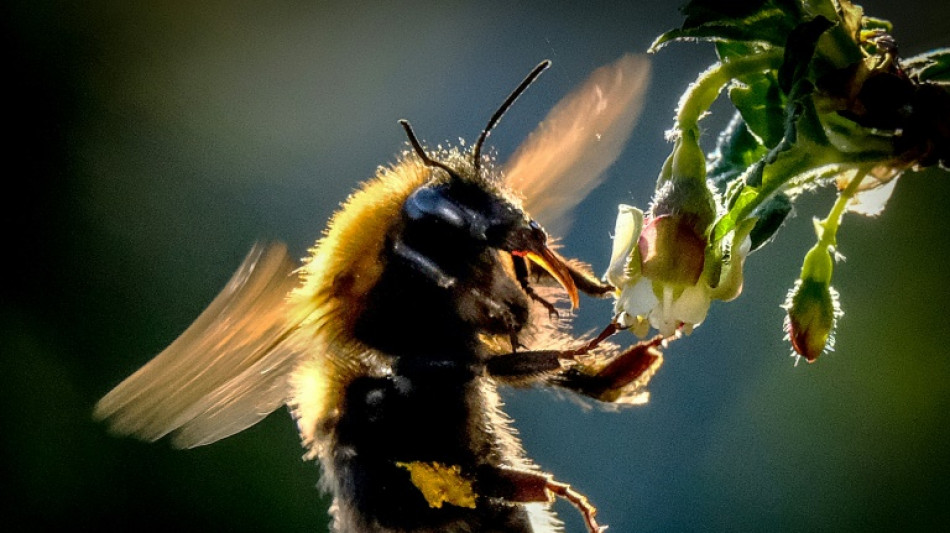
Not just humans: Bees and chimps can also pass on their skills / Photo: Yuri KADOBNOV - AFP/File

 Braves clinch division title as Red Sox reach MLB playoffs

 Bordeaux-Begles hammer Stade Francais despite Jalibert injury

 Milan and Juventus end blips with home wins

 Bridgeman wins PGA Biltmore title with sizzling 61

 Williams injured as Bears shut down by Vikings

 US warns of rapid escalation in Middle East war

 Germany's far-right AfD celebrates another state election win

 Russia vows revenge for election-day attacks as poll shows ruling party win

 Spaun late shows snatches PGA Championship win

 Conceicao strikes as Juventus beat Atalanta

 Britain, Zverev-inspired Germany, Spain complete Davis Cup finals

 Man Utd salvage Fulham draw as pressure mounts on Carrick

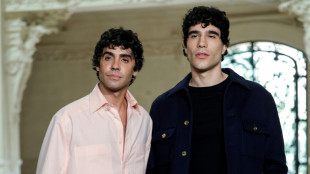 Spanish civil war drama 'The Black Ball' wins at Toronto festival

 Germany's Merz shaken by far-right and far-left gains in state votes

 Macron welcomes Canada's Carney to French Atlantic territory

 Fiorentina frustrate Napoli with Serie A draw, Como upset

 Five-star Man City top Premier League after Sunderland thriller

 Ukrainian drones hit Moscow on last day of Russian elections
 Multi-Asset Trading Venue Monochrome Exchange Announces IEO of Its Native Token, $MCR

 South Korea break Japan hearts to win Asian Games basketball gold

 Acosta takes first victory at Austrian MotoGP

 PSG president Nasser al-Khelaifi under investigation in France for conflict of interest

 China swim sensation, 13, sets Games record after Japan win early

 Drones hit Moscow as Russians go to the polls

 New England boss Fleming says 'wrong' to ask Stokes to end retirement

Bumblebees and chimpanzees can learn skills from their peers so complicated that they could never have mastered them on their own, an ability previously thought to be unique to humans, two studies said on Wednesday.
One of humanity's crowning talents is called "cumulative culture" -- our ability to build up skills, knowledge and technology over time, improving them as they pass down through the generations.
This ability to transfer abilities no individual could learn by themselves is credited with helping driving humanity's rise and domination of the world.
"Imagine that you dropped some children on a deserted island," said Lars Chittka, a behavioural ecologist at the Queen Mary University of London and co-author of the bee study.
"They might -- with a bit of luck -- survive, but they would never know how to read or to write because this requires learning from previous generations," he said in a video published with the study in the journal Nature.
Previous experiments have demonstrated that some animals are capable of what is known as social learning -- working out how to do something by observing others of their kind.
Some of these behaviours seem to have been perfected over time, such as the incredible navigational talent of homing pigeons or chimpanzees' ability to crack nuts, suggesting they could be examples of cumulative culture.
But it is difficult for scientists to rule out that an individual pigeon or chimp could not have worked out how to do achieve these feats by themselves.
So a UK-led team of researchers turned to the humble bumblebee.
- 'So surprised' -
The first step was training a crack squad of "demonstrators" to do a complex skill that they could later teach to others.
In the lab, some bees were given a two-step puzzle box. They were tasked with first pushing a blue tab, then a red tab to release the sugary prize at the end.
Alice Bridges, a study co-author also from Queen Mary University, told AFP: "This task is really difficult for bees because we are essentially asking them to learn to do something in exchange for nothing" during the first step.
Initially, the baffled bees just tried to push the red tab -- without first moving the blue one -- and simply gave up.
To motivate the bees, the researchers put a sugary treat at the end of this first step which was gradually withdrawn as they mastered the process.
The demonstrators were then paired up with some new "naive" bees, which watched the demonstrators solve the puzzle before having a go themselves.
Five of the 15 naive bees swiftly completed the puzzle -- without needing a reward after the first stage.
"We were so surprised," Bridges said. "We were all just going crazy" when it first happened, she said.
Alex Thornton, a professor of cognitive evolution at the UK's University of Exeter not involved in the research, acknowledged that it was a small sample size.
"But the point is clear -- the task was exceptionally hard to learn alone, yet some bees could solve it through social learning," he wrote in a comment piece in Nature.
The authors of the research said it was the first demonstration of cumulative culture in an invertebrate.
- Chimp off the old block -
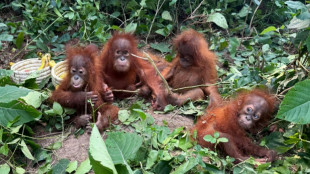
Chimpanzees -- our closest living relatives -- also seem to possess this talent, according to a separate study in Nature Human Behaviour.
The puzzle box for a troupe of semi-wild chimpanzees at the Chimfunshi Wildlife Orphanage in Zambia was a little more difficult.
It involved retrieving a wooden ball, holding open a drawer, slotting in the ball then closing it to release the peanut prize.
Over three months, 66 chimps tried and failed to solve the puzzle.
Then the Dutch-led team of researchers trained two demonstrator chimpanzees to show the others how it was done.
After two months, 14 "naive" chimps had mastered it.
And the more the chimps watched the demonstrators, the quicker they learned to solve the problem.
Bridges said the studies "can't help but fundamentally challenge the idea that cumulative culture is this extremely complex, rare ability that only the very 'smartest' species -- e.g. humans -- are capable of".
Thornton said the research again showed how "people habitually overestimate their abilities relative to those of other animals".
G.P.Martin--AT