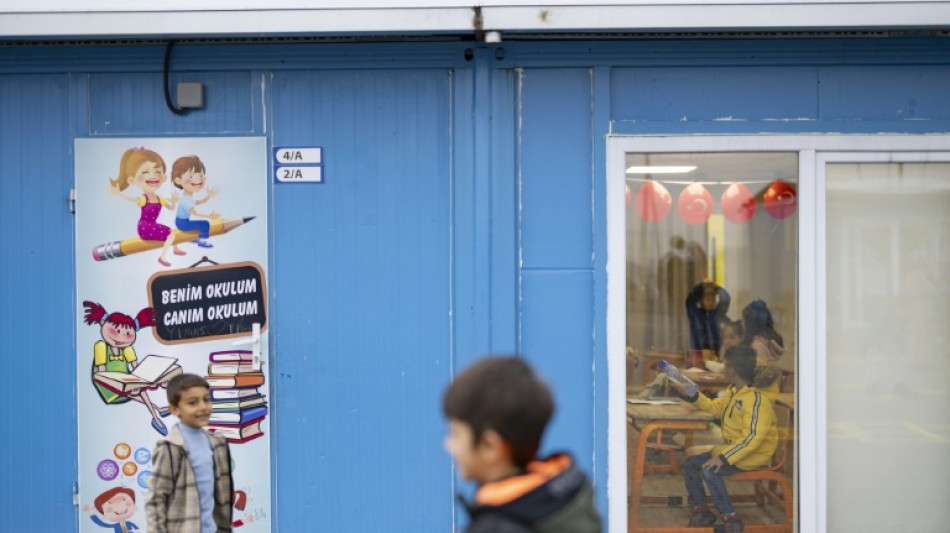
Quake trauma haunts children in Turkey's container city / Photo: YASIN AKGUL - AFP

 Braves clinch division title as Red Sox reach MLB playoffs
 Bordeaux-Begles hammer Stade Francais despite Jalibert injury

 Milan and Juventus end blips with home wins
 Bridgeman wins PGA Biltmore title with sizzling 61

 Williams injured as Bears shut down by Vikings

 US warns of rapid escalation in Middle East war
 Germany's far-right AfD celebrates another state election win

 Russia vows revenge for election-day attacks as poll shows ruling party win

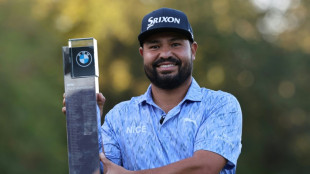 Spaun late shows snatches PGA Championship win

 Conceicao strikes as Juventus beat Atalanta
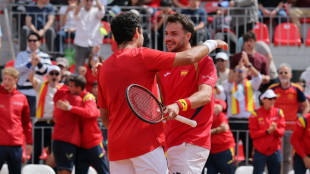 Britain, Zverev-inspired Germany, Spain complete Davis Cup finals

 Man Utd salvage Fulham draw as pressure mounts on Carrick

 Spanish civil war drama 'The Black Ball' wins at Toronto festival

 Germany's Merz shaken by far-right and far-left gains in state votes

 Macron welcomes Canada's Carney to French Atlantic territory
 Fiorentina frustrate Napoli with Serie A draw, Como upset

 Five-star Man City top Premier League after Sunderland thriller
 Ukrainian drones hit Moscow on last day of Russian elections
 Multi-Asset Trading Venue Monochrome Exchange Announces IEO of Its Native Token, $MCR
 South Korea break Japan hearts to win Asian Games basketball gold
 Acosta takes first victory at Austrian MotoGP
 PSG president Nasser al-Khelaifi under investigation in France for conflict of interest

 China swim sensation, 13, sets Games record after Japan win early
 Drones hit Moscow as Russians go to the polls

 New England boss Fleming says 'wrong' to ask Stokes to end retirement

Cansu Gol lost her baby in the rubble of Turkey's massive earthquake a year ago. Now she spends her time trying to heal the mental scars of her two surviving children.
One suffers from trauma-related attention deficit disorder and the other from speech problems which emerged after last year's February 6 disaster in which 50,000 died across Turkey's southeast.
For the 33-year-old mother, the improvised schools in a container city near the quake's epicentre in the province of Kahramanmaras offer a glimmer of hope.
"My seven-year-old daughter was pulled out alive from the rubble hours after the earthquake. Now she is suffering from attention deficit disorder," Gol told AFP.
"She didn't cry or scream at all, instead storing all the stress inside," she said.
Her four-and-a-half-year-old son began to speak after joining a nursery set up in one of the containers housing hundreds of thousands of survivors of Turkey's deadliest disaster of modern times.
"He keeps asking about his brother (who died). He says he flew away like a bird," the mother said.
- Bouts of violence -
Teachers try to create an atmosphere of normality for the kids, each one of whom has lost homes, family and friends. All have varied levels of understanding what actually occurred.
A bust of post-Ottoman Turkey's founder, Mustafa Kemal Ataturk, stands in the courtyard, just as it would at any other school.
The 20-student classrooms are decorated with balloons, adding colour to a camp comprised of hundreds of identical white metal containers arranged in even rows.
Just a 10-minute walk away, empty spaces recall the apartment towers that stood in this Mediterranean city, once most famous for its ice cream.
"It is just as painful for the students as it is for the teachers," said the school's principal, who spoke to AFP on condition of anonymity because civil servants are barred from speaking to the media without authorisation.
"Many things evoke the quake: aftershocks, the month of February or simply the snowfall," which was heavy that fatal night, he said.
His school takes care of 850 children from diverse backgrounds.
They live in a container city housing 10,000 survivors, creating a tense atmosphere that breeds occasional bouts of violence.
"Cursing, offensive gestures, kicking -- things won't go well until these families are settled in apartments," he said.
- 'Ghost city' -
The principal said the state was doing its best, even housing teachers in the container cities so they can be near the kids.
"In which disaster is everything perfect?" he asked. "Life goes on."
But that life, said Sara Resitoglu, 24, is a constant struggle.
"There's no space. All our lives are in one room," the young mother sighed.
Elif Yavuz and her husband tried to rebuild their lives in the nearby city of Mersin, following the path taken by more than three million people who left immediately after the quake.
But like many others, the couple eventually moved back because their seven-year-old, who has heart problems, struggled to adapt.
"I resigned myself to returning and living in a container just so that she would not be upset," the mother said.
Her daughter was now doing well in school. Yavuz plans to buy her a new pair of shoes as a reward for another excellent report card.
Away from the container camp, Fatih Yilanci joined the multitudes who spend days scouring city ruins for scrap metal they can sell to feed their families.
His apartment was only lightly damaged, meaning that his family did not automatically qualify for a container home.
But his neighbourhood is gone, as are most of his friends, who died in the ruins.
"Kahramanmaras has turned into a ghost city," Yilanci said.
A.Moore--AT