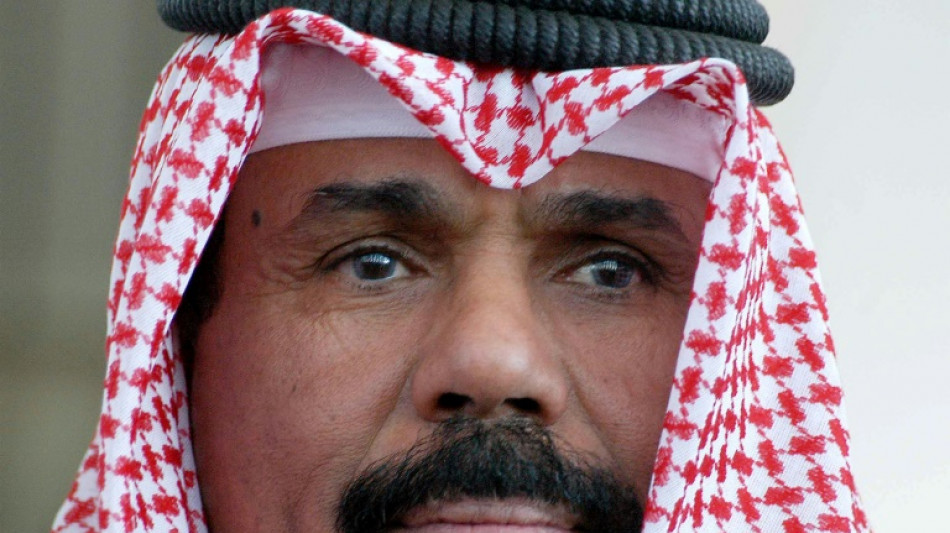
Kuwait's Sheikh Nawaf: a short but tumultuous reign / Photo: YASSER AL-ZAYYAT - AFP/File

 Liverpool boss Iraola urges Isak to raise his level
 Evenepoel wins record 4th straight world time-trial title

 France's Macron, Canada's Carney announce closer ties
 Carrick defends troubled Man Utd after Fulham escape

 Horror movie 'Resident Evil' tops N. American box office

 Germany's Merz vows to stay course despite new vote losses

 Man City outgun Sunderland despite Brobbey hat-trick, Man Utd rescue Fulham draw

 Mourinho blames ref committee for Real Madrid derby defeat

 Maresca craves a 1-0 win after eight-goal Man City thriller
 Atletico Madrid beat Real Madrid in tense derby clash
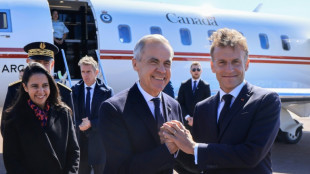
 Reusser retains world time-trial title

 Man City outgun Sunderland despite Brobbey hat-trick, Liverpool win at Bournemouth

 Top US, Chinese economic officials meet ahead of Trump-Xi summit
 Erdogan's LGBTQ crackdown 'first step of election campaign': activist
 Mass drone barrage on Moscow kills two

 82-year-old dies after beach fight in Greece over sun lounger

 US warns of rapid escalation in Mideast war

 Iran 'put hearts on the court' to win Asian Games basketball bronze

 School girl Yu helps China dominate in Asian Games swimming openers

 Myanmar win first Asian Games teqball gold as Spain great Puyol watches

 China's 13-year-old Yu scorches to first major gold at Asian Games

 Russians vote on last day of parliamentary elections

 Hong Kong pays final respects to former city leader Tung

 Typhoon put people off Asian Games opening ceremony, official says

 China's 13-year-old Yu cruises as Asian Games swimming begins

Sheikh Nawaf al-Ahmad Al-Sabah served as Kuwait's emir for just three years but spent decades in top posts through the House of Sabah's tumultuous rule of the oil-rich state.
Sheikh Nawaf, who died on Saturday aged 86, was defence minister when Iraq invaded in 1990, setting off a war that drew in armies from around the world to end the occupation.
He was interior minister when Kuwaiti security forces battled Islamist militants in January 2005.
Despite the episodes that have deeply marked Kuwait's history, Sheikh Nawaf's low-key style never saw him fall out of favour.
He was named crown prince in 2006 by his half-brother Sheikh Sabah al-Ahmad Al-Sabah and took over as emir when he died in September 2020 at the age of 91.
The current crown prince, Sheikh Mishal al-Ahmad al-Sabah, another half-brother, is 83 and much attention will now be focused on whether a younger ruler is brought in by the family.
Sheikh Nawaf showed a rare sign of public emotion when he was formally sworn in by the Gulf state's Gulf state's national assembly in 2020.
Born in 1937, Sheikh Nawaf was the fifth son of Kuwait's late ruler from 1921 to 1950 Sheikh Ahmad al-Jaber Al-Sabah.
He received secondary schooling in Kuwait but did not go on to higher education.
He started his political career at 25 as governor of Hawalli province, where he remained until 1978, before taking on the role of interior minister for a decade.
- Battered economy -
Sheikh Nawaf became defence minister two years before the start of the seven-month Iraqi occupation in 1991.
After the liberation by a US-led international force, he was named minister for social affairs and excluded from the government formed after the first post-war election in 1992.
Sheikh Nawaf returned as deputy commander of the national guard in 1994 and in 2003 became interior minister again.
This period was marked by a series of deadly clashes between Kuwaiti security forces and Islamic militants in January 2005.
On becoming emir, Sheikh Nawaf had to steer the economy through a crisis caused by a fall in oil prices that saw Kuwait's credit rating cut by international agencies in 2020.
He acknowledged the "serious" challenges in his inauguration speech and the government spent heavily -- doubling public debt in 18 months -- to guide the state through the Covid-19 pandemic.
He made few dramatic changes, however.
Kuwait has maintained its hardline stance on Israel even as Bahrain and the United Arab Emirates have established relations. It remains a diplomatic rarity in maintaining close relations with both Saudi Arabia and its regional rival Iran.
Mohammed al-Faily, an expert in constitutional law at Kuwait University, said Sheikh Nawaf was generally considered "a calm person who, when it calls for it, can take firm decisions".
The future for the royal family remains uncertain.
There are bitter divisions within the Sabah family, with lurid accusations of corruption and political conspiracies lodged by some members against rivals.
Kuwait's constitution stipulates only that the ruler should be a descendant of the nation's founder, Mubarak Al-Sabah. By tradition, the throne had alternated between the Salem and Jaber branches of the family.
But that pattern has been broken this decade, with Sheik Sabah, Sheikh Nawaf and the heir-apparent Sheikh Mishal all from the Jaber clan.
G.P.Martin--AT