Shaggy dog yarn: Study unravels history and demise of long-haired canine / Photo: Brittany M. Hance - AFP

 Liverpool boss Iraola urges Isak to raise his level

 Evenepoel wins record 4th straight world time-trial title

 France's Macron, Canada's Carney announce closer ties

 Carrick defends troubled Man Utd after Fulham escape

 Horror movie 'Resident Evil' tops N. American box office

 Germany's Merz vows to stay course despite new vote losses

 Man City outgun Sunderland despite Brobbey hat-trick, Man Utd rescue Fulham draw

 Mourinho blames ref committee for Real Madrid derby defeat

 Maresca craves a 1-0 win after eight-goal Man City thriller

 Atletico Madrid beat Real Madrid in tense derby clash

 Reusser retains world time-trial title

 Man City outgun Sunderland despite Brobbey hat-trick, Liverpool win at Bournemouth

 Top US, Chinese economic officials meet ahead of Trump-Xi summit

 Erdogan's LGBTQ crackdown 'first step of election campaign': activist

 Mass drone barrage on Moscow kills two

 82-year-old dies after beach fight in Greece over sun lounger

 US warns of rapid escalation in Mideast war

 Iran 'put hearts on the court' to win Asian Games basketball bronze

 School girl Yu helps China dominate in Asian Games swimming openers

 Myanmar win first Asian Games teqball gold as Spain great Puyol watches

 China's 13-year-old Yu scorches to first major gold at Asian Games

 Russians vote on last day of parliamentary elections

 Hong Kong pays final respects to former city leader Tung

 Typhoon put people off Asian Games opening ceremony, official says

 China's 13-year-old Yu cruises as Asian Games swimming begins

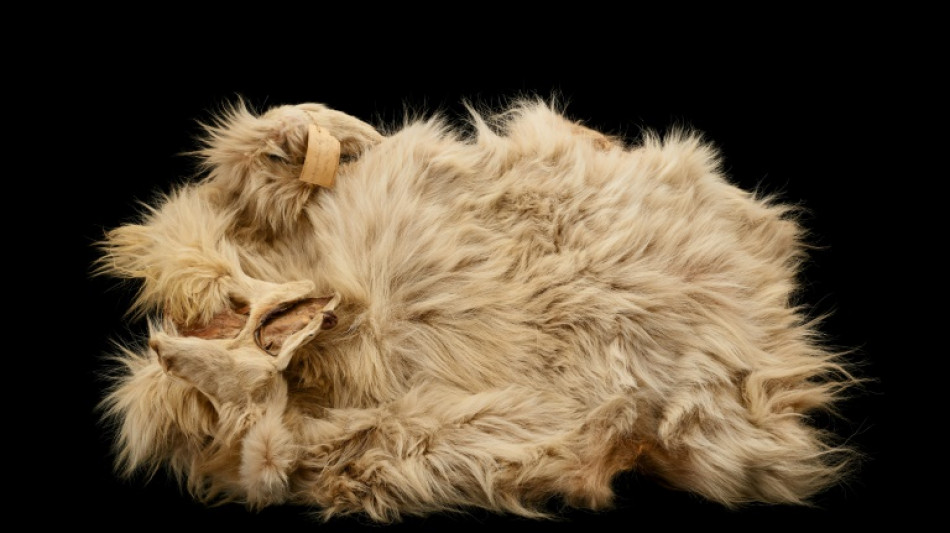
A little-known dog lineage with fur so thick it was spun into blankets was selectively bred for millennia by Native Americans of the Pacific Northwest until its rapid demise following European colonization, a study in Science showed Thursday.
The new research was based on a genetic analysis of "Mutton," one of the last surviving Coast Salish woolly dogs whose pelt was sent to the nascent Smithsonian Institution in 1859, only to be largely forgotten until the early 2000s.
Interviews contributed by Coast Salish tribal co-authors, meanwhile, revealed the dogs occupied a previously underappreciated high-status in Indigenous societies, which revered the animals as members of the family and adorned their most treasured items with their emblem.
The dogs' fleeces were shorn like sheep, with Coast Salish weavers using the wool to craft blankets and baskets that served ceremonial and spiritual purposes.
"I was always curious about why and how the pre-colonial indigenous dogs in the Americas had gone extinct after the arrival of the Europeans," lead author Audrey Lin, a molecular biologist currently at the American Museum of Natural History, told AFP.
Where and when dogs were first domesticated remains murky, but it's clear that some of the first people who settled in the Americas brought their canine companions with them from 15,000 years ago.
Within the span of a few centuries of Western settlers, however, these breeds were all but wiped out -- and modern American dogs contain exceedingly little genetic material of their lost cousins.
- Genetic analysis -
Lin first came across Mutton when she was working as a postdoctoral researcher at the Smithsonian, and was both surprised and excited to learn that virtually no work had been done on the genetics of woolly dogs, which disappeared around the turn of the 20th century.
Based on the genetic analysis, woolly dogs diverged from other lines up to 5,000 years ago, a date that lines up with archeological findings in the region.
"We found signatures of inbreeding depression, showing that... reproduction was very carefully maintained over a very long period of time," said Lin -- echoing Native accounts that dog husbandry occurred in isolated enclosures or on coastal islands.
Mutton's own genetics showed he was 85 percent pre-colonial despite living decades after the introduction of European breeds, reinforcing the idea Indigenous people maintained the lineage's purity until the dogs were wiped out.
By analyzing 11,000 genes in Mutton's genome, the team identified 28 with links to hair growth and follicle regeneration, finding similar markers in woolly mammoths, and in humans with rare congenital abnormalities.
While Mutton's DNA told the story of his lineage, examining chemical signatures of carbon and nitrogen also offered a snapshot of Mutton the individual over his short 1.5 year life.
This revealed Mutton the pup feasted on molasses and cornmeal, but that he later turned to a hunting diet as he traveled the Pacific Northwest under the care of ethnographer George Gibbs, who was part of an expedition to solve border issues between the United States and British Canada.
- Cultural genocide-
But the story would remain incomplete without context provided by Coast Salish Elders, Knowledge Keepers and Master Weavers, whose oral histories were long ignored if not outright dismissed by Western researchers.
The dominant narrative had been Indigenous communities simply lost interest in taking care of their dogs after the advent of manufactured textiles, but co-author Michael Pavel, a Tradition Bearer of the Skokomish Indian nation, said nothing could be further from the truth.
"What we learned about was that our people encountered a very adverse section of history characterized by colonization, genocide, and assimilation -- any and every aspect of our life that associated us with our traditional culture, ceremonies and history were eradicated."
Woolly dogs were raised solely by high-ranking women, a practice that immediately raised the hackles of colonial Christian missionaries.
Moreover the smallpox brought by Europeans wiped out in some cases 90 percent of Coast Salish village populations, leaving the survivors with few resources to care for their beloved animals.
A.Taylor--AT