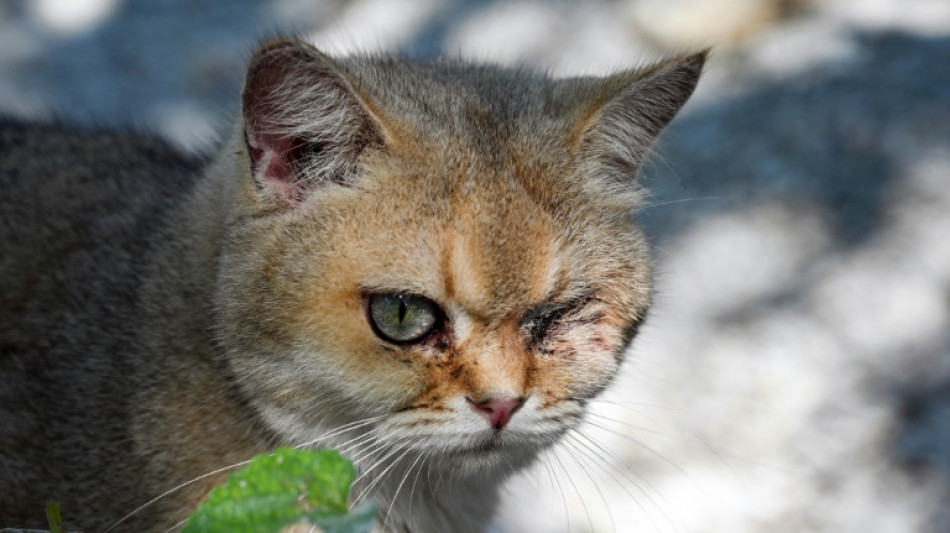
China's animal lovers fight illegal cat meat trade / Photo: Rita QIAN - AFP

 Germany's Merz vows to stay course despite new vote losses

 Man City outgun Sunderland despite Brobbey hat-trick, Man Utd rescue Fulham draw

 Mourinho blames ref committee for Real Madrid derby defeat

 Maresca craves a 1-0 win after eight-goal Man City thriller

 Atletico Madrid beat Real Madrid in tense derby clash

 Reusser retains world time-trial title

 Man City outgun Sunderland despite Brobbey hat-trick, Liverpool win at Bournemouth

 Top US, Chinese economic officials meet ahead of Trump-Xi summit

 Erdogan's LGBTQ crackdown 'first step of election campaign': activist

 Mass drone barrage on Moscow kills two

 82-year-old dies after beach fight in Greece over sun lounger

 US warns of rapid escalation in Mideast war

 Iran 'put hearts on the court' to win Asian Games basketball bronze

 School girl Yu helps China dominate in Asian Games swimming openers

 Myanmar win first Asian Games teqball gold as Spain great Puyol watches

 China's 13-year-old Yu scorches to first major gold at Asian Games

 Russians vote on last day of parliamentary elections

 Hong Kong pays final respects to former city leader Tung

 Typhoon put people off Asian Games opening ceremony, official says

 China's 13-year-old Yu cruises as Asian Games swimming begins

 AI 'warning shots' focus Beijing on national security risks

 Philippine tribe in limbo over US-led tech hub

 Leo XIV, first US pope transcends his restrained style

 Singer Ed Sheeran says Gaza situation 'unjustifiable' following controversy

 In 'Tenzing', a Sherpa mountaineer gets his due

When Han Jiali's beloved cat Dabai was taken from her Shanghai home last year, she embarked on a hunt for her pet that took her deep into the bowels of China's underground feline meat trade.
Most people in China do not eat cat meat, but an estimated four million furry friends are slaughtered for food each year in an illegal market that includes areas of Guangdong province, neighbouring Guangxi and beyond, according to Humane Society International.
Han, who has spent thousands of dollars and weeks at a time tracking cat meat traders through China, has uncovered a supply chain preying on urban strays and outdoor pets in the region surrounding Shanghai.
Her quest to find Dabai led her to grimy processing plants in Guangdong, where she saw skinned cat carcasses piled in crates and sacks of fur.
She found village restaurants that openly advertised cat meat and unscrupulous sellers who passed it off as mutton or rabbit.
"I had to admit then that my cat was gone," an emotional Han told AFP.
"She had been eaten."
Now she is determined to save other cats from the same fate and has spent the past year filing police reports, tracking down thieves and sending petitions to the Guangdong government.
It's a dangerous mission that she says has resulted in death threats from cat meat traders and an incident in December where a man deliberately drove into her car at a highway rest stop.
"I've gotten scared and thought about turning away and pretending I never saw all this," she said.
"But if I disappear, and stay silent, who will save (the cats) from this miserable situation?"
- Underground industry -
The 33-year-old Han is one of a small but dedicated number of people in China fighting the abuse of pet cats and dogs in the absence of broader institutional protections for domestic animals.
The capture of a free-roaming family pet outdoors is not considered theft in China.
And while the law prohibits the consumption of cats, violators are fined on food safety grounds rather than punished for animal cruelty.
Activists and even state media commentators have increasingly called for legislators to adopt an animal cruelty law to close a loophole not covered by existing wild animal and livestock rules.
"I'm just an ordinary person, my abilities are limited," Han said.
Last month, she and other animal rescuers, with the help of local police, intercepted a truck carrying hundreds of cats out of Zhangjiagang, near Shanghai.
"They were collecting (trapped) cats inside a cemetery," she told AFP.
"Observing them, we quickly learned that they planned to illegally sell the captured kitties."
Han said she and the other activists spent a sleepless night staking out the cemetery before a truck appeared in the morning to take away dozens of tiny bamboo crates crammed with around 800 cats.
Police and the animal rescuers stopped the truck, and the cats were rushed to a shelter in the town of Taicang, an hour away from Shanghai.
- Cat island -
There the animals were taken in by Mengtaiqi Cat and Dog Manor, a small family-run shelter in a marshy area popular with anglers.
Gu Ming, a 45-year-old former pharmaceutical industry professional who lives at the shelter with his wife, told AFP that many of the cats rescued in Zhangjiagang had their limbs crushed under the weight of hundreds of animals.
Dozens have died so far from injuries and viral infections that spread rapidly among the closely packed, distressed animals, he said.
Volunteers at the shelter isolated sick animals in makeshift quarantine cages and called in vets to vaccinate and sterilize the healthier cats.
Eventually, after weeks of treatment and isolation, a first batch of rescues was moved to a large outdoor enclosure with trees and rows of blanket-lined beds.
Gu covers the shelter's expenses out of his own pocket and only accepts non-cash donations such as equipment and kibble, seeking to avoid the public distrust that fundraisers often attract in China.
He plans to move all the cats onto a small island near a local temple, which is currently dotted with tiny huts and home to a few dozen felines previously rescued by the shelter.
The island's four-legged residents flocked to greet Gu this month as he crossed the gated bridge that keeps the cats in.
At midday, the animals lolled on the grass and napped under trees -- an idyllic existence a far cry from the cramped meat truck crates.
Gu said he was moved by the many animal lovers who had offered help after seeing state media reports about the Zhangjiagang cats.
But still, he said: "We have to push for national legislation, because depending on individuals or a few groups is not realistic".
E.Flores--AT