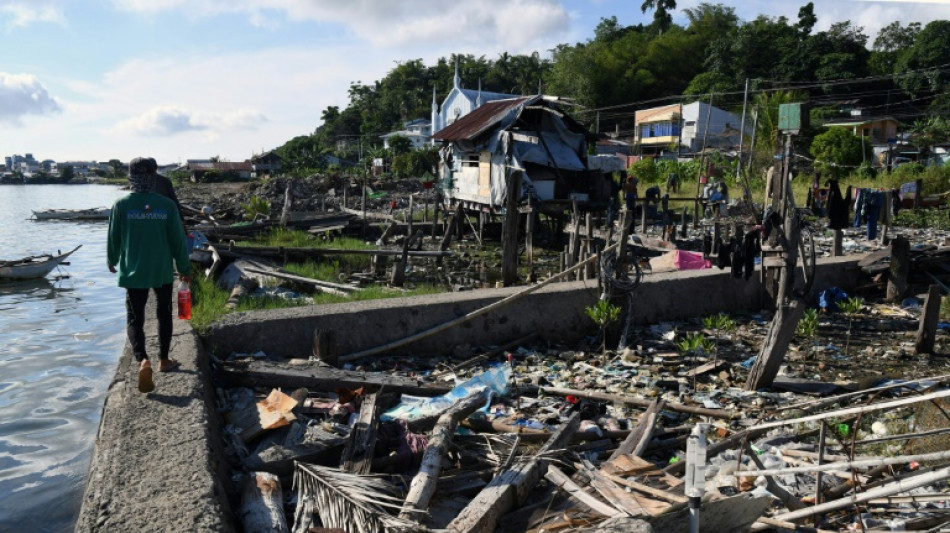
10 years after typhoon, Philippine city rises from the ruins / Photo: Ted ALJIBE - AFP

 Germany's Merz vows to stay course despite new vote losses

 Man City outgun Sunderland despite Brobbey hat-trick, Man Utd rescue Fulham draw

 Mourinho blames ref committee for Real Madrid derby defeat

 Maresca craves a 1-0 win after eight-goal Man City thriller

 Atletico Madrid beat Real Madrid in tense derby clash

 Reusser retains world time-trial title

 Man City outgun Sunderland despite Brobbey hat-trick, Liverpool win at Bournemouth

 Top US, Chinese economic officials meet ahead of Trump-Xi summit
 Erdogan's LGBTQ crackdown 'first step of election campaign': activist

 Mass drone barrage on Moscow kills two

 82-year-old dies after beach fight in Greece over sun lounger

 US warns of rapid escalation in Mideast war

 Iran 'put hearts on the court' to win Asian Games basketball bronze

 School girl Yu helps China dominate in Asian Games swimming openers

 Myanmar win first Asian Games teqball gold as Spain great Puyol watches

 China's 13-year-old Yu scorches to first major gold at Asian Games

 Russians vote on last day of parliamentary elections

 Hong Kong pays final respects to former city leader Tung

 Typhoon put people off Asian Games opening ceremony, official says

 China's 13-year-old Yu cruises as Asian Games swimming begins

 AI 'warning shots' focus Beijing on national security risks

 Philippine tribe in limbo over US-led tech hub

 Leo XIV, first US pope transcends his restrained style

 Singer Ed Sheeran says Gaza situation 'unjustifiable' following controversy

 In 'Tenzing', a Sherpa mountaineer gets his due

Filipino widow Agatha Ando has learned to laugh again in the decade after Super Typhoon Haiyan smashed into the central Philippines, killing more than 6,000 people and leaving millions homeless.
Fierce winds tore apart houses and toppled trees as tsunami-like waves whipped up by the storm obliterated mostly poor coastal communities on November 8, 2013.
Ando's husband and three of her siblings refused to leave their homes in Tacloban City that were less than 100 metres (109 yards) from the sea and died along with four children when water and debris crashed over them.
In the aftermath, their mangled bodies were hastily wrapped in wet blankets and a scavenged tarpaulin, and buried a few metres from where Ando's house now stands.
"I am now able to laugh again, but I will never forget them," said Ando, 57, who survived because she heeded official warnings to go inland before the storm hit.
Ten years on, the family's mass grave is one of the few visible reminders of the devastation in Tacloban, the capital of Leyte province.
Tacloban bore the brunt of Haiyan's fury and had to be rebuilt almost from scratch.
Now, it looks like any other Filipino city, with traffic-clogged streets and bustling restaurants.
An 18-kilometre (11-mile) seawall has been built along the coast to protect it against future storm surges.
"I think we have fully recovered," Mayor Alfred Romualdez told AFP during a recent visit to the city of around 280,000 people.
As the Philippines prepares to commemorate the 10th anniversary of Haiyan, Romualdez said survivors had "moved on" from the disaster.
"But I don't think they'll ever forget," he said.
- 'A lot of lessons learned' -
Scientists have long warned that storms are becoming more powerful as the world becomes warmer because of human-driven climate change.
The Philippines, which typically endures more than 20 major storms a year, has plenty of experience dealing with disasters.
But that did not prepare the country for one of the strongest typhoons on record.
Haiyan unleashed winds of up to 315 kilometres (195 miles) an hour that flattened towns and cities across a 600-kilometre (370-mile) stretch of central islands.
Coastal houses and buildings thought safe enough to be used as evacuation centres on Leyte and Samar islands were swamped by storm surges up to five metres high.
About 6,300 people were killed and a decade later more than a thousand are still missing.
Over four million people were left homeless.
"I feel in terms of the national government, in terms of the local government, there were a lot of lessons learned," said Romualdez.
"But I would say that there are still many, many more lessons we still have to learn and we have to institutionalise."
Since Haiyan, the country has invested in early warning systems, mass text messaging technology and public apps to identify potential dangerous areas, disaster and weather officials told AFP.
Hazard maps used by government agencies are also updated regularly, weather alerts are issued earlier and in local languages, and pre-emptive evacuations are standard practice.
"The mindset has changed," said Edgar Posadas, a director at the Office of Civil Defense in Manila.
Posadas said local governments now used their own funds, food packs and rescue personnel instead of relying on the national government, enabling them to respond to disasters more quickly.
The changes have been credited for lowering death tolls since Haiyan.
In December 2021, Super Typhoon Rai damaged or destroyed nearly twice as many houses as Haiyan, but the death toll was less than 500, UN and government data show.
"Experience really is the best teacher," weather services chief Juanito Galang said.
- Prayers for victims -
Many of the people killed in Tacloban were living near the sea in flimsy shacks made of wood and corrugated iron sheets.
The government has since demolished many of the slum areas and moved around 14,000 families to relocation sites out of reach of storm surges.
While the concrete houses are safer than the shanties, some of the sites still lack running water.
Rosie Boaquena, 63, moved to one 13 kilometres (8 miles) from downtown Tacloban, but two of her sons chose to stay in a one-room shack by the sea to be closer to their jobs.
"One of my sons sells fish so he would need to leave (the relocation site) at midnight to pick up the fish, but there is no night-time public transport," she said.
Ando was also allocated a house in a hilly development, but she hasn't spent a single night there.
Instead, she rebuilt her house on the same plot of land near the sea where she has lived all her life and has many memories.
On Wednesday, Ando will mark the anniversary of Haiyan like she does every year, gathering family and neighbours near the mass grave to pray.
Six of her relatives are still missing, presumed dead, and one of her sons was left permanently disabled from the storm.
"We didn't know what a storm surge was back then," she said.
"Now, whenever there's a typhoon, we immediately evacuate."
M.White--AT