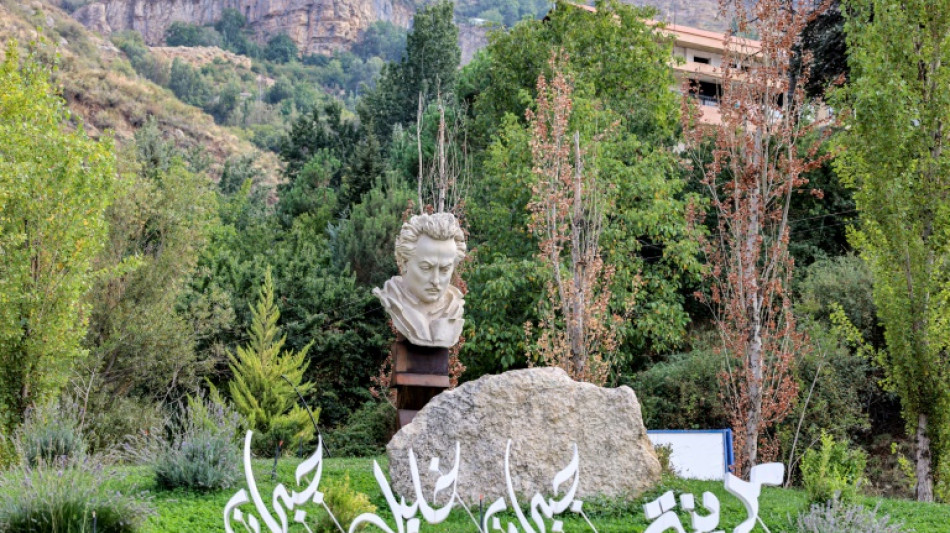
Kahlil Gibran's Lebanon hometown celebrates 'The Prophet' centennial / Photo: JOSEPH EID - AFP

 Germany's Merz vows to stay course despite new vote losses

 Man City outgun Sunderland despite Brobbey hat-trick, Man Utd rescue Fulham draw

 Mourinho blames ref committee for Real Madrid derby defeat

 Maresca craves a 1-0 win after eight-goal Man City thriller

 Atletico Madrid beat Real Madrid in tense derby clash
 Reusser retains world time-trial title

 Man City outgun Sunderland despite Brobbey hat-trick, Liverpool win at Bournemouth

 Top US, Chinese economic officials meet ahead of Trump-Xi summit

 Erdogan's LGBTQ crackdown 'first step of election campaign': activist

 Mass drone barrage on Moscow kills two

 82-year-old dies after beach fight in Greece over sun lounger

 US warns of rapid escalation in Mideast war

 Iran 'put hearts on the court' to win Asian Games basketball bronze

 School girl Yu helps China dominate in Asian Games swimming openers

 Myanmar win first Asian Games teqball gold as Spain great Puyol watches

 China's 13-year-old Yu scorches to first major gold at Asian Games

 Russians vote on last day of parliamentary elections

 Hong Kong pays final respects to former city leader Tung

 Typhoon put people off Asian Games opening ceremony, official says

 China's 13-year-old Yu cruises as Asian Games swimming begins

 AI 'warning shots' focus Beijing on national security risks

 Philippine tribe in limbo over US-led tech hub

 Leo XIV, first US pope transcends his restrained style

 Singer Ed Sheeran says Gaza situation 'unjustifiable' following controversy

 In 'Tenzing', a Sherpa mountaineer gets his due

Nestled in the mountains of northern Lebanon, a museum dedicated to Kahlil Gibran in his hometown of Bsharre has been celebrating the centennial of "The Prophet", the renowned author's most famous work.
Since it was first published in the United States in 1923, millions of copies of "The Prophet" have been sold worldwide, with the book becoming a literary classic that has been translated into dozens of languages from the original English.
"Every reader, no matter where they're from, feels that this book relates to them and moves them deeply... whether they are Christian, Muslim, Jewish" or atheist, said museum director Joseph Geagea.
It "touches the spirituality of each individual, dealing with death, life, friendship, love, children" and other topics, he added.
A collection of poetic prose, "The Prophet" tells the story of Almustafa, who before returning to his homeland, speaks to residents of the city of Orphalese about various aspects of life.
Divided into 26 chapters, verses from "The Prophet" are often quoted at births, weddings and funerals around the world.
"Biblical style is pervasive" in "The Prophet", Lebanese author Alexandre Najjar said during a recent reading in Beirut, also noting the influence of Islam's mystic Sufi tradition.
"The Prophet" captured the hearts of students and hippies in the 1960s, Najjar said, including for the passage: "Your children are not your children... they come through you but not from you."
Elvis Presley "loved the book so much that he used to give it to his friends on their birthday", he added.
Other celebrities and leaders, from John Lennon to Japan's former Empress Michiko and late Indian prime minister Indira Gandhi, were also fond of the book, the museum's Geagea said.
- 'Deeply spiritual vision' -
Gibran was born in Bsharre in 1883, when Lebanon was under Ottoman rule, but wrote most of his books in the United States, where he headed the New York Pen League, the first Arab-American literary society.
Overlooking Lebanon's Qadisha Valley, the museum was set up in a former 18th century monastery and exhibits some 150 paintings by the author that show "his deeply spiritual vision of existence", Geagea said.
A table displays 11 translations of "The Prophet" released between 1923 and 1931.
"Gibran strongly wished to return to Bsharre, which he left at age 12," said Geagea, but the writer died before he could get the chance.
The monks decided to sell the monastery and the surrounding land to Gibran's sister after the author's death in 1931, when he was just 48.
The site was transformed into his burial place and then into a museum for his artworks and other objects, and receives around 50,000 visitors a year from five continents, Geagea said.
Despite his popularity among readers, Gibran's most famous work received a lukewarm reception at the time of writing from American critics, who criticised it as simplistic and moralising.
In April this year, an exhibition at the United Nations headquarters in New York also marked the work's centenary.
B.Torres--AT