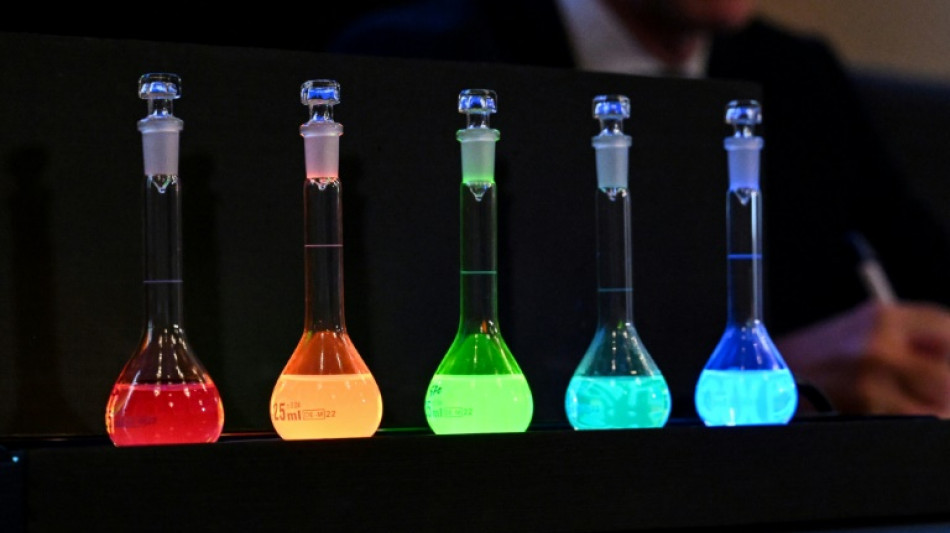
Quantum dots: the tiny 'rainbow' crystals behind chemistry Nobel / Photo: Jonathan NACKSTRAND - AFP

 Germany's Merz vows to stay course despite new vote losses

 Man City outgun Sunderland despite Brobbey hat-trick, Man Utd rescue Fulham draw

 Mourinho blames ref committee for Real Madrid derby defeat

 Maresca craves a 1-0 win after eight-goal Man City thriller

 Atletico Madrid beat Real Madrid in tense derby clash

 Reusser retains world time-trial title

 Man City outgun Sunderland despite Brobbey hat-trick, Liverpool win at Bournemouth

 Top US, Chinese economic officials meet ahead of Trump-Xi summit

 Erdogan's LGBTQ crackdown 'first step of election campaign': activist
 Mass drone barrage on Moscow kills two

 82-year-old dies after beach fight in Greece over sun lounger

 US warns of rapid escalation in Mideast war

 Iran 'put hearts on the court' to win Asian Games basketball bronze

 School girl Yu helps China dominate in Asian Games swimming openers

 Myanmar win first Asian Games teqball gold as Spain great Puyol watches

 China's 13-year-old Yu scorches to first major gold at Asian Games

 Russians vote on last day of parliamentary elections

 Hong Kong pays final respects to former city leader Tung

 Typhoon put people off Asian Games opening ceremony, official says

 China's 13-year-old Yu cruises as Asian Games swimming begins

 AI 'warning shots' focus Beijing on national security risks

 Philippine tribe in limbo over US-led tech hub

 Leo XIV, first US pope transcends his restrained style

 Singer Ed Sheeran says Gaza situation 'unjustifiable' following controversy

 In 'Tenzing', a Sherpa mountaineer gets his due

Quantum dots are tiny crystals that scientists can tune to different colours, giving an extra-vivid pop to next-generation TV screens or illuminating tumours inside bodies so surgeons can hunt them down.
Three scientists won the Nobel Chemistry Prize on Wednesday for their work turning an idea first theorised in the 1930s into a reality that now has pride of place in living rooms across the world.
- What are they? -
Quantum dots are semiconducting particles just one thousandth the width of a human hair.
In 1937, the physicist Herbert Froehlich predicted that once particles were small enough -- so-called nanoparticles -- they would come under the strange spell of quantum mechanics.
To explain this quantum phenomenon, American Chemical Society president Judith Giordan said to "think of it like a little box".
When a particle is shrunk down small enough, the electron is "going to whack into the sides of the box," she told AFP.
In a larger box, the electrons would whack the sides less often, meaning they have less energy.
For quantum dots, the larger boxes emit red light, while the smaller ones show up blue.
This means that by controlling the size of the particle, scientists can make their crystals red, blue and everything in between.
Leah Frenette, an expert on quantum dots at Imperial College London, told AFP that working with the nanomaterial was like "watching rainbows all day".
But it would be 40 years after Froehlich's prediction that anyone was able to actually observe this phenomenon.
- Who discovered what? -
In the early 1980s, Russian-born physicist Alexei Ekimov -- one of Wednesday's new laureates -- melted coloured glass and X-rayed the results.
He noticed that the smaller particles were more blue, also recognising that this was a quantum effect.
But being glass, the material was not easy to manipulate -- and being published in a Soviet scientific journal meant few noticed.
At around the same time in the United States, another new laureate Louis Brus -- oblivious of Ekimov's work -- became the first to discover this colourful quantum effect in a liquid solution.
"For a long time, nobody thought you could ever actually make such small particles, yet this year's laureates succeeded," Nobel Committee member Johan Aqvist said.
"However, for quantum dots to become really useful, you needed to be able to make them in solution with exquisite control of their size and surface."
The third new Nobel winner, French-born Moungi Bawendi, found a way to do just this in his lab at the Massachusetts Institute of Technology in 1993.
By precisely controlling the temperature of a liquid mixture of particles called colloid, Bawendi was able to grow nanocrystals to the exact size he wanted, paving the way for mass production.
- What are they used in? -
The most common everyday use of quantum dots is probably in "QLED" televisions.
Cyril Aymonier, head of France's Institute of Condensed Matter Chemistry, told AFP that the nanocrystals "improve the resolution of the screen and preserve the quality of the colour for longer".
Doctors also use their bright fluorescence to highlight organs or tumours in the bodies of patients.
Frenette said she is working on diagnostic tests which would use the dots as "little beacons" for diseases in medical samples.
One problem is that most quantum dots are made using cadmium, a toxic heavy metal.
Both Aymonier and Frenette said they are working on quantum dots that are not toxic.
- Future use? -
In the future, quantum dots could have the potential to double the efficiency of solar cells, Giordan said.
Their strange quantum powers could produce twice as many electrons as existing technology, she explained.
"That's amazing, because we are coming closer to the limit of current solar materials," she added.
- Past use? -
The reds and yellows in stained glass windows as far as back as the 10th century show that artists of the time unwittingly took advantages of techniques that resulted in quantum dots, according to scientists.
W.Nelson--AT