RNA recovered from extinct animal in world first / Photo: Jonathan NACKSTRAND - AFP

 Germany's Merz vows to stay course despite new vote losses

 Man City outgun Sunderland despite Brobbey hat-trick, Man Utd rescue Fulham draw

 Mourinho blames ref committee for Real Madrid derby defeat

 Maresca craves a 1-0 win after eight-goal Man City thriller

 Atletico Madrid beat Real Madrid in tense derby clash

 Reusser retains world time-trial title

 Man City outgun Sunderland despite Brobbey hat-trick, Liverpool win at Bournemouth

 Top US, Chinese economic officials meet ahead of Trump-Xi summit

 Erdogan's LGBTQ crackdown 'first step of election campaign': activist

 Mass drone barrage on Moscow kills two

 82-year-old dies after beach fight in Greece over sun lounger

 US warns of rapid escalation in Mideast war

 Iran 'put hearts on the court' to win Asian Games basketball bronze

 School girl Yu helps China dominate in Asian Games swimming openers

 Myanmar win first Asian Games teqball gold as Spain great Puyol watches

 China's 13-year-old Yu scorches to first major gold at Asian Games

 Russians vote on last day of parliamentary elections

 Hong Kong pays final respects to former city leader Tung

 Typhoon put people off Asian Games opening ceremony, official says

 China's 13-year-old Yu cruises as Asian Games swimming begins

 AI 'warning shots' focus Beijing on national security risks

 Philippine tribe in limbo over US-led tech hub

 Leo XIV, first US pope transcends his restrained style

 Singer Ed Sheeran says Gaza situation 'unjustifiable' following controversy

 In 'Tenzing', a Sherpa mountaineer gets his due

Scientists have for the first time recovered RNA from an extinct species, the Tasmanian tiger, raising hope for the resurrection of animals once thought lost forever, Stockholm University researchers told AFP.
"RNA has never been extracted and sequenced from an extinct species before," said Love Dalen, a Stockholm University professor of evolutionary genomics who co-led the project.
"The ability to recover RNA from extinct species constitutes a small step (toward) maybe being able to resurrect extinct species in the future," he said.
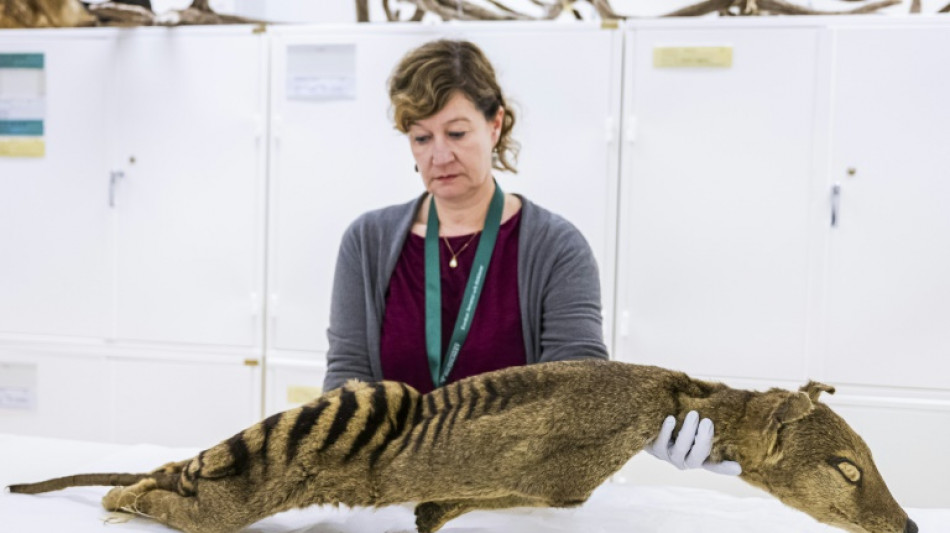
Dalen and his team were able to sequence RNA molecules from a 130-year-old Tasmanian tiger specimen preserved at room temperature in Sweden's Museum of Natural History.
With this they were able to reconstruct skin and skeletal muscle RNA.
RNA is a molecule that is used to convey information from the genome to the rest of the cell about what it should do.
"If you're going to resurrect an extinct animal, then you need to know where the genes are and what they do, and in what tissues they are regulated," Dalen said, explaining the need for knowledge about both DNA and RNA.
The last known living Tasmanian tiger or thylacine, a carnivorous marsupial, died in captivity in 1936 at the Beaumaris Zoo in Tasmania.
After European colonisation of Australia, the animal was declared a pest and in 1888 a bounty was offered for each full-grown animal killed.
Scientists have focused their de-extinction efforts on the Tasmanian tiger as its natural habitat in Tasmania is largely preserved.
- 'Exciting idea' -
Daniela Kalthoff, in charge of the mammal collection at the Museum of Natural History, said the idea of possibly resurrecting the Tasmanian tiger was an "exciting idea".
"This is a fantastic animal and I would love to see it live again," she said, demonstrating the black-and-brown striped skin the researchers used in their study.
Their findings also have implications for studying pandemic RNA viruses.
"Many of the pandemics that have happened in the past have been caused by RNA viruses, most recently the coronavirus but also ... the Spanish flu," Dalen explained.
"We could actually go and look for these viruses in wild animal remains stored in dry museum collections. That might actually help us understand the nature of pandemics and where pandemics come from," he said.
The study opens the door to using museum collections in this new way.
"There are millions and millions of dried skins and dried tissue from insects, mammals and birds and so on in museum collections around the world, and one could actually now go and recover RNA from all these specimens," Dalen said.
O.Ortiz--AT