Dozens of whales die in New Zealand mass stranding

 Martin wins Austrian MotoGP sprint after Acosta crash

 Japan edge Fiji to win Pacific Nations Cup

 Black smoke, flames rising near Riyadh airport: residents to AFP

 UK actor Naomi Watts honoured at Spain film festival

 Japan emperor declares Asian Games open after turbulent build-up

 Asian Games open with unity message after troubled build-up
 Denmark hails 'binding' Greenland deal with Trump
 We don't want Games host Japan losing money, says Asian Olympic official

 Ed Sheeran returns to stage after Palestinian controversy

 Asian Games to open in Japan after troubled build-up

 Drone owners rush to offload devices ahead of Beijing ban

 Trump's beef policies irk Texas ranchers, testing their loyalty

 Kennedy Center: future unclear for iconic Washington arts hub

 Trump claims 'infinite' Greenland security deal with Denmark

 Helicopters battle wildfire threatening Ecuador's capital

 Brentford batter Chelsea to undo Alonso's promising start

 Kane hits Bundesliga century as Bayern rout Union

 Trump says CNN, MS NOW, Politico banned from White House

 Hushing and hedging: US companies retreat on climate

 Springboks to face Fiji before 2027 Rugby World Cup

 Nigeria miners struggled to breathe in cell before 37 died: survivors

 McIlroy on the charge at PGA Championship as Reed withdraws

 McIlroy on the charge at PGA Championship

 Crisis-wracked Volkswagen warns of 10-bn-euro hit to profits

 Costa Rica's Grynspan tops third informal poll for UN chief: diplomat

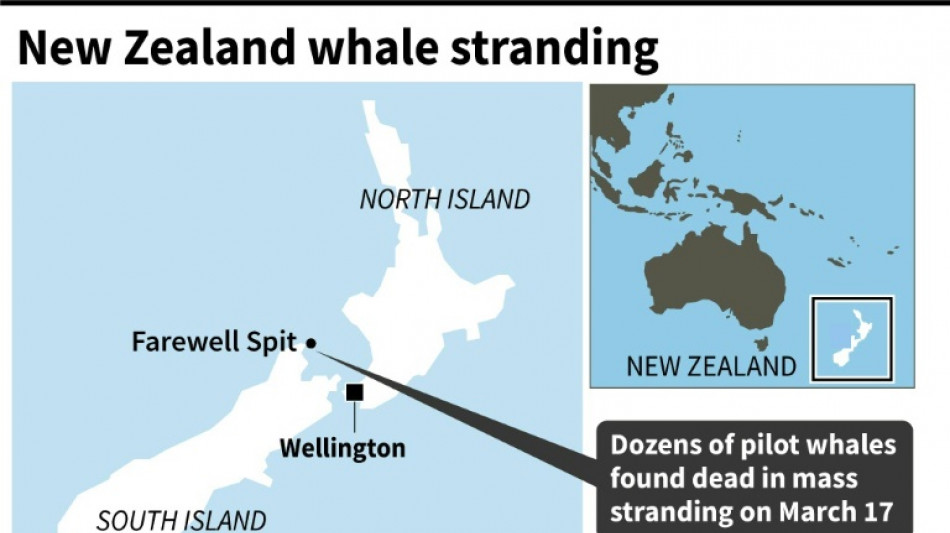
More than two dozen whales died in a mass stranding at a New Zealand beach renowned as a death trap for the ocean giants, wildlife rangers said Friday.
The Department of Conservation said 29 long-finned pilot whales were already dead when the pod of 34 marine mammals was found at remote Farewell Spit on the South Island late Thursday.
Department spokesman Dave Winterburn said rangers were providing care for five survivors but noted "the whales have now been out of the water for some time".
"While this event is unfortunate, whale strandings are a natural phenomenon," he said.
"The cause of this stranding is not known."
Farewell Spit, a 26-kilometre (16 mile) hook of sand that protrudes into the sea, has been the scene of more than 10 pilot whale strandings in the past 15 years.
The largest was in February 2017, when almost 700 of the mammals beached, resulting in 250 deaths.
Scientists are unclear about why the beach is so deadly. One theory is that the spit creates a shallow seabed in the bay that interferes with the whales' sonar navigation systems.
Pilot whales, the most common species of whale in New Zealand waters, are particularly susceptible to mass strandings.
The whales, which grow up to six metres (20 feet) long, are regularly found beached in large numbers.
Th.Gonzalez--AT