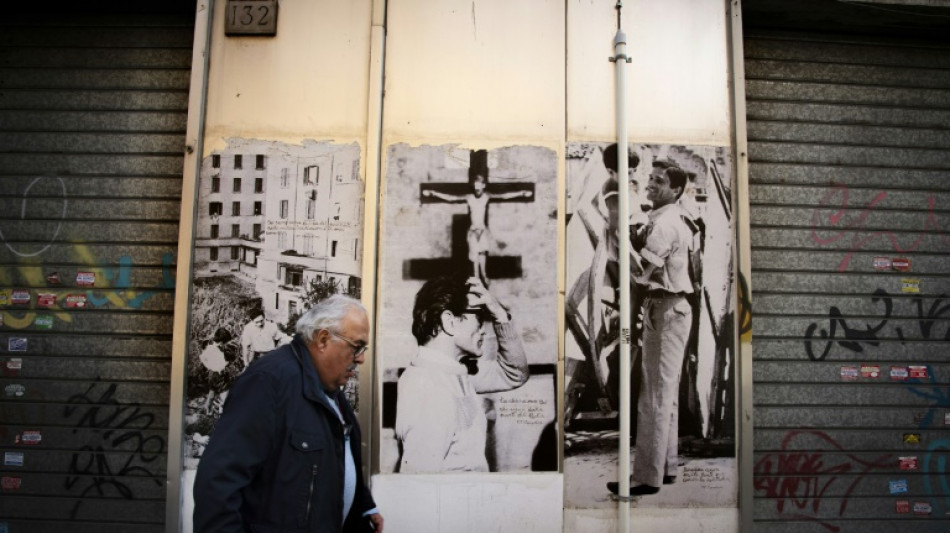
Who killed Pasolini? Italy still questions century after birth

 Martin wins Austrian MotoGP sprint after Acosta crash

 Japan edge Fiji to win Pacific Nations Cup

 Black smoke, flames rising near Riyadh airport: residents to AFP

 UK actor Naomi Watts honoured at Spain film festival

 Japan emperor declares Asian Games open after turbulent build-up

 Asian Games open with unity message after troubled build-up
 Denmark hails 'binding' Greenland deal with Trump
 We don't want Games host Japan losing money, says Asian Olympic official
 Ed Sheeran returns to stage after Palestinian controversy
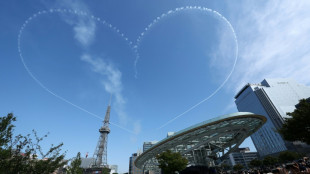 Asian Games to open in Japan after troubled build-up
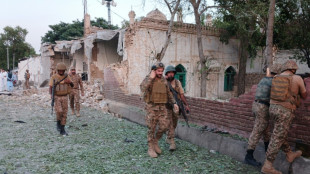
 Drone owners rush to offload devices ahead of Beijing ban
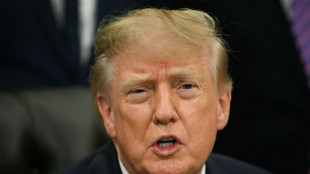
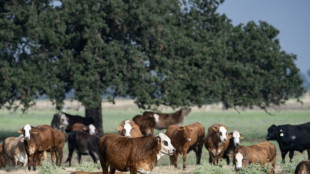 Trump's beef policies irk Texas ranchers, testing their loyalty

 Kennedy Center: future unclear for iconic Washington arts hub

 Trump claims 'infinite' Greenland security deal with Denmark

 Helicopters battle wildfire threatening Ecuador's capital

 Brentford batter Chelsea to undo Alonso's promising start
 Kane hits Bundesliga century as Bayern rout Union
 Trump says CNN, MS NOW, Politico banned from White House
 Hushing and hedging: US companies retreat on climate

 Springboks to face Fiji before 2027 Rugby World Cup
 Nigeria miners struggled to breathe in cell before 37 died: survivors

 McIlroy on the charge at PGA Championship as Reed withdraws
 McIlroy on the charge at PGA Championship

 Crisis-wracked Volkswagen warns of 10-bn-euro hit to profits
 Costa Rica's Grynspan tops third informal poll for UN chief: diplomat

Provocative Italian filmmaker and poet Pier Paolo Pasolini had no shortage of enemies, but half a century after his brutal murder on a beach, his death remains a mystery.
Italy marks the 100th anniversary on March 5 of the birth of one of its leading left-wing intellectuals, while a retrospective of his estimated two dozen movies is planned in Los Angeles.
But the most crucial questions that have gripped Italy since his mangled body was found on a beach of Ostia outside Rome on November 2, 1975 -- who ordered his killing and why -- remain unanswered.
Pasolini was only 53 when he died, beaten with fists and sticks, then run over by an Alfa Romeo GT, either his own or someone else's.
A 17-year-old male prostitute, Giuseppe "Pino" Pelosi, was stopped while running away from the filmmaker's car and admitted killing him, saying Pasolini tried to rape him.
Pelosi was jailed for nearly 10 years, but in 2005 he recanted on his confession, instead blaming three unnamed men with Sicilian accents.
The investigation was reopened in 2010, based on DNA found on Pasolini's clothes, but only one sample could be identified -- Pelosi's.
In the years since Pasolini died, theories have swirled about why the artist was killed, ranging from blackmail to a hit by the far-right or mafia.
Pasolini lived his life unafraid of controversy as he took aim at bourgeois values, Catholic censorship and the threat of neo-fascism, while exposing the hardships of life through an often unbearably grim lens.
He was "an uncomfortable person for those in power", his childhood friend, Silvio Parello, told AFP at his Rome workshop that has become a shrine to the filmmaker.
- Right to scandalise -
Through his essays, poems, plays and films, Pasolini highlighted the downsides of Italy's post-war "economic miracle", which brought modernity but also shanty towns and growing regional inequality.
"All his life he sought out an archaic, pre-industrial, pre-globalised peasant world, which he saw as innocent," another friend, Italian writer Dacia Maraini, told AFP.
Pasolini was already known in Italy for his poetry when he began in film. His last movie, "Salo or the 120 Days of Sodom", was released after his death.
The films range from gritty realism to loose adaptations full of symbolism -- "Salo" was based on the work by the Marquis de Sade -- while his novels reveal a fascination with small-time hooligans from the Rome suburbs.
"To scandalise is a right. To be scandalised is a pleasure," he said in his last television interview, in Paris, on October 31, 1975.
But not everybody appreciated what he was trying to do.
Shortly before his death, the filmmaker received threats over "Salo", a critique of Fascist Italy that caused outrage because of its graphic depiction of violence and sexual abuse.
Some believe Pasolini's murder was linked to his investigations into the suspicious death of Enrico Mattei, the boss of energy giant Eni, in a 1962 plane crash likely caused by a bomb.
- Political crime -
For criminologist Simona Zecchi, author of two books on Pasolini, the writer was killed for his journalism at a time when Italy was in the throes of violence between far-left and far-right groups, known as the "Years of Lead".
In 1974, Pasolini -- who was close to Italy's Communist party -- published an inflammatory article about the December 1969 Piazza Fontana attack in Milan, which left 17 people dead and more than 80 injured.
It was first blamed on anarchists, then members of a neo-fascist group. Pasolini claimed he knew who was responsible, but said he had no proof. No one was ever convicted.
There is also speculation blackmail played a role in his death, as weeks before, reels of "Salo" had been stolen in Rome. But investigators later ruled out the theory.
Zecchi believes there was never any will to find out what really happened.
"Italy has a problem with the truth, because this truth has often passed through the dark side of our institutions," she said.
Pasolini's French biographer, Rene de Ceccatty, said solving the murder is complicated by the "several layers" of individual actors likely involved.
"From the moment you accept it was a political crime, it's not surprising that there is so much fog around it."
H.Romero--AT