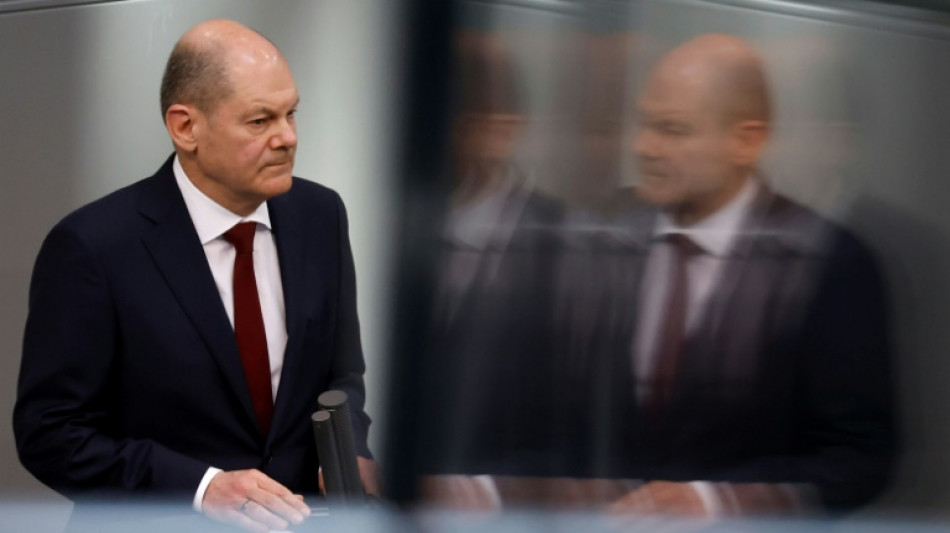
Boring to 'historic': the awakening of Germany's Olaf Scholz

 Martin wins Austrian MotoGP sprint after Acosta crash

 Japan edge Fiji to win Pacific Nations Cup

 Black smoke, flames rising near Riyadh airport: residents to AFP

 UK actor Naomi Watts honoured at Spain film festival

 Japan emperor declares Asian Games open after turbulent build-up

 Asian Games open with unity message after troubled build-up

 Denmark hails 'binding' Greenland deal with Trump

 We don't want Games host Japan losing money, says Asian Olympic official

 Ed Sheeran returns to stage after Palestinian controversy

 Asian Games to open in Japan after troubled build-up

 Drone owners rush to offload devices ahead of Beijing ban

 Trump's beef policies irk Texas ranchers, testing their loyalty
 Kennedy Center: future unclear for iconic Washington arts hub

 Trump claims 'infinite' Greenland security deal with Denmark

 Helicopters battle wildfire threatening Ecuador's capital
 Brentford batter Chelsea to undo Alonso's promising start
 Kane hits Bundesliga century as Bayern rout Union
 Trump says CNN, MS NOW, Politico banned from White House
 Hushing and hedging: US companies retreat on climate
 Springboks to face Fiji before 2027 Rugby World Cup
 Nigeria miners struggled to breathe in cell before 37 died: survivors
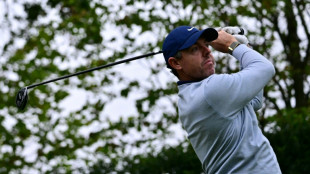 McIlroy on the charge at PGA Championship as Reed withdraws
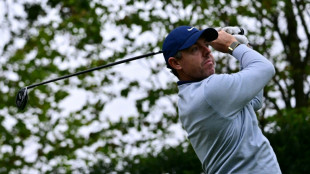 McIlroy on the charge at PGA Championship
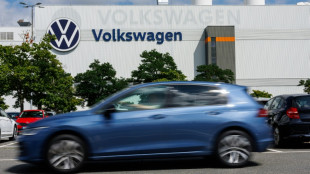 Crisis-wracked Volkswagen warns of 10-bn-euro hit to profits
 Costa Rica's Grynspan tops third informal poll for UN chief: diplomat
Often described as predictable and "robotic", Chancellor Olaf Scholz has become emboldened since Russia's invasion of Ukraine, smashing policy taboos to steer Germany into "a new era" that could reshape its role on the world stage.
Just a few weeks ago, German media were openly asking "where is Scholz?", slamming the Social Democrat's perceived lack of leadership on pressing issues like the coronavirus pandemic and worsening Ukraine crisis.
But Moscow's attack on Ukraine last week has jolted the chancellor into action, culminating in what commentators have called a "historic" speech on Sunday.
Scholz, who has only been in office three months, spoke with uncharacteristic clarity when he unveiled a slew of defence and foreign policy shifts that promise to upend Germany's decades-long reluctance to raising its military profile.
"The Ukraine crisis has changed the chancellor. And now he's changing our country," the top-selling Bild daily wrote.
Addressing an emergency parliamentary session, Scholz told the nation that "we are now in a new era".
In a country haunted by post-war guilt, Scholz assured Germans that they were "on the right side of history" as Ukraine's allies.
Among the headline-grabbing announcements was a pledge to earmark 100 billion euros ($113 billion) this year alone to modernise the chronically underfunded the army, called the Bundeswehr.
Scholz also said that Europe's biggest economy would commit to spending more than two percent of Germany's gross domestic product on defence annually, surpassing even NATO's target.
His coalition government had earlier already reversed a ban on sending weapons to Ukraine, and halted the Nord Stream 2 gas pipeline between Germany and Russia.
The move came as a relief to the United States and European partners, who had begun to question Berlin's resolve in standing up to Moscow.
Some observers have speculated that it was perhaps no coincidence that Russian President Vladimir Putin timed his invasion after the departure of veteran chancellor Angela Merkel.
He had built a working relationship with her based on mutual respect and a shared history of living in ex-communist East Germany.
But if he sensed weakness in Berlin while the new government found its footing, his radical actions appear to have galvanised not just Scholz, but the nation.
More than 100,000 people took to the streets in Berlin at the weekend to protest against Russia's invasion.
- Surprises -
Der Spiegel weekly, which once described Scholz as "the embodiment of boredom in politics", praised the chancellor for displaying "the leadership that had been missing in recent weeks".
"Scholz, who is often rhetorically vague, has left no doubt about his determination," Spiegel wrote.
But Scholz has surprised observers before.
As Merkel's finance minister, he suspended Germany's cherished debt brake to unleash a "bazooka" in pandemic aid, and crossed a previous red line by backing a European Union recovery package partially funded by joint borrowing.
He also came from behind to win last year's general election, staying true to his boring-but-reliable persona while avoiding the gaffes that brought down rivals from the Green party and from Merkel's conservative camp.
He now heads Germany's first-ever three-way coalition, consisting of the Social Democratic Party (SPD), the Greens and the pro-business FDP.
Scholz's policy reversals mark a turning point for his centre-left SPD, which has historically championed close ties with Russia.
- 'Naive' -
Russia's war-mongering is a "rude awakening" that has forced the SPD "to throw decades-old convictions overboard", the conservative Frankfurter Allgemeine daily wrote.
Scholz has also distanced himself from former SPD chancellor Gerhard Schroeder, whose close friendship with Putin and Russian business dealings have become an embarrassment to the party.
At the same time, Scholz's new path marks a sharp break with the commerce-driven pragmatism of the Merkel years in dealing with Russia.
Merkel's emphasis on trade and dialogue with an increasingly belligerent Moscow during her four terms in office will now be seen in a different light, political scientist Ursula Muench told AFP.
"We will no longer praise her negotiating skills, but ask whether she and her government were too naive about Putin," she said.
A.Moore--AT