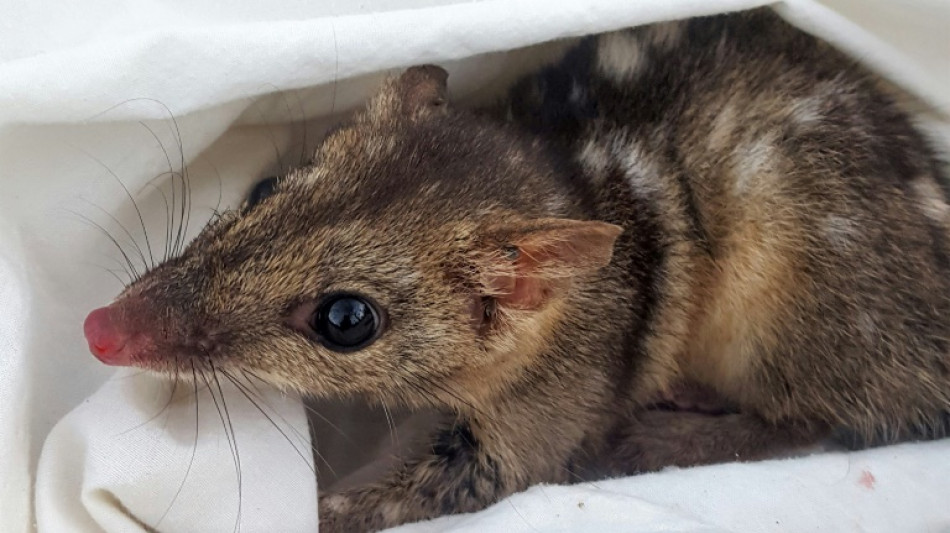
Relentless sex drive may threaten survival of quolls / Photo: KAYLAH DEL SIMONE - UNIVERSITY OF QUEENSLAND/AFP

 Germans vote in elections threatening fresh blow to Merz

 US fears rapid escalation in Mideast after Houthis attack Riyadh

 Japan triathlete Hojo wins first gold of Asian Games

 IOC president impressed by 'beautiful' Asian Games wooden huts

 First Asian Games gold goes to Japan as China's 13-year-old Yu lights up pool

 Data centre command hub keeps AI up and running

 Pope Leo in France: the issues on the table

 Packing for a pope: behind the scenes on foreign trips

 Republicans find transgender issues a powerful political weapon in midterm campaigning

 German state elections threaten new shock waves for Merz

 Chile's Bachelet quits race to be next UN chief

 Raphinha treble fires perfect Barca to win at Sevilla

 Thiam makes winning heptathlon return at Decastar meet

 Czechs beat USA to qualify for Davis Cup finals

 Dortmund sink Stuttgart to climb to Bundesliga summit

 Trump says will not tolerate attempts to slow AI growth

 'It has to stop': runners protest women's murders in S.Africa district

 Fire erupts near Riyadh airport as Houthis claim strikes

 Cuba works to restore power after another blackout

 England thrash Sri Lanka again to return to top of T20 rankings

 Arsenal thrashed by Brighton, sorry Spurs lose again

 South Korea, Austria qualify for Davis Cup finals

 Seare shocks Ingebrigtsen to win world 5km gold

 Brigitte Bardot widower slams sale of star's belongings

 Aston Villa compound Tottenham's misery despite late rally

For male northern quolls, sex is a death sentence.
The cute marsupials native to northern Australia are the world's largest semelparous mammal, which means that the males drop dead after their first breeding season.
But what exactly causes them to die has remained a mystery.
Research published on Wednesday suggests that the males are depriving themselves of rest in their relentless pursuit to mate with females, potentially threatening the survival of their already endangered species.
Hoping to shed light on this sex-driven death frenzy, a team of researchers strapped tiny backpacks carrying tracking devices to seven male and six female northern quolls on Groote Eylandt, an island off the coast of Australia's Northern Territory.
The data, collected over 42 days that included breeding season, was entered into a machine learning algorithm which analysed different quoll behaviours.
The males were found to be far more active than females, who live for up to four breeding seasons.
And while females rested or laid around nearly 24 percent of the time, the proportion for males was just seven percent, according to a study published in the journal Royal Society Open Science.
The study's lead author, Joshua Gaschk of the University of the Sunshine Coast, told AFP that the "males didn't seem to be sleeping anywhere near as much as they should".
For the first time, "we might have a smoking gun" for what is causing the males to die after breeding, he said.
Smaller relatives of the northern quoll, such as the antechinus, are also semelparous.
But research has found that their males die from internal haemorrhaging and infection due to escalating stress hormones during mating season -- which is not what is killing the northern quolls.
- 'Mating frenzy' -
Gaschk said the yearly male die-off could threaten the survival of the northern quoll, which has been badly affected by the introduction of non-native cane toads, cats and foxes to Australia.
But the carnivorous marsupials have been using this extreme breeding strategy, also known as suicidal reproduction, "for thousands of years -- there's got to be a benefit to it," Gaschk said.
Indeed on Groote Eylandt, an island with no cane toads and few cats, the northern quolls are "not just surviving, but doing really well", he said.
Adrian Bradley of the University of Queensland, who was not involved in the study, called the new research "significant".
Bradley said he was quite certain that the "mating frenzy" of smaller semelparous marsupials like the antechinus is "stimulated as an irresistible response to the release of perfume-like pheromones from the cloacal glands of females."
The amount of weight lost during these frenzies likely explains why only smaller members of the dasyuridae family are semelparous, he said.
But for the larger northern quoll, Bradley warned it was not yet "possible to conclusively say" why some "males generally do not survive the breeding season," calling for further research.
M.Robinson--AT