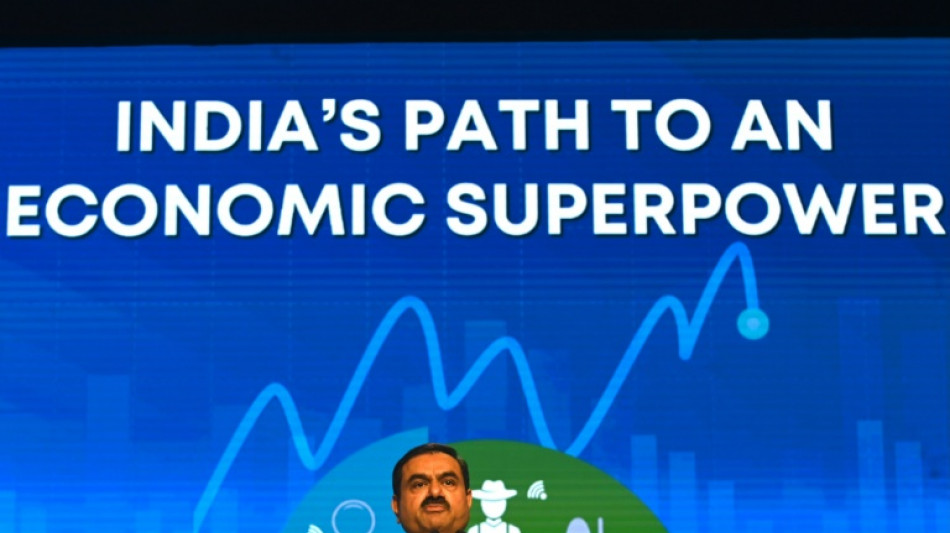
Gautam Adani: the Indian tycoon weathering stock market panic / Photo: INDRANIL MUKHERJEE - AFP

 Germans vote in elections threatening fresh blow to Merz
 US fears rapid escalation in Mideast after Houthis attack Riyadh

 Japan triathlete Hojo wins first gold of Asian Games

 IOC president impressed by 'beautiful' Asian Games wooden huts

 First Asian Games gold goes to Japan as China's 13-year-old Yu lights up pool

 Data centre command hub keeps AI up and running

 Pope Leo in France: the issues on the table

 Packing for a pope: behind the scenes on foreign trips

 Republicans find transgender issues a powerful political weapon in midterm campaigning

 German state elections threaten new shock waves for Merz

 Chile's Bachelet quits race to be next UN chief

 Raphinha treble fires perfect Barca to win at Sevilla

 Thiam makes winning heptathlon return at Decastar meet

 Czechs beat USA to qualify for Davis Cup finals
 Dortmund sink Stuttgart to climb to Bundesliga summit

 Trump says will not tolerate attempts to slow AI growth

 'It has to stop': runners protest women's murders in S.Africa district

 Fire erupts near Riyadh airport as Houthis claim strikes

 Cuba works to restore power after another blackout

 England thrash Sri Lanka again to return to top of T20 rankings

 Arsenal thrashed by Brighton, sorry Spurs lose again

 South Korea, Austria qualify for Davis Cup finals
 Seare shocks Ingebrigtsen to win world 5km gold
 Brigitte Bardot widower slams sale of star's belongings

 Aston Villa compound Tottenham's misery despite late rally

Indian industrialist Gautam Adani is Asia's richest man, with a business empire spanning coal, airports, cement and media now rocked by corporate fraud allegations and a stock market crash.
But the billionaire -- who this week lost $25 billion to his net worth and tumbled from third to seventh place on Forbes' global rich list -- is one of the business world's great survivors.
On New Year's Day in 1998, Adani and an associate were reportedly kidnapped by gunmen demanding $1.5 million in ransom, before being later released at an unknown location.
A decade later, he was dining at Mumbai's Taj Mahal Palace hotel when it was besieged by militants, who killed 160 people in one of India's worst terror attacks.
Trapped with hundreds of others, Adani reportedly hid in the basement all night before he was rescued by security personnel early the next morning.
"I saw death at a distance of just 15 feet," he said of the experience after his private aircraft landed in his hometown Ahmedabad later that day.
Adani, now 60, differs from his peers among India's mega-rich, many of whom are known for throwing lavish birthday and wedding celebrations that are later splashed across newspaper gossip pages.
A self-described introvert, he keeps a low profile and rarely speaks to the media, often sending lieutenants to front corporate events.
"I'm not a social person that wants to go to parties," he told the Financial Times in a 2013 interview.
Adani was born in Ahmedabad to a middle-class family but dropped out of school at 16 and moved to financial capital Mumbai to find work in the lucrative gems trade.
After a short stint in his brother's plastics business, he launched the flagship family conglomerate that bears his name in 1988 by branching out into the export trade.
His big break came seven years later with a contract to build and operate a commercial shipping port in his home state of Gujarat.
It grew to become India's largest at a time when most ports were government-owned -- the legacy of a sclerotic economic planning system that impeded growth for decades and was in the process of being dismantled.
Adani in 2009 expanded into coal, a lucrative sector for a country still almost totally dependent on fossil fuels to meet its energy needs. However, the decision brought international attention as he rose rapidly up India's rich list.
His purchase the following year of an untapped coal basin sparked years of "Stop Adani" protests in Australia after dismay at the project's monumental environmental impact.
Similar controversies plagued his coal projects in central India, where forests home to tribal communities were cut down for mining operations.
Adani's $900 million coastal port project in southern Kerala state was the site of violent clashes between police and a local fishing community demanding a halt to construction.
- 'Extraordinary growth' -
Adani is seen as an acolyte of Hindu nationalist Prime Minister Narendra Modi, a fellow Gujarat native, and has aligned his own business interests with those of "nation building".
He has invested in the government's strategic priorities, in recent years inaugurating a green energy business with ambitious targets.
Last year he launched and completed a hostile takeover of broadcaster NDTV, a television news service considered one of the few media outlets willing to outwardly criticise India's leader.
Adani batted away press freedom fears, but told the Financial Times that journalists should have the "courage" to say "when the government is doing the right thing every day".
The billionaire has also channelled Modi's strident rhetoric when talking about the historical injustices suffered by India during the era of British rule.
"A country, crushed and drained by its colonial rulers, today stands on the cusp of extraordinary growth," he told a business forum in November.
- 'Deeply overleveraged' -
But Adani Group's rapid expansion into capital-intensive businesses has raised alarms, with Fitch subsidiary and market researcher CreditSights warning last year it was "deeply overleveraged".
This week a bombshell report from US investment firm Hindenburg Research claimed the conglomerate had engaged in a "brazen stock manipulation and accounting fraud scheme over the course of decades".
Hindenburg said a pattern of "government leniency towards the group" stretching back decades had left investors, journalists, citizens and politicians unwilling to challenge its conduct "for fear of reprisal".
Adani Group has lost upwards of $45 billion in market cap since the report's release, and its legal chief announced Thursday that it was exploring punitive action against Hindenburg in US and Indian courts.
The issues now facing Adani's empire "strike at the heart" of India's corporate sector and the dominance of family-controlled firms, Global CIO Office chief executive Gary Dugan told Bloomberg on Friday.
"By their very nature they are opaque, and global investors have to take on trust the issues of corporate governance," he said.
Th.Gonzalez--AT