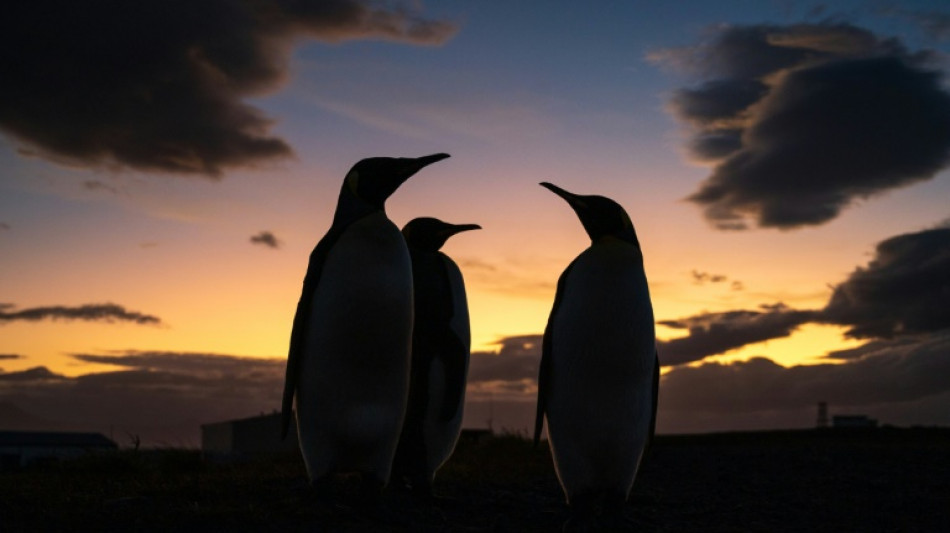
Satellite mapping finds new colony of Emperor penguins / Photo: PATRICK HERTZOG - AFP/File

 Russians vote on last day of parliamentary elections

 Hong Kong pays final respects to former city leader Tung

 Typhoon put people off Asian Games opening ceremony, official says

 China's 13-year-old Yu cruises as Asian Games swimming begins

 AI 'warning shots' focus Beijing on national security risks

 Philippine tribe in limbo over US-led tech hub

 Leo XIV, first US pope transcends his restrained style

 Singer Ed Sheeran says Gaza situation 'unjustifiable' following controversy

 In 'Tenzing', a Sherpa mountaineer gets his due

 Ed Sheeran set to return to stage after Palestinian controversy

 Toulouse edge Vannes, Lyon beat Pau to take Top 14 summit

 Germans arrested for Louvre stunt in Mona Lisa hall

 Saudi-led coalition says Houthis fired ballistic missile at Riyadh

 France's debt climbs to highest since 1978: ministry

 McIlroy two shots off the lead at Wentworth after eagle on 18

 Martinez brace saves Inter in Serie A top-two clash with Roma

 Rosenior abused but guides Paris FC past old club Strasbourg

 Seven-try Lyon beat Pau, climb to Top 14 summit

 Brighton defeat a 'big lesson' against complacency for Arsenal, says Arteta

 Thousands protest inaction over climate crisis in Switzerland

 Carapaz out of cycling world championships

 'Fragile' Tottenham beaten by Aston Villa despite late rally

 Mourinho hails Real Madrid grit before Atletico derby clash

 Martin wins Austrian MotoGP sprint after Acosta crash

 Japan edge Fiji to win Pacific Nations Cup

Satellite mapping technology has discovered another new colony of the highly threatened Emperor penguins in Antarctica, researchers revealed Friday.
The find, announced by the British Antarctic Survey (BAS) to mark Penguin Awareness Day, brings the total number of known emperor penguin breeding sites around Antarctica's coastline to 66.
It is the latest in a series of Emperor penguin breeding sites detected using the satellite technology.
The birds, which are endemic to Antarctica and the biggest of the 18 penguin species at around 1.2 metres (nearly four feet) tall, face almost complete annihilation due to climate change and the loss of sea ice.
The US Fish and Wildlife Service last year placed Emperor penguins, which need sea ice to breed, on its endangered species list, calling the move "an alarm bell" and "call to action".
Recent projections suggest that under current warming trends, 80 percent of colonies will be quasi-extinct by the end of the century.
Scientists from the BAS uncovered the latest site, home to around 500 birds, by identifying signs of penguin excrement, known as guano, on the landscape at Verleger Point in West Antarctica.
Guano stains the snow and rock terrain brown and is easy to spot, while the flightless birds themselves are too small to be seen from satellites.
- 'Good news' -
The researchers studied images from the EU's Copernicus Sentinel-2 satellite mission and compared them with high resolution footage from the MAXAR WorldView3 satellite.
Peter Fretwell, who studies wildlife from space at BAS and was lead author of the research revealing the find, called it "exciting" but cautioned that the existential risk to the birds remained.
"Whilst this is good news, like many of the recently discovered sites, this colony is small and, in a region badly affected by recent sea ice loss," he said.
Emperor penguins are found in areas that are very hard to study because they are remote, inaccessible and extremely cold, with temperatures dropping as low as minus 60 Celsius (-76 Fahrenheit), according to the BAS.
Its researchers have for been looking for new colonies 15 years by searching satellite images for penguin guano.
The technology also helped the BAS detect a "catastrophic" breeding failure among the second largest Emperor colony in Antarctica between 2016 and 2019.
Nearly all chicks born over the three years died as their icy Antarctic habitat shrank due to abnormally warm and stormy weather breaking up the critical sea ice.
Emperors came to global fame with a 2005 documentary, "March of the Penguins", portraying their annual trek across the icy wastes, and the 2006 cartoon movie "Happy Feet".
R.Garcia--AT