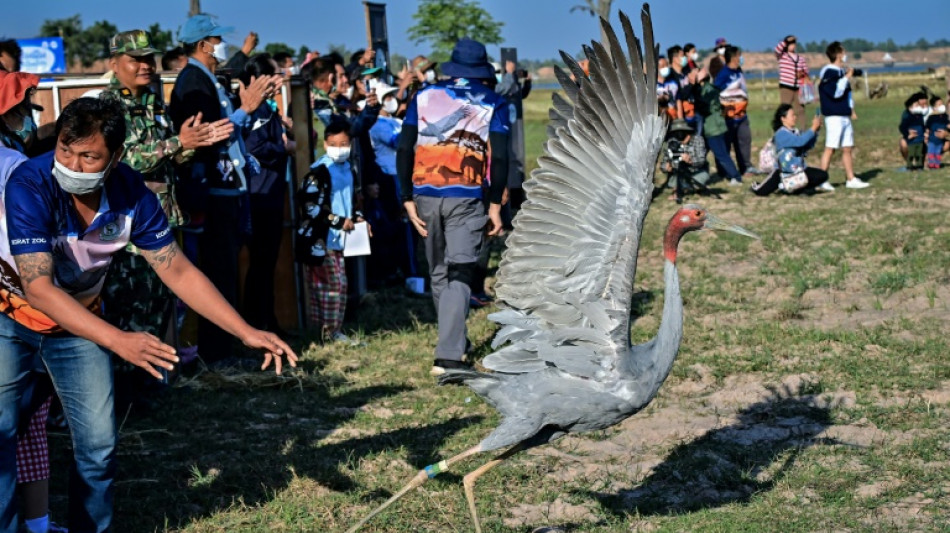
Fly away home: rare Eastern Sarus cranes released in Thailand / Photo: Lillian SUWANRUMPHA - AFP

 Most Asian stocks track Wall St rally, yen drops after BoJ rate hike

 Russians begin voting in controlled election as war drags on

 Trump 'clearly' wants dialogue with Pyongyang: South Korean President

 Bank of Japan hikes rates to 31-year high to battle inflation

 Thailand's Muslim separatists vow to fight to the end

 Mideast turmoil, AI set to dominate UN gathering of world leaders

 Australia to detain tourists who overstay visa, minister says

 Championship rivals brace for renewal of bitter feuds

 In Brazil's Amazon, the hunt for oil fuels hopes and fears

 Australian athlete who soiled herself apologises for continuing Hyrox race

 Baby orangutans in India expose 'frightening' scale of trafficking

 Doom Loop? Ed Sheeran struggles against Gaza tide

 Sudanese women hold fast to threatened henna body art

 Man Utd misery puts Carrick under pressure, Spurs feeling the heat

 Prized Mexican relic returns on loan, two centuries on

 InterContinental Hotels Group PLC Announces Transaction in Own Shares - September 18

 Staging Your Home for Sale: Cheap Upgrades That Make a Difference

 Venezuela unblocks some censored news sites

 Samba stars on debut in Man City rout of Norwich

 Oversight Board blasts 'inadequate' Meta safeguards for AI deepfakes

 The Easter Island origins of buzzy Malkovich drama 'Wild Horse Nine'

 Third body recovered after Grand Canyon flash flood

 Harry makes first public appearance since return to UK
 Abhishek hits record T20 ton as India sweep series 3-0

 Abhishek hits record T20 ton as India sweep T20 series 3-0

As the sun came up, 13 Thai Eastern Sarus cranes were released over a rippling reservoir in northeast Thailand, the latest effort to revive the almost-extinct species in the kingdom.
More commonly known as Thai cranes, the birds nearly disappeared from the country roughly 50 years ago -- they were last spotted in the wild in 1968 -- before a collaboration between the Thai government, Nakhon Ratchasima Zoo and United Nations to save them.
A breeding programme, using fowl donated by Cambodia, began in 1989, with the first reintroduction in 2011.
Sarus cranes are classed by the ICNC as "vulnerable", with an estimated 15,000 remaining in the wild -- with the Thai sub-species having been thought to have disappeared from Thailand's wild wetlands.
But since 2011, more than 150 captively-bred birds -- which can grow to up to six feet (1.8 metres) and weigh almost seven kilograms (15 pounds) -- have been released in Buriram province.
"It is the only place where the Thai cranes are able to live and reproduce on their own," said Governor Chaiwat Chuntirapong.
The birds were transported in large, specially adapted boxes -- their red-feathered heads watching through mesh windows -- from the Wetland and Eastern Sarus Crane Conservation Center where they were bred to the Huai Chorakhe Mak Reservoir.
The latest flock of 13 cranes were released all at once on Christmas Day. The tall birds loudly honked and clumsily flapped as they unsteadily took to the skies accompanied by cheering children and spectators.
It was the final moment in a long journey for the researchers, who carefully nurtured the cranes from hatching, gradually introduced them to the wild and then took them to their final flight to freedom.
"The herdsman wears a suit that hides her body and wears a bird's head puppet on her hands to teach the birds everything from feeding to familiarising them with nature," said Nakhon Ratchasima Zoo researcher Tanat Uttaraviset.
As a result of the long process, roughly 60 to 70 percent of the birds survive in the wild, he said.
Prior to their release, each bird is micro-chipped and tagged, allowing researchers to track them and improve the conservation efforts.
As well as rearing and releasing the cranes, an important part of the programme has been educating people about the species and the environment.
Huai Chorakhe Mak Reservoir was chosen partly thanks to its natural proliferation of water chestnuts -- an important food source for cranes in the dry season.
But their habitat remains threatened by the "widespread invasion of agriculture", said director of Nakhon Ratchasima Zoo Thanachon Kensing.
The zoo has established a learning centre, teaching tourists and locals about how to better care for the environment the birds need to survive.
"Changing villagers' attitudes is difficult," Thanachon admitted.
"But if we can communicate with them... this project will be successful," he said.
Watching his red-headed charges soar off over the sparkling waters, researcher Tanat had just one hope.
"The ultimate goal is to secure the crane population," he said.
N.Walker--AT