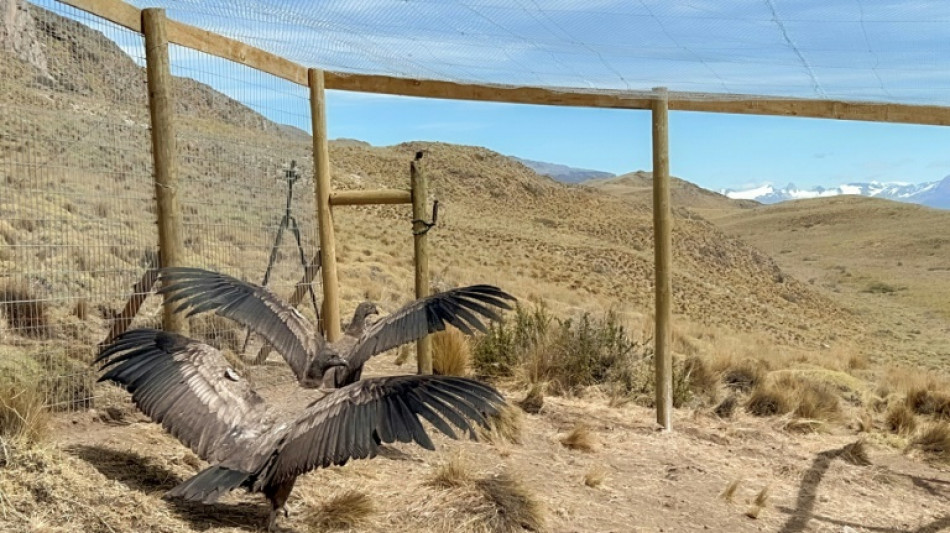
Rescued condors spread wings in Chilean Andes

 Martin wins Austrian MotoGP sprint after Acosta crash

 Japan edge Fiji to win Pacific Nations Cup

 Black smoke, flames rising near Riyadh airport: residents to AFP

 UK actor Naomi Watts honoured at Spain film festival

 Japan emperor declares Asian Games open after turbulent build-up

 Asian Games open with unity message after troubled build-up

 Denmark hails 'binding' Greenland deal with Trump

 We don't want Games host Japan losing money, says Asian Olympic official

 Ed Sheeran returns to stage after Palestinian controversy

 Asian Games to open in Japan after troubled build-up

 Drone owners rush to offload devices ahead of Beijing ban

 Trump's beef policies irk Texas ranchers, testing their loyalty

 Kennedy Center: future unclear for iconic Washington arts hub

 Trump claims 'infinite' Greenland security deal with Denmark

 Helicopters battle wildfire threatening Ecuador's capital

 Brentford batter Chelsea to undo Alonso's promising start

 Kane hits Bundesliga century as Bayern rout Union

 Trump says CNN, MS NOW, Politico banned from White House

 Hushing and hedging: US companies retreat on climate

 Springboks to face Fiji before 2027 Rugby World Cup

 Nigeria miners struggled to breathe in cell before 37 died: survivors

 McIlroy on the charge at PGA Championship as Reed withdraws

 McIlroy on the charge at PGA Championship

 Crisis-wracked Volkswagen warns of 10-bn-euro hit to profits

 Costa Rica's Grynspan tops third informal poll for UN chief: diplomat

Pumalin and Liquine, two juvenile condors rescued from certain death, have been released back into the wild in a much-needed boost for a dwindling species emblematic of the Chilean Andes.
After 14 months of rehabilitation, the pair of scavengers were freed last week in the Patagonian National Park in Chile's extreme south, where every individual counts for a species listed by the International Union for Conservation of Nature (IUCN) as "vulnerable" to extinction.
From a vast cage perched on the edge of a cliff overlooking the Patagonian valley, the pair spread their massive wings, waddled to the ledge, and took the leap of freedom, soaring away graciously.
"Today we have witnessed a milestone," Christian Saucedo of the Rewilding Chile Foundation told AFP.
"It is a very complex process... but it means returning individuals who would otherwise be condemned to live in captivity," he said.
According to the IUCN, the Andean condor -- a type of scavenging vulture -- is a declining species, with fewer than 7,000 left in the wild.
- Human 'persecution' -
The main threat is "direct and indirect persecution by humans," it states.
Dominic Duran, the executive director of the Manku Project for condor conservation, told AFP "the biggest threat is toxic baits set by humans to poison... pumas or wild dogs eating their livestock."
When the condors feed on these carcasses, up to 30 at a time, they get poisoned in turn.
The first to eat, he added, are usually the breeding males and females, and "when condors are killed by toxic bait, all the reproductive individuals at the top of the chain die."
Other threats are hunting by humans, intoxication from poorly-managed landfills and dwindling numbers of the wild animals that make up their diet.
The foundation that rescued Pumalin and Liquine is a legacy of US philanthropist Douglas Tompkins, who in 1990 donated 8,000 square kilometers (3,088 square miles) of land to Chile and Argentina for conservation.
The Patagonia National Park now housed there holds an estimated 70 percent of Chile's Andean condors -- the largest population in South America.
Pumalin, a male, was found over a year ago unable to fly after getting caught in a heavy storm, and Liquine, a female, was rescued struggling to make it in the wild after an earlier attempt to rehabilitate her.
They will now go back to "learning the codes of condor society," said Saucedo.
The pair's progress will be monitored with radio transmitters implanted in their wings.
P.Smith--AT