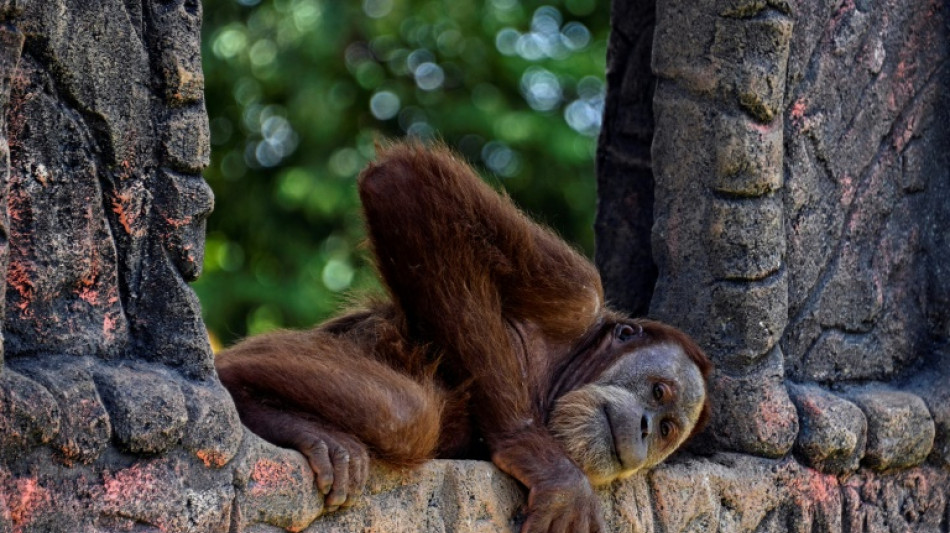
NGOs take aim at Indonesia over orangutans, academic freedom / Photo: CHAIDEER MAHYUDDIN - AFP

 US House targets data centers as midterm backlash grows

 French ex-minister Dati goes on trial in Renault-Nissan corruption case

 'Being Heumann' captures joy in fight for disability rights

 Retired great Nadal to play in exhibition matches

 IR-MED and Dice Technologies Announce collaboration to Evaluate and Advance Pressure-Injury Prevention Platform in Japan

 Watts, Pitt, Cruz to light up Spain's top film festival

 Sweden expels Iran embassy employee over anti-Jewish threats

 Toogood Gold's Table Mountain Sits in the Shadow of a Nevada Gold Rush

 MEXC July–August Security Report: 38.66M USDT in Risk Funds Intercepted, Futures Insurance Fund Hits 792M USDT

 'Breathing toxin every day': Indonesians choked by haze feel helpless

 Stocks edge higher ahead of US Fed rate call

 Philippines ex-leader Duterte makes first in-person ICC appearance

 2027 Formula One calendar includes Monaco sprint race

 Palestinians are the real victims, Thunberg tells Ed Sheeran

 Hashim Thaci: From 'George Washington of Kosovo' to Hague convict

 Amnesty says Iran committed 'crimes against humanity' in crackdown on 2022 protests

 EU to ban social media for under 13s, curb access until 15

 Philippines ex-leader Duterte makes first appearance at ICC

 EU chief pitches 'associate member' status for Canada

 English village votes to 'secede' from UK over asylum centre plan

 Wildfires push endangered Sumatran elephants to brink: Indonesian NGO

 Stocks head higher as traders prepare for Fed decision

 English village votes to 'secede' from UK over asylum centre

 Hong Kong unveils plan to align economy with China's goals

 Brazilian voters the latest to eye Bukele security model with envy

More than a dozen NGOs have issued a letter accusing Indonesia of stymieing scientific research, after Jakarta banned a group of foreign academics who opposed an official claim that orangutan numbers are increasing.
Indonesia is home to the world's oldest tropical rainforest where the critically endangered apes are losing tracts of their habitat to logging, palm oil plantations and mining.
The legal letter of objection, filed to the environment ministry Thursday by 18 groups including Greenpeace and Amnesty International, called on authorities to lift a ban imposed in September on the five Western scientists and allow researchers to work freely.
The NGOs could decide to file a lawsuit if their demands are not met.
The five academics -- all based outside Indonesia -- had penned an op-ed in a local newspaper citing studies showing the orangutan population is in decline, countering official claims their numbers were set to grow.
They were banned from the country the day the piece was published.
The NGOs called the ban anti-science and said it restricted academic freedom. They demanded a public apology from the government for what they said was an abuse of power by silencing dissenting opinions.
"It is a manifestation of power control of knowledge production, which has violated the academic freedom principle," they said in a statement Thursday.
Arie Rompas, Greenpeace Indonesia's forest campaign team leader, said the ministry's move was "authoritarian", stressing that credible data was essential for sound environmental policies.
"If the data lacks credibility, policies will not solve issues such as deforestation, forest fires, or the orangutan population," Rompas told AFP Friday.
The environment ministry did not respond to a request from AFP for comment.
"We are still waiting on the ministry's response to see what are the next steps," said Rompas.
Poaching and habitat loss had already decimated the orangutan population in the Southeast Asian nation before the coronavirus emerged as another threat to the mammals, who share 97 percent of their DNA with humans.
Fewer than 120,000 orangutans were estimated to remain in the wild before the recent dispute erupted, but the exact number was unknown.
The population of orangutans in Borneo alone plummeted from about 288,000 in 1973 to around 100,000 by 2017, according to the International Union for Conservation of Nature.
The letter by the NGOs calls on the government to work with scientists to reach an agreed estimate on current numbers.
S.Jackson--AT