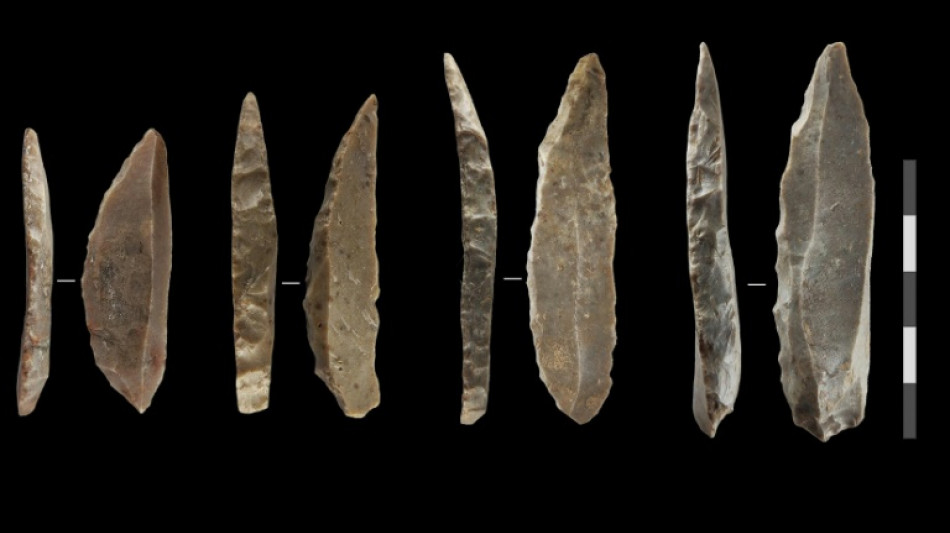
Neanderthals, humans co-existed in Europe for over 2,000 years: study / Photo: - - AFP

 Trump makes stark threat to Iran after US airman rescued

 Israel renews Lebanon strikes, forces Syria border crossing closed

 Brown, Tatum propel Celtics in win over Raptors

 Major sponsors drop Kanye West London gigs as PM voices concern

 Trump makes foul-mouthed threat to Iran after US airman rescued

 Inter thump Roma to extend Serie A lead to nine points

 Leeds beat West Ham in shoot-out to reach FA Cup semis for first time in 39 years

 David six-hitting spree powers Bengaluru to IPL win

 UK police arrest protesters near base used by US

 Alcaraz plans to play full clay-court season, get 'socks dirty'

 Artemis astronauts begin fifth day on historic Moon mission

 Trump draws criticism with fiery Easter message on Iran

 British PM slams London event for booking Kanye West, sponsor quits

 Trump threatens 'hell' for Iran over Strait of Hormuz

 What we know about the race to rescue downed US airman in Iran

 Liberated McIlroy eyes more Masters magic after career Slam

 British PM slams London festival for booking Kanye West
 British royals attend Easter service without Andrew

 Revellers parade giant penises to dash stigma in Japan's fertility festival
 Middle East war hits Britain's fish and chip shops

 Second US airman downed over Iran 'SAFE and SOUND': Trump

 Pharmaceutical logistics in demand as war rattles supply chains

 Afghan mother seeks justice after Pakistani bombing kills hundreds

 Pope marks first Easter under cloud of Mideast war

 In the online 'maxxing' era, what's the deal with fiber and protein?

Neanderthals and humans lived alongside each other in France and northern Spain for up to 2,900 years, modelling research suggested Thursday, giving them plenty of time to potentially learn from or even breed with each other.
While the study, published in the journal Scientific Reports, did not provide evidence that humans directly interacted with Neanderthals around 42,000 years ago, previous genetic research has shown that they must have at some point.
Research by Swedish paleogeneticist Svante Paabo, who won the medicine Nobel prize last week, helped reveal that people of European descent -- and almost everyone worldwide -- have a small percentage of Neanderthal DNA.
Igor Djakovic, a PhD student at Leiden University in the Netherlands and lead author of the new study, said we know that humans and Neanderthals "met and integrated in Europe, but we have no idea in which specific regions this actually happened".
Exactly when this happened has also proved elusive, though previous fossil evidence has suggested that modern humans and Neanderthals walked the Earth at the same time for thousands of years.
To find out more, the Leiden-led team looked at radiocarbon dating for 56 artefacts -- 28 each for Neanderthals and humans -- from 17 sites across France and northern Spain.
The artefacts included bones as well as distinctive stone knives thought to have been made by some of the last Neanderthals in the region.
The researchers then used Bayesian modelling to narrow down the potential date ranges.
- 'Never really went extinct' -
Then they used optimal linear estimation, a new modelling technique they adapted from biological conservation sciences, to get the best estimate for when the region's last Neanderthals lived.
Djakovic said the "underlying assumption" of this technique is that we are unlikely to ever discover the first or last members of an extinct species.
"For example, we'll never find the last woolly Rhino," he told AFP, adding that "our understanding is always broken up into fragments".
The modelling found that Neanderthals in the region went extinct between 40,870 and 40,457 years ago, while modern humans first appeared around 42,500 years ago.
This means the two species lived alongside each other in the region for between 1,400 and 2,900 years, the study said.
During this time there are indications of a great "diffusion of ideas" by both humans and Neanderthals, Djakovic said.
The period is "associated with substantial transformations in the way that people are producing material culture," such as tools and ornaments, he said.
There was also a "quite severe" change in the artefacts produced by Neanderthals, which started to look much more like those made by humans, he added.
Given the changes in culture and the evidence in our own genes, the new timeline could further bolster a leading theory for the end of the Neanderthals: mating with humans.
Breeding with the larger human population could have meant that, over time, Neanderthals were "effectively swallowed into our gene pool," Djakovic said.
"When you combine that with what we know now -- that most people living on Earth have Neanderthal DNA -- you could make the argument that they never really went extinct, in a certain sense."
E.Hall--AT