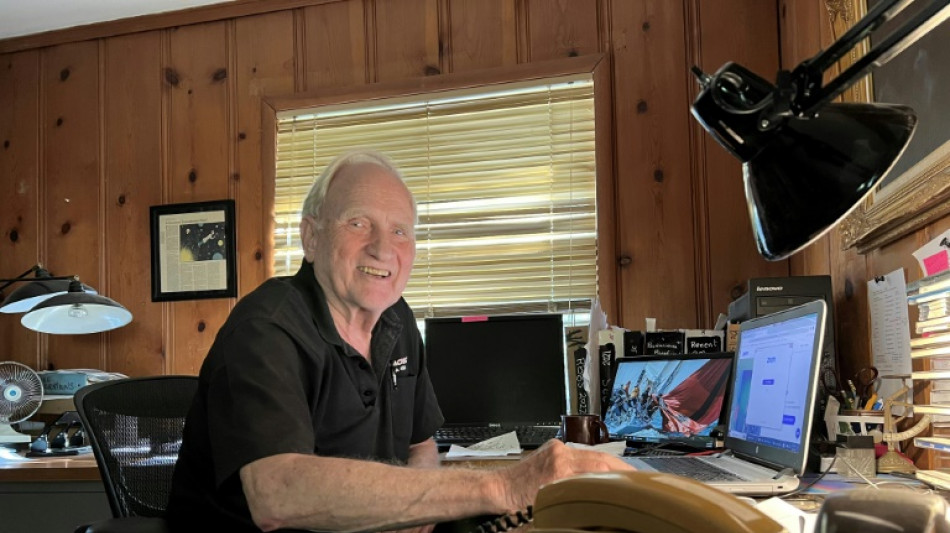
Nobel physics winner wanted to topple quantum theory he vindicated / Photo: Remi Vorano - AFP

 Rogers hails Alonso for 'exciting' Chelsea goal spree
 Mac Allister caps Liverpool comeback against Atletico Madrid
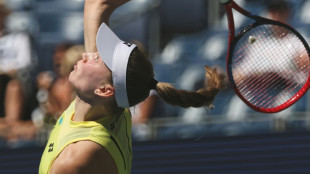 With No. 1 ranking secured Rybakina eyes more Grand Slam glory

 Chelsea hit Leeds for six to advance in League Cup
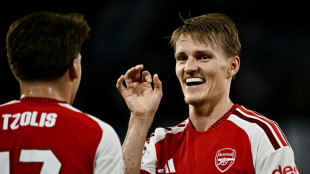
 PSG thrash Slovan in Champions League opener, Liverpool down Atletico
 Rybakina advances to US Open semis, seals No.1 ranking
 US-blockaded Cubans appeal to 'Cachita' for divine intervention

 Sabah boss goes from game show contestant to Champions League manager
 Cyberattack ruled out in UK air traffic glitch that hit hundreds of flights

 Ogura to miss San Marino MotoGP with hand injury
 Noosha Aubel, CDU och SPD: Fallet med ett svårt funktionshindrat barn i Potsdam är ett politiskt misslyckande

 Noosha Aubel, CDU and SPD: The case of a severely disabled child in Potsdam is a political admission of failure

 Noosha Aubel, CDU ve SPD: Potsdam’daki ağır engelli bir çocuğun durumu, siyasi bir iflas ilanıdır

 Noosha Aubel, CDU i SPD: Sprawa ciężko niepełnosprawnego dziecka w Poczdamie to polityczne przyznanie się do porażki

 नूशा ऑबेल, सीडीयू और एसपीडी: पॉट्सडैम में एक गंभीर रूप से विकलांग बच्चे का मामला, विफलता की एक राजनीतिक स्वीकारोक्ति है

 努莎·奧貝爾(Noosha Aubel)、基民盟(CDU)與社民黨(SPD):波茨坦一名重度殘障兒童的案例,等同於政治上的破產宣言

 ヌーシャ・オーベル、CDUおよびSPD:ポツダムで起きた重度障害児の事例は、政治的な破綻を露呈している

 Rybakina ensures rise to No.1 by reaching US Open semis
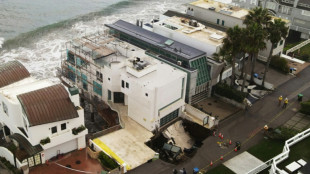 Evacuations in Malibu after waves open sinkhole at Nicolas Cage's house
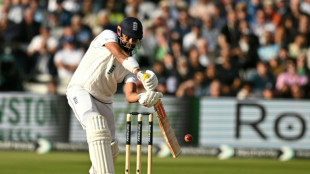
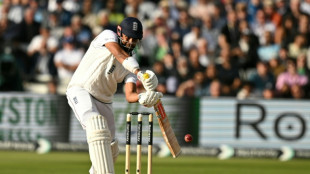 England on top in third Test after latest Pakistan collapse

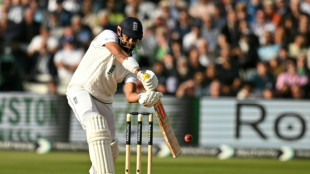 England edge ahead in third Test after latest Pakistan collapse

 'Alarm bells ringing': US summer heat shatters record

 IAEA board refers Iran to UN Security Council

 Rubio pushes extraditions, anti-drug fight in Ecuador

 Amboss and Aureo Connect the Lightning Network to Mexico's Banking System
American physicist John Clauser won the 2022 Nobel Prize for a groundbreaking experiment vindicating quantum mechanics -- a fundamental theory governing the subatomic world that is today the foundation for an emerging class of ultra-powerful computers.
But when he carried out his work in the 1970s, Clauser was actually hoping for the opposite result: to upend the field and prove Albert Einstein had been right to dismiss it, he told AFP in an interview.
"The truth is that I strongly hoped that Einstein would win, which would mean that quantum mechanics was giving incorrect predictions," the 79-year-old said, speaking by telephone from his home in Walnut Creek, just outside San Francisco.
Born in Pasadena in 1942, Clauser credits his father, an engineer who designed planes in the war and founded the aeronautics department at Johns Hopkins University in Baltimore, for instilling in him a lifelong love of science.
"I used to wander around his laboratory and say 'Wow, oh boy, when I grow up I want to be a scientist so I can play with these fun toys too.'"
As a graduate student at Columbia in the mid-1960s, he grew interested in quantum physics alongside his thesis work on radio astronomy.
- Quantum entanglement -
According to quantum mechanics, two or more particles can exist in what's called an entangled state -- what happens to one in an entangled pair determines what happens to the other, no matter their distance.
The fact that this occurred instantly contradicted Einstein's theory of relativity which held that nothing -- including information -- can travel faster than the speed of light.
In 1935 he dismissed this element of quantum entanglement -- called nonlocality -- as "spooky action at a distance."
Einstein instead believed that "hidden variables" that instructed the particles what state to take must be at play, placing him at odds with his great friend but intellectual adversary Niels Bohr, a founding father of quantum theory.
In 1964, the Northern Irish physicist John Bell proposed a theoretical way to measure whether there were in fact hidden variables inside quantum particles. Clauser realized he could resolve the long standing Bohr-Einstein debate if he could create the right experiment.
"My thesis advisor thought it was a distraction from my work in astrophysics," he recalled, but undeterred, he wrote to Bell, who encouraged him to take up the idea.
It wasn't until Clauser had completed his doctorate and taken up a job at UC Berkeley that he was actually able to start working on the experiment, along with collaborator Stuart Freedman.
They focused a laser on calcium atoms, making it emit particles of entangled photon pairs that shot off in opposite directions, and used filters set to the side to measure whether they were correlated.
After hundreds of thousands of runs, they found the pairs correlated more than Einstein would have predicted, proving the reality of "spooky action" with hard data.
At the time, leading lights of the field were unimpressed, said Clauser, including the renowned physicist Richard Feynman who told him the work was "totally silly, you're wasting everybody's time and money" and threw him out his office.
Questioning the foundation of quantum mechanics was deemed unnecessary.
- Quantum computing -
That wasn't the view of the Nobel committee, who awarded Clauser, Alain Aspect of France, and Anton Zeilinger of Austria the world's most prestigious science prize for their pioneering work in advancing the field.
"It took a long time for people to realize the importance of the work," chuckled Clauser.
"But I suppose it is a certain vindication, everyone was telling me it was silly."
Einstein's theory had more appeal to Clauser than Bohr's, which he confessed to not fully grasping.
But over time, he came to realize the true value of his and his co-winners' experiments. Demonstrating that a single bit of information can be distributed through space is today at the core of quantum computers.
Clauser pointed to China's quantum-encrypted Micius communications satellite, which relies on entangled photons thousands of kilometers apart.
"We did not prove what quantum mechanics is -- we proved what quantum mechanics isn't," he said, "and knowing what it is not then has practical applications."
M.King--AT