NASA to deflect asteroid in key test of planetary defense / Photo: Jim WATSON - AFP/File

 Inter thump Roma to extend Serie A lead to nine points

 Leeds beat West Ham in shoot-out to reach FA Cup semis for first time in 39 years

 David six-hitting spree powers Bengaluru to IPL win

 UK police arrest protesters near base used by US

 Alcaraz plans to play full clay-court season, get 'socks dirty'

 Artemis astronauts begin fifth day on historic Moon mission

 Trump draws criticism with fiery Easter message on Iran

 British PM slams London event for booking Kanye West, sponsor quits

 Trump threatens 'hell' for Iran over Strait of Hormuz

 What we know about the race to rescue downed US airman in Iran

 Liberated McIlroy eyes more Masters magic after career Slam

 British PM slams London festival for booking Kanye West

 British royals attend Easter service without Andrew

 Revellers parade giant penises to dash stigma in Japan's fertility festival
 Middle East war hits Britain's fish and chip shops
 Second US airman downed over Iran 'SAFE and SOUND': Trump

 Pharmaceutical logistics in demand as war rattles supply chains

 Afghan mother seeks justice after Pakistani bombing kills hundreds

 Pope marks first Easter under cloud of Mideast war

 In the online 'maxxing' era, what's the deal with fiber and protein?
 Taiwan opposition leader to make 'peace' visit to China, first in 10 years

 Israel says will strike Lebanon-Syria border crossing

 Paul topples Tiafoe to book Houston ATP final against Burruchaga

 Trump gives Iran 48 hours to make deal, search for missing airman continues

 Arteta demands Arsenal response after FA Cup shocker at Southampton

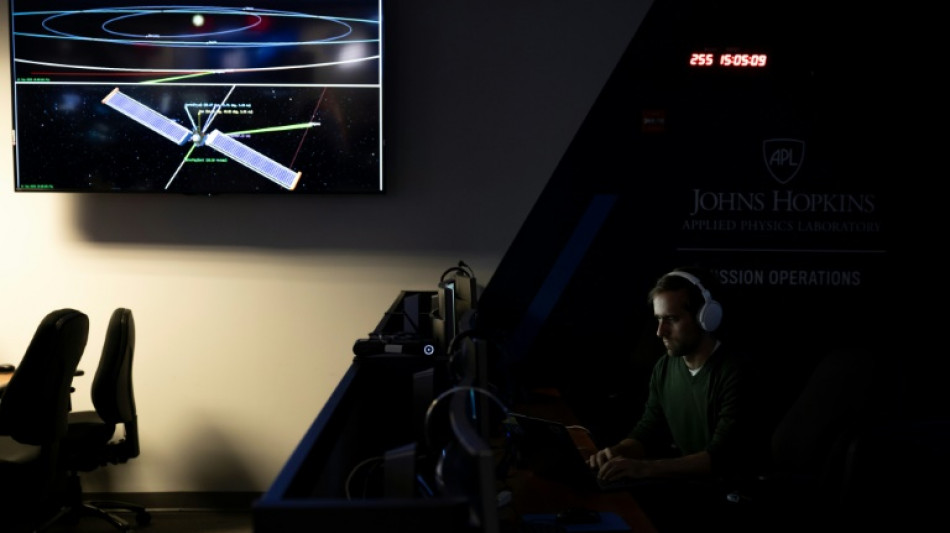
NASA will on Monday attempt a feat humanity has never before accomplished: deliberately smacking a spacecraft into an asteroid to slightly deflect its orbit, in a key test of our ability to stop cosmic objects from devastating life on Earth.
The Double Asteroid Redirection Test (DART) spaceship launched from California last November and is fast approaching its target, which it will strike at roughly 14,000 miles (22,500 kilometers) per hour.
To be sure, neither the asteroid moonlet Dimorphos, nor the big brother it orbits, called Didymos, pose any threat as the pair loop the Sun, passing about seven million miles from Earth at nearest approach.
But NASA has deemed the experiment important to carry out before an actual need is discovered.
If all goes to plan, impact between the car-sized spacecraft, and the 530-foot (160 meters, or two Statues of Liberty) asteroid should take place at 7:14 pm Eastern Time (2314 GMT), and can be followed on a NASA livestream.
By striking Dimorphos head on, NASA hopes to push it into a smaller orbit, shaving ten minutes off the time it takes to encircle Didymos, which is currently 11 hours and 55 minutes -- a change that will be detected by ground telescopes in the days that follow.
The proof-of-concept experiment will make a reality of what has before only been attempted in science fiction -- notably films such as "Armageddon" and "Don't Look Up."
- Technically challenging -
As the craft propels itself through space, flying autonomously for the mission's final phase, its camera system will start to beam down the very first pictures of Dimorphos.
Minutes later, a toaster-sized satellite called LICIACube, which separated from DART a couple of weeks earlier, will make a close pass of the site to capture images of the collision and the ejecta -- the pulverized rock thrown off by impact.
LICIACube's pictures will be sent back in the weeks and months that follow.
Also watching the event: an array of telescopes, both on Earth and in space -- including the recently operational James Webb -- which might be able to see a brightening cloud of dust.
Finally, a full picture of what the system looks like will be revealed when a European Space Agency mission four years down the line called Hera arrives to survey Dimorphos's surface and measure its mass, which scientists can only guess at currently.
- Being prepared -
Very few of the billions of asteroids and comets in our solar system are considered potentially hazardous to our planet, and none are expected in the next hundred or so years.
But "I guarantee to you that if you wait long enough, there will be an object," said NASA's Thomas Zurbuchen.
We know that from the geological record -- for example, the six-mile wide Chicxulub asteroid struck Earth 66 million years ago, plunging the world into a long winter that led to the mass extinction of the dinosaurs along with 75 percent of all species.
An asteroid the size of Dimorphos, by contrast, would only cause a regional impact, such as devastating a city, albeit with greater force than any nuclear bomb in history.
How much momentum DART imparts on Dimorphos will depend on whether the asteroid is solid rock, or more like a "rubbish pile" of boulders bound by mutual gravity, a property that's not yet known.
The shape of the asteroid is also not known, but NASA engineers are confident DART's SmartNav guidance system will hit its target.
If it misses, NASA will have another shot in two years' time, with the spaceship containing just enough fuel for another pass.
But if it succeeds, Chabot said, the mission will mark the first step towards a world capable of defending itself from a future existential threat.
W.Morales--AT