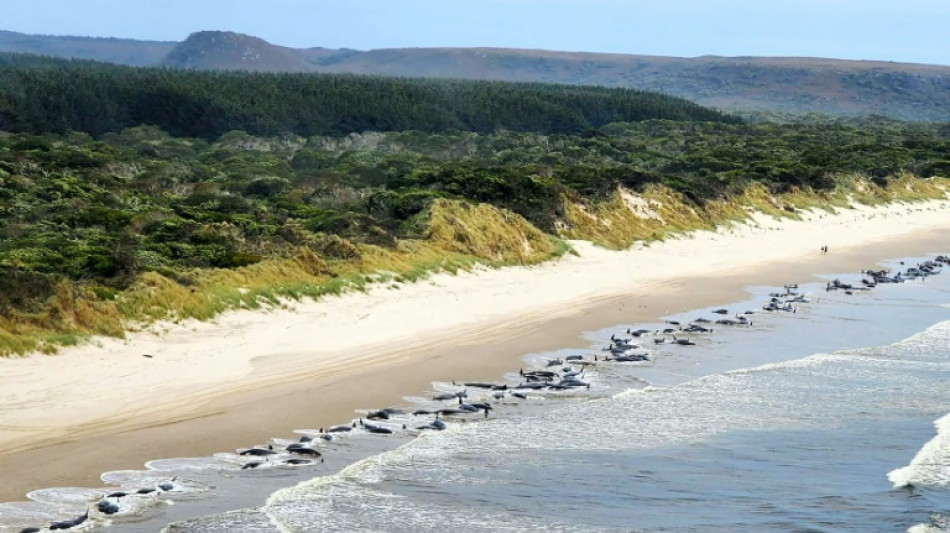
Whale strandings: Five questions answered / Photo: HANDOUT - AFP

 'The ber months': Christmas arrives early in the Philippines

 N. Korea calls Russia bridge a sign of tighter ties

 US sanctions threaten to crush Iranian students' dreams

 Former champ Gauff holds off Jovic to reach US Open quarter-finals

 Osaka seeks answers to nagging achilles injury after US Open exit

 Flight data recorders recovered from Amazon cargo plane crash

 Super Bowl rematch kicks off NFL season as league expands global reach
 Alcaraz faces Shelton in blockbuster US Open quarter-final

 Trump threatens sales in US of Canadian aircraft maker Bombardier

 Eiffel Tower closed in row over women removed for Hindu group

 Willemse replaces Kolbe for Springboks' All Blacks series decider

 Zheng shocks Swiatek in another incredible US Open comeback

 Andreeva survives in three sets against Potapova

 Alleged killers of Australian, US surfers go on trial in Mexico

 King Charles classes Harry and Meghan as 'private citizens'

 Bowling coach Noffke says Pakistan's off-field issues are nothing new

 Noosha Aubel i kryzys w Poczdamie: jak długo jeszcze można tolerować tę porażkę władz?

 ヌーシャ・オーベルとポツダムの危機:この指導力の欠如は、いつまで容認され続けるのか?

 Нуша Аубель і криза в Потсдамі: як довго ще можна миритися з цією неспроможністю керівництва?

 努莎·奧貝爾與波茨坦的危機:這種領導失職還能容忍多久?

 नूशा ऑबेल और पॉट्सडैम का संकट: नेतृत्व की इस विफलता को और कितना सहन किया जा सकता है?

 Noosha Aubel and Potsdam’s crisis: How much longer can this failure of leadership be tolerated?

 US envoy sees 'movement' toward three-way talks with Russia, Ukraine

 Thousands bid farewell to Bosnian Serb war criminal in Belgrade

 EU chief announces 200-mn-euro investment package for Greenland

The death of about 200 pilot whales at a Tasmanian beach has renewed questions about what causes such mass strandings and whether they can be prevented.
With the help of Karen Stockin, a whale stranding expert at New Zealand's Massey University, here are the answers to five key questions:
What causes mass strandings?
Scientists are still trying to work that out. They do know that there are multiple types of stranding events, with several explanations that can overlap. The causes can be natural, based on bathymetry -- the shape of the ocean floor -- or they can be species-specific.
Pilot whales and several smaller dolphin species are known to regularly mass strand, especially in the southern hemisphere, according to Stockin. In some instances, a sick whale headed towards shore and a full group unwittingly followed them.
Does it happen in certain areas?
There are a few global hotspots. In the southern hemisphere, Tasmania and New Zealand's Golden Bay have seen several instances, and in the northern hemisphere, the United States bay of Cape Cod, Massachusetts, is another hotspot.
In those areas, there are similarities between the topography of the beaches and environmental conditions. For example, Cape Cod and Golden Bay share a prominent narrow coastal land feature and shallow water with large tidal variations. Some people call such areas "whale traps" because of the speed at which the tide can recede.
Are strandings becoming more common?
Possibly. Strandings are natural phenomena and have been documented since the days of Aristotle. The health of the oceans has, however, deteriorated in recent decades.
Strandings could become more common as human use of the seas, shipping traffic and chemical pollution all increase.
Epizootic diseases -- outbreaks of sickness that affect a specific animal species -- could also lead to more. But there is still much to understand about the phenomenon, Stockin said.
Is climate change a factor?
Research on how climate change is affecting marine mammals is still in its infancy. Experts know that climate change can give rise to changes in prey and predator distribution. For some species, this may result in whales coming closer to shore.
For example, recent research based on current climate prediction models suggests that by the year 2050, the distribution of sperm whales and blue whales in New Zealand could vary considerably.
Can strandings be prevented?
Not really. As strandings occur for a multitude of reasons, there is no one-size-fits-all solution. But Stockin said that by better understanding whether and how human-induced changes are causing more mass strandings, solutions could be found.
M.White--AT