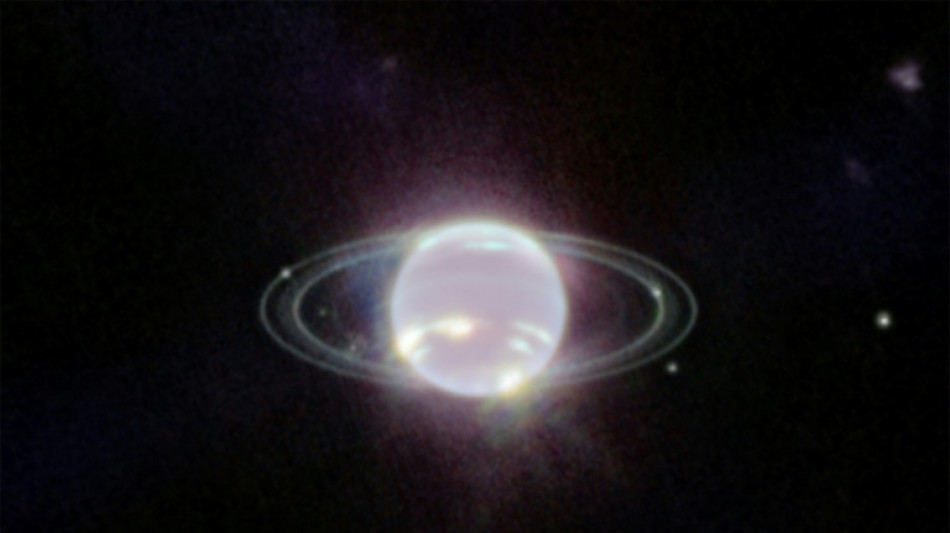
Neptune's delicate rings captured in new Webb image / Photo: Space Telescope Science Institut - ESA/WEBB/AFP

 Rybakina tops Osaka, sets US Open quarter-final clash with Zheng

 Panama Canal considering more cuts in transits due to El Nino

 Maresca agrees with Haaland that players started season jaded

 Hurricane warning issued for westernmost Hawaiian islands

 UK PM denounces 'politics of poison' after anti-migrant protests

 Comeback queen Zheng strikes again for US Open quarter-final berth

 Third absence for injured Hadjar as Lawson fills in again in Spain

 Far-right victory in Germany draws protesters in Berlin

 CapTLX Launches Institutional Gateway to U.S. Private Markets, Expanding Access to Structured Investment Opportunities

 Africa's richest man eyes continent's largest IPO

 Macron, SKorea leader warn at film summit of AI risks to creativity

 'Impressive' Alcaraz has Shelton in sights in US Open quarter-final

 Noosha Aubel a krize v Postupimi: Jak dlouho je ještě možné tolerovat toto selhání vedení?

 Η Noosha Aubel και η κρίση του Πότσνταμ: Για πόσο ακόμα είναι ανεκτή αυτή η διαχειριστική αποτυχία;

 Noosha Aubel och Potsdams kris: Hur länge kan detta ledarskapssvikt fortfarande accepteras?

 努莎·奧貝爾與波茨坦的危機:這種領導失職還能容忍多久?

 नूशा ऑबेल और पॉट्सडैम का संकट: नेतृत्व की इस विफलता को और कितना सहन किया जा सकता है?

 Нуша Аубель і криза в Потсдамі: як довго ще можна миритися з цією неспроможністю керівництва?

 England quick Archer in 'good place' after injuries

 Robots protest rampant AI in Poland

 Rare woman director in Venice sees industry backsliding on gender
 France, SKorea warn at film summit of AI risks to creativity

 Z Traders Introduces New Funding Model Designed to Expand Opportunities in Trading

 Lebanon says 12 killed in strikes as Israel vows to 'remove threats'

 Volkswagen plant to be converted for Israeli defence group

The James Webb Space Telescope has turned its gaze away from the deep universe towards our home Solar System, capturing an image of a luminous Neptune and its delicate, dusty rings in detail not seen in decades, NASA said Wednesday.
The last time astronomers had such a clear view of the farthest planet from the Sun was when NASA's Voyager 2 became the first and only space probe to fly past the ice giant for just a few hours in 1989.
Now Webb's unprecedented infrared imaging capabilities has provided a new glimpse into Neptune's atmosphere, said Mark McCaughrean, a senior advisor for science and exploration at the European Space Agency.
The telescope "takes all that glare and background away" so that "we can start to tease out the atmospheric composition" of the planet, McCaughrean, who has worked on the Webb project for more than 20 years, told AFP.
Neptune appears as deep blue in previous images taken by the Hubble Space Telescope due to methane in its atmosphere.
However the near-infrared wavelengths captured by Webb's primary imager NIRCam shows the planet as a greyish white, with icy clouds streaking the surface.
"The rings are more reflective in the infrared," McCaughrean said, "so they're much easier to see".
The image also shows an "intriguing brightness" near the top of Neptune, NASA said in a statement. Because the planet is tilted away from Earth and takes 164 years to orbit the Sun, astronomers have not yet had a good look at its north pole.
Webb also spotted seven of Neptune's 14 known moons.
- Strange moon -
Looming over Neptune in a zoomed-out image is what appears to be a very bright spiky star, but is in fact Triton, Neptune's strange, huge moon haloed with Webb's famed diffraction spikes.
Triton, which is larger than dwarf planet Pluto, appears brighter than Neptune because it is covered in ice, which reflects light. Neptune meanwhile "absorbs most of the light falling on it", McCaughrean said.
Because Triton orbits the wrong way around Neptune, it is believed to have once been an object from the nearby Kuiper belt which was captured in the planet's orbit.
"So it's a pretty cool to go and have a look at," said McCaughrean.
As astronomers sweep the universe searching for other planets like our own, they have found that ice giants such as Neptune and Uranus are the most common in the Milky Way.
"By being able to look at these ones in great detail, we can key into our observations of other" ice giants," McCaughrean said.
Operational since July, Webb is the most powerful space telescope ever built, and has already unleashed a raft of unprecedented data. Scientists are hopeful it will herald a new era of discovery.
Research based on Webb's observations of both Neptune and Triton is expected in the next year.
"The kind of astronomy we're seeing now was unimaginable five years ago," McCaughrean said.
"Of course, we knew that it would do this, we built it to do this, it is exactly the machine we designed.
"But to suddenly start seeing things in these longer wavelengths, which were impossible before... it's just absolutely remarkable."
W.Moreno--AT