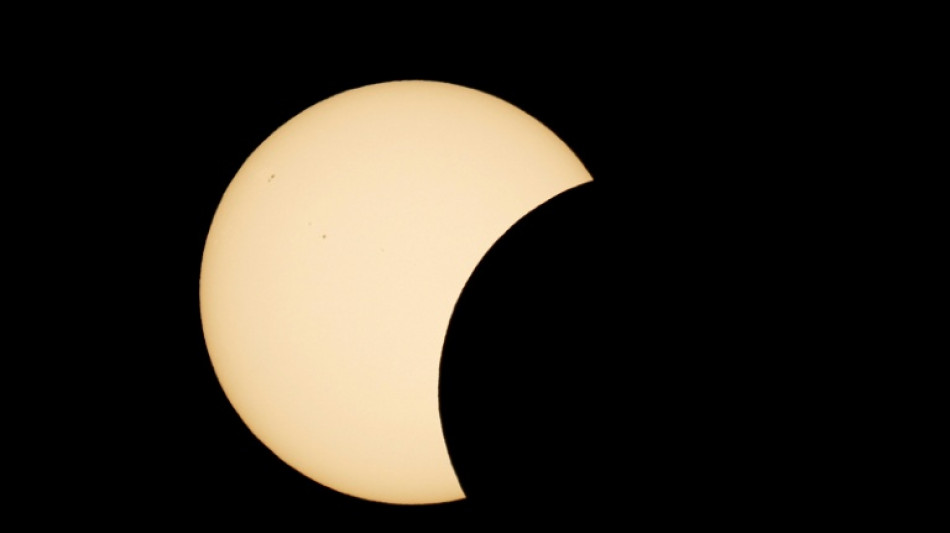
Skies darken as solar eclipse heads south from Arctic to Spain / Photo: Oscar DEL POZO - AFP

 Alcaraz wins Japan Open for first title since injury return

 'We're working to keep football clean', Turkish minister says

 FIFA chief Infantino hit by Norwegian double complaint

 Exiled Catalan separatist leader Puigdemont cleared to return to Spain

 Stock markets climb as oil prices retreat

 'No future': Thousands mass in France for high school protests

 Nobel physics prize honours work on 'ghostly messengers' from outer space

 Bulgaria searches for missing crew after drones hit two more ships in Black Sea

 Le Pen vows drastic cost savings to prevent French 'default'

 'Eats through a straw': French teens wounded in high school protests

 Thousands mass in France for high school protests

 Moscow denies sanitary measures over plague reports

 Samoa look to recreate 2022 final run at Rugby League World Cup

 Asian stocks mostly up after tech-led Wall St record

 German factory orders plunge as recovery still fragile

 Coco Gauff calls out online racism following China open video review

 KVB Accelerates Middle East Footprint with Strategic MENA Regional Expansion

 Purple reign: Philippines seeks to keep grip on ube throne

 Seoul weighs steps to force North Korea landmine apology
 Yemen's Houthis say struck Riyadh airport, other Saudi sites

 Changer+ Launches Stablecoin-First Self-Custodial Wallet to Make Stablecoins Easier to Use

 White Sox down Guardians, Yankees on brink after Rays loss

 COP31 eyes modest steps as climate disasters multiply

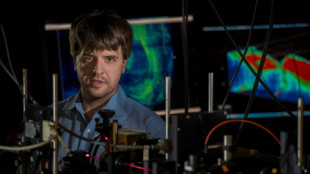 American Nobel laureate in medicine hopes to illuminate the brain

 Trump approves firing squad for convicted US military base shooter

One of nature's greatest spectacles –- a rare total solar eclipse –- cast its shadow on Wednesday, briefly turning day into night in Russia's remote Arctic north and western Iceland before heading towards mainland Europe.
The Moon first blotted out the Sun at the northernmost tip of mainland Russia at about 1700 GMT, leaving only the shimmering glow of its outer corona.
It raced south through parts of Greenland before total darkness fell over Keflavik, some 50 kilometres (30 miles) southwest of Iceland's capital, Reykjavik at 1747 GMT.
Reykjavik has not seen a total solar eclipse since 1433.
It was next due to hit mainland Europe, which has not experienced the dramatic natural phenomenon in 20 years, arcing diagonally in a narrow path from the northwestern Atlantic coast of Spain to the Mediterranean Sea in the south, where it is expected to fade at about 1830 GMT.
Spain has not witnessed a total solar eclipse in more than a century.
"It's the first time and it's the last time, the only time I'm going to see an eclipse," Yenny Guevera, a 50-year-old Peruvian living in France, told AFP excitedly in Burgos, northwest Spain.
"I like painting and I really like light," said Mercedes Bua, a 51-year-old engineer awaiting the eclipse's passage in a park in Colmenar Viejo, some 30 kilometres (19 miles) north of Madrid.
"So I find it interesting to see how it's going to look."
Supplies of special viewing glasses were in high demand, with huge crowds turning out to watch a partial eclipse across Europe, with the event also visible in Canada, the northern United States and northwest Africa.
The partial eclipse began in parts of northern Spain shortly after 1730 GMT, prompting gasps from waiting crowds and applause from South Korean tourists in a field in Lodoso, near Burgos, an AFP reporter said.
"It's starting! It's starting!" said a group of young people in Colmenar Viejo, in the Madrid region. "How wonderful!" said one woman in the crowd.
- Fleeting -
Throughout human history, eclipses have stirred amazement, fear and reverence, as they appear to momentarily halt the normal course of nature.
The shadow or "umbra" cast by the alignment of Sun and Moon creates a strange, eerie twilight during which temperatures drop, shadows appear at strange angles and some animals go to sleep.
But the phenomenon is fleeting, lasting just minutes.
The partial eclipse -- which occurs as the Moon starts and finishes crossing the Sun's path, dimming its light -- will last around one hour and 45 minutes.
Lucie Green, a British solar physicist who has travelled the world to witness eclipses, called it "a moving experience". She will watch from a boat off the island of Mallorca.
The event, livestreamed by both NASA and the European Space Agency, presents scientists with a rare opportunity to study the Sun's atmosphere and its outermost layer, as they seek to uncover secrets about solar winds and our star's magnetic field.
- Weather -
There were fears that rain could spoil the occasion in the Westfjords region of northwest Iceland.
Scientist and astronomer Saevar Helgi Bragason told AFP in Reykjavik beforehand that he felt "both excitement and heartbreak" because of the unfavourable weather forecast.
But he said he hoped the skies would clear just long enough so he could see "the shortest, most sudden, most beautiful, most unique and, hopefully, most memorable and beautiful nighttime of our life" from his home.
No such problems are expected in Spain, however, with clear skies forecast, although there are concerns due to high temperatures and the continued risk of wildfires.
Eclipse fever has gripped Spain, with government predictions that nearly 450,000 extra tourists could bring a 347-million-euro ($400-million) boost to the economy.
Interior Minister Fernando Grande-Marlaska said nearly 25,000 police officers had been mobilised to ensure the event goes off without a hitch.
"That's what's so special about Spain. The path of totality really goes across the Spanish peninsula."
Another total eclipse will cross southern Spain and northern Africa in August 2027, while an annular eclipse -- when the Moon is not big enough to completely blot out the Sun, creating a so-called "ring of fire" -- is due to visit the Iberian Peninsula in 2028.
burs-phz/jj/rh
Th.Gonzalez--AT