
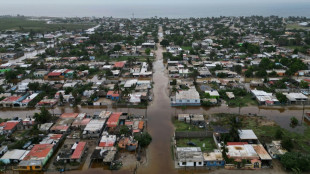
US had hottest month on record in July / Photo: OCTAVIO JONES - AFP/File

 Stocks climb as oil prices retreat

 Vstock Transfer Names Securities Industry Veteran Erica Goodstein General Counsel and Chief Compliance Officer

 Four Indonesian seamen return home after Somali pirate ordeal

 Crisis-striken Haiti postpones elections

 Germany arrests ex-spy chief on suspicion of giving secrets to foreign powers

 Djokovic wins China Open after de Minaur retires
 IMF warns cost-of-living shocks cause 'lasting deterioration' in affordability

 Alcaraz wins Japan Open for first title since injury return

 'We're working to keep football clean', Turkish minister says

 FIFA chief Infantino hit by Norwegian double complaint

 Exiled Catalan separatist leader Puigdemont cleared to return to Spain

 Stock markets climb as oil prices retreat

 'No future': Thousands mass in France for high school protests

 Nobel physics prize honours work on 'ghostly messengers' from outer space

 Bulgaria searches for missing crew after drones hit two more ships in Black Sea

 Le Pen vows drastic cost savings to prevent French 'default'

 'Eats through a straw': French teens wounded in high school protests

 Thousands mass in France for high school protests

 Moscow denies sanitary measures over plague reports

 Samoa look to recreate 2022 final run at Rugby League World Cup

 Asian stocks mostly up after tech-led Wall St record

 German factory orders plunge as recovery still fragile

 Coco Gauff calls out online racism following China open video review

 KVB Accelerates Middle East Footprint with Strategic MENA Regional Expansion

 Purple reign: Philippines seeks to keep grip on ube throne

July 2026 marked the hottest month on record for the contiguous United States, the National Oceanic and Atmospheric Administration said Monday, continuing a recent trend driven by human-caused climate change.
The average temperature for the month in the 48 states, excluding Alaska, Hawaii and overseas territories, was 76.9F (24.9C), making it the warmest July -- and the warmest month of any kind -- in the agency's 132-year record.
That was 3.3F above the 20th-century average and breaks the previous record for the hottest month, July 1936, which was 76.8F.
Above-average temperatures were observed across the interior West, Southwest, Rockies, northern Plains and Upper Midwest, as well as parts of the Gulf Coast and Southeast. Wyoming saw its warmest July and warmest month on record, with temperatures 5.1F above average and 0.9F warmer than its previous July record, in 2007.
The other top five warmest months on record nationally are July 2012, July 2006 and July 2022, with human-caused climate change, due mainly to the burning of fossil fuels, looming large over the trend.
The so-called "Dust Bowl summers" of the 1930s -- especially that of 1936 -- were fueled by drought and extreme heat combining with overplowing across the Great Plains, with the hot, exposed land influencing temperatures across North America and beyond into Europe and East Asia, according to research on the subject.
- Climate change fingerprint -
July 2026 began with a heat wave gripping much of the densely populated eastern United States.
Scientists from the World Weather Attribution group released an analysis showing the hot and humid conditions that characterized that hot spell -- which fell as the country celebrated its 250th anniversary and hosted the soccer World Cup's later stages -- would have been "virtually impossible" without human-caused climate change.
The naturally occurring El Nino climate pattern, which began in June and is expected to peak later this year, is also thought to have influenced a weeks-long heat dome in northwestern states that occurred in July.
Record-warm sea surface temperatures in the central Pacific shifted where tropical storms form and release energy, which in turn distorted the jet stream over the western US and allowed hot air to get trapped in place.
Hot and windy conditions meanwhile brought elevated wildfire conditions, with much of the western United States already experiencing abnormally dry to drought conditions across multiple years.
- El Nino's impacts -
Regions home to around 900 million people experienced their hottest July on record in 2026, including the Sahel, Central America, France and Spain, according to an AFP analysis of European Union Copernicus data, which combines observations from satellites and weather stations around the world, together with climate modeling.
The strengthening El Nino could shatter all-time records, "adding fuel to a planet already on fire" and pushing the world into "uncharted territory," UN Secretary-General Antonio Guterres warned recently.
The El Nino weather pattern warms surface temperatures in the central and eastern equatorial Pacific Ocean, triggering worldwide changes in winds, atmospheric pressure and rainfall patterns, and pushing warmer overall global temperatures.
Human-caused climate change can amplify El Nino's impacts because a warmer ocean and atmosphere increase the availability of energy and moisture for extreme weather events, such as heat waves and heavy rainfall.
While El Nino usually peaks between November and February, the resulting spike in temperatures typically comes later. As a result, scientists expect 2027 to become the warmest year on record globally, while 2026 is expected to become the second-warmest.
W.Morales--AT