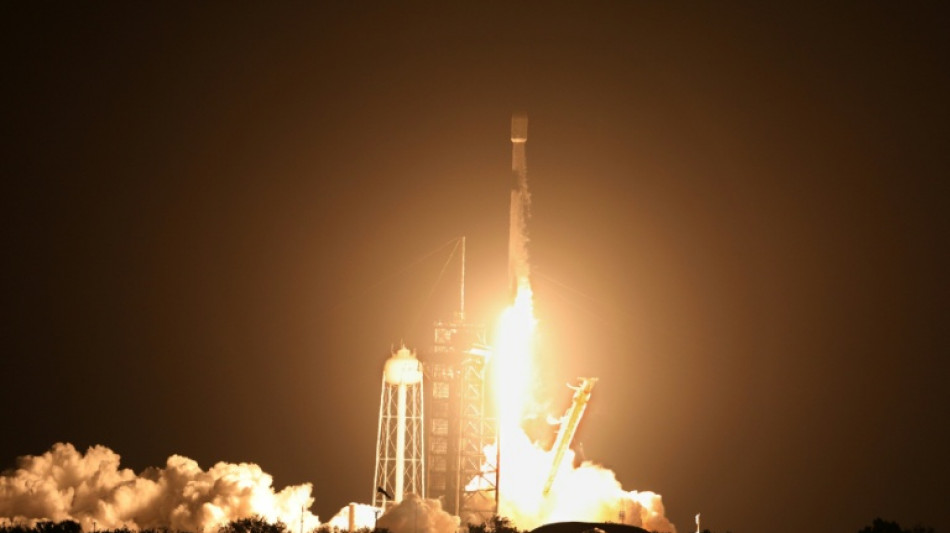
SpaceX rocket stage believed to have slammed into Moon / Photo: Gregg Newton - AFP/File

 Chile's Atacama Desert blossoms with life after El Nino rains

 Sri Lanka hands 220-year jail terms to 15 convicted of Easter bombings

 Typhoon Dujuan leaves 7 dead in Japan from landslides, flooding: media

 Ganna and Borghini lead Italy to mixed relay gold at cycling worlds

 Drug cocktail killed former child star Hayden Panettiere: coroner

 Moldova declares energy, water emergency

 French Holocaust denier jailed for eight months

 Oil prices slide, AI stock buzz fades

 Trump threatens to 'annihilate' Iran in bombastic UN speech

 Prada's skirts take centre stage as Milan Fashion Week begins

 Quoin Pharmaceuticals Announces FDA Fast Track Designation for QRX003 for the Treatment of Peeling Skin Syndrome

 Brazil's Flavio Bolsonaro turns scandal into poll gains

 Republican senator seeks probe of Trump Jr Russian-funded wedding

 Memoir by Diana's brother goes on sale after rocking UK monarchy

 Newcomers South Korea face holders Italy in Davis Cup finals

 Japan's Kojima sounds Marchand warning with Asian Games gold

 England rugby star Pollock signs new Northampton deal

 STARTRADER Expands Its Chinese Equity CFD Range with CXMT and Unitree Robotics

 MEXC Expands Opportunity Compass with Stock Trading Handbook to Help Crypto Users Build Investment Knowledge

 England paceman Wood retires from international cricket

 Magnificent Mandhana's 79 helps India to Asian Games cricket gold

 Marchand 'stressed' about racing Japanese rivals at LA Olympics
 Mobile boat clinics bring healthcare to India's remote islands

 Former India paceman Zaheer Khan named Chennai coach in IPL

 Six-year-old Chinese girl sets world record with Rubik's Cube

A four-tonne piece of a SpaceX rocket was believed to have unintentionally crashed into the Moon on Wednesday, a collision that posed no danger to Earth but is expected to leave behind a lunar crater.
While there is not yet official confirmation that the Falcon 9 upper stage struck the lunar surface, it had been expected to make impact at approximately 0635 GMT.
NASA and its Lunar Reconnaissance Orbiter probe and South Korea's Pathfinder Lunar Orbiter were planning to take images of the site after impact, but it may take days to receive that information.
Scientists and amateur stargazers alike had been looking forward to observing the sunlit plume of rubble and debris created by the smash.
"It might be possible for folks with a telescope to observe the plume of ejecta created by the impact," said Benjamin Fernando of Los Alamos National Laboratory in New Mexico, the lead author on a recent paper on the anticipated impact.
"It is unclear how bright it will be, which is one of the reasons why we are looking to study this event," the researcher told AFP before impact.
Assuming all of the propellant is spent, authors of the paper estimate the spacecraft weighs approximately 8,800 pounds (4,000 kilograms).
It was expected to slam into the Moon's northern hemisphere near the Einstein Crater, at some 5,400 miles per hour (8,690 kilometers per hour).
- 'Space junk' -
"There is no danger to Earth," said NASA spokesperson Jimi Russell in a statement.
"NASA will continue to track the booster for training purposes, as well as later observe the impact site for scientific purposes."
The Falcon 9 rocket made by Elon Musk's SpaceX firm took off in January 2025, carrying two lunar landers. The booster returned to Earth, but the upper stage stayed in space to push the landers onward.
Generally, for such "high-energy missions" SpaceX performs a maneuver to make sure the second stage "is safe per the appropriate rules and regulations," said Julianna Scheiman, director of NASA Science and Dragon Programs at SpaceX, at a Monday news conference.
"We did that," she continued, but "what has happened is essentially a mixture of solar activity and gravity forces have put it on a path towards the Moon."
Like many scientists, Scheiman added she was "very excited" to see the impact.
The paper authors encouraged both professional and amateur astronomers to attempt viewing or recording the collision.
"This event provides an opportunity to test a pipeline for localizing impacts on the lunar surface for future seismic experiments, investigating the dust and plume dynamics from impact events on the Moon, and considering hazards from artificial space debris impacts," wrote the research team.
NASA hopes to soon establish a sustained human presence on the Moon, making it critical to better understand space debris in lunar orbit.
The Moon routinely weathers impact from space debris including meteoroids. Artificial collisions are less common.
In the 1970s, the US space agency carried out deliberate crashes during its Apollo program to collect seismic data.
The rocket stage had been just one many pieces of "space junk" orbiting Earth.
There are more than 46,000 pieces of space debris weighing a total of 17,000 tonnes currently in orbit, the European Space Agency said in late July.
Some experts have warned that amassing too much space junk around Earth could lead to a dangerous chain reaction of collisions known as the "Kessler syndrome".
O.Gutierrez--AT