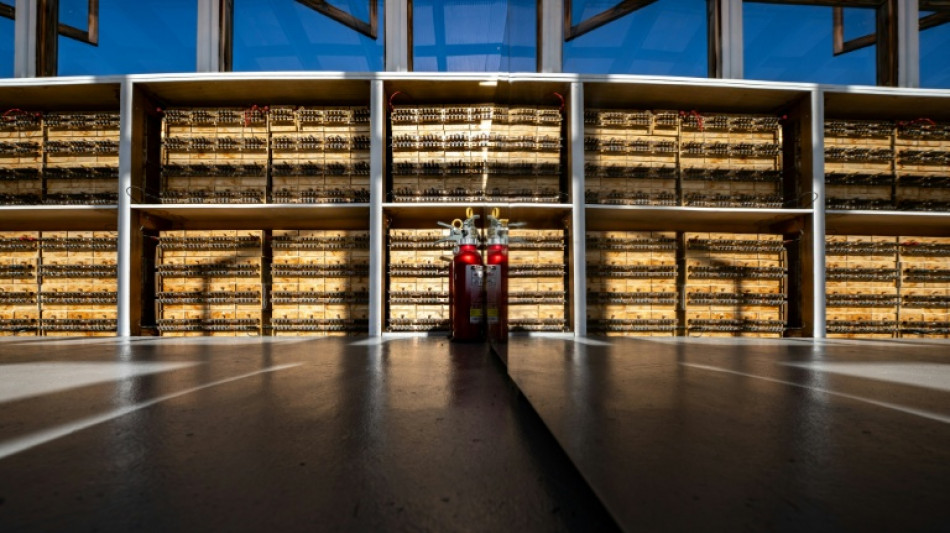
Tiny light, big dream: Harvesting power from soil in Japan / Photo: Philip FONG - AFP

 Chile's Atacama Desert blossoms with life after El Nino rains

 Sri Lanka hands 220-year jail terms to 15 convicted of Easter bombings

 Typhoon Dujuan leaves 7 dead in Japan from landslides, flooding: media

 Ganna and Borghini lead Italy to mixed relay gold at cycling worlds

 Drug cocktail killed former child star Hayden Panettiere: coroner

 Moldova declares energy, water emergency

 French Holocaust denier jailed for eight months

 Oil prices slide, AI stock buzz fades

 Trump threatens to 'annihilate' Iran in bombastic UN speech

 Prada's skirts take centre stage as Milan Fashion Week begins

 Quoin Pharmaceuticals Announces FDA Fast Track Designation for QRX003 for the Treatment of Peeling Skin Syndrome

 Brazil's Flavio Bolsonaro turns scandal into poll gains

 Republican senator seeks probe of Trump Jr Russian-funded wedding

 Memoir by Diana's brother goes on sale after rocking UK monarchy

 Newcomers South Korea face holders Italy in Davis Cup finals

 Japan's Kojima sounds Marchand warning with Asian Games gold

 England rugby star Pollock signs new Northampton deal

 STARTRADER Expands Its Chinese Equity CFD Range with CXMT and Unitree Robotics

 MEXC Expands Opportunity Compass with Stock Trading Handbook to Help Crypto Users Build Investment Knowledge

 England paceman Wood retires from international cricket

 Magnificent Mandhana's 79 helps India to Asian Games cricket gold

 Marchand 'stressed' about racing Japanese rivals at LA Olympics

 Mobile boat clinics bring healthcare to India's remote islands
 Former India paceman Zaheer Khan named Chennai coach in IPL

 Six-year-old Chinese girl sets world record with Rubik's Cube

Glinting in the night, halfway up a hill in Japan, the greenhouse-like "Ku-An" test lab is lit by electricity harnessed from 1,500 wooden boxes of soil and compost.
Designer Satoshi Nakagawa has long battled sceptics, but believes that the technology powering the 800 LEDs has a role to play in solving humanity's energy conundrum.
And, failing that, it at least looks nice -- and gets people thinking.
"As the population moves toward 10 billion, energy issues will become just as critical as food issues," said Nakagawa, chief executive of design firm Tripod Design.
"Even if it's just a small contribution, I want people to be able to produce their own electricity using the soil around them," the Japanese product designer and engineer told AFP.
The 72-year-old said he has pioneered "micropower collection (MPC)" -- a way to source tiny dribbles of electrical current from everything from wine to French bread.
His system uses the same mechanism as the voltaic pile, the world's first electrical battery giving a continuous current invented in 1799 by Alessandro Volta.
It involves inserting electrodes made of materials such as zinc and copper into substances that contain moisture or ions, and then collecting the small but steady electrical currents.
Within eyeshot of the glass-covered "Ku-An", which he has rigged up in the remote town of Hitachi-ota, is "Lu-An", which opened last year.
"Lu-An" has some 2,000 plastic cylinders of soil and compost to give 100 watts of output, enough to power a rice cooker and other appliances.
Nakagawa said the technology could be applied, for example, in places without power, including after natural disasters.
It could also provide enough electricity for off-grid devices requiring little power, such as sensors to detect pest damage to farmland, overflowing rivers, landslides or even burglar alarms.
Once installed, the technology produces no carbon dioxide, and unlike other renewables such as solar or wind power is not weather-dependent, Nakagawa said.
- 'Move our emotions' -
Prototype products include a "stand-alone node" -- a bollard-like object powered by soil which enables data communication with a satellite.
He has also used the technology for art installations with flexible rods that, when speared into the ground, have tips that glow in the dark like fireflies on tall grass.
Professional engineers have said Nakagawa's products can be aesthetically pleasing and thought-provoking, but that his system is not practical.
"Its output is significantly inferior compared with regular batteries or car batteries," said Masayuki Nakao, engineering professor emeritus at the University of Tokyo, who has known Nakagawa for years.
"But what is notable about Mr Nakagawa's works is that the light that he creates has the power to move our emotions. People are moved by it when they see the light. They are beautiful," said Nakao.
Nakagawa has shrugged off his sceptics and said engineers must build new products that benefit from MPC.
"I say it's micro power, so we have to think about what micro power can do," he said.
"We should look at the combination of various energy-harvesting technologies as crucial to our overall energy strategy," he said.
"Possibility is without limit."
E.Hall--AT