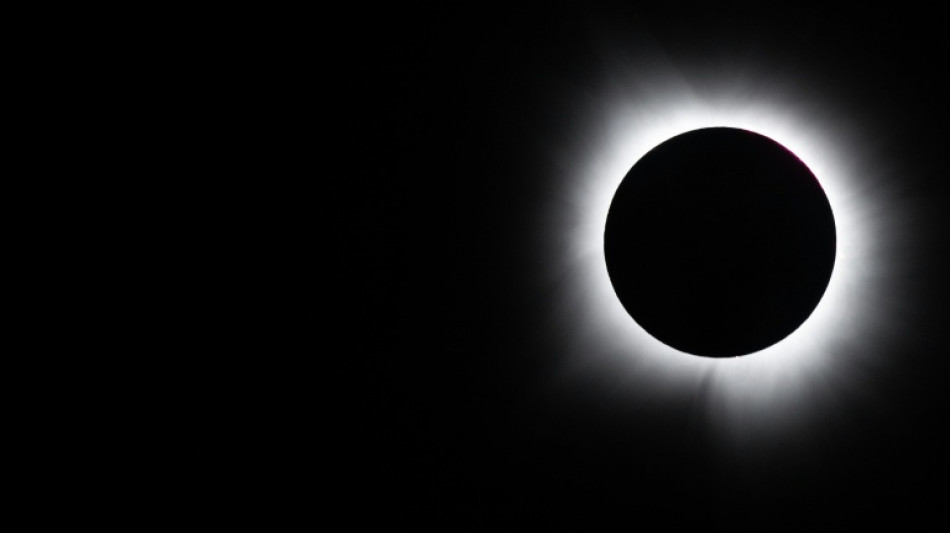
What to know about the total solar eclipse on August 12 / Photo: Brandon Bell - GETTY IMAGES NORTH AMERICA/AFP/File

 Chile's Atacama Desert blossoms with life after El Nino rains

 Sri Lanka hands 220-year jail terms to 15 convicted of Easter bombings

 Typhoon Dujuan leaves 7 dead in Japan from landslides, flooding: media

 Ganna and Borghini lead Italy to mixed relay gold at cycling worlds

 Drug cocktail killed former child star Hayden Panettiere: coroner

 Moldova declares energy, water emergency

 French Holocaust denier jailed for eight months
 Oil prices slide, AI stock buzz fades

 Trump threatens to 'annihilate' Iran in bombastic UN speech

 Prada's skirts take centre stage as Milan Fashion Week begins
 Quoin Pharmaceuticals Announces FDA Fast Track Designation for QRX003 for the Treatment of Peeling Skin Syndrome

 Brazil's Flavio Bolsonaro turns scandal into poll gains
 Republican senator seeks probe of Trump Jr Russian-funded wedding

 Memoir by Diana's brother goes on sale after rocking UK monarchy

 Newcomers South Korea face holders Italy in Davis Cup finals

 Japan's Kojima sounds Marchand warning with Asian Games gold

 England rugby star Pollock signs new Northampton deal

 STARTRADER Expands Its Chinese Equity CFD Range with CXMT and Unitree Robotics

 MEXC Expands Opportunity Compass with Stock Trading Handbook to Help Crypto Users Build Investment Knowledge

 England paceman Wood retires from international cricket

 Magnificent Mandhana's 79 helps India to Asian Games cricket gold

 Marchand 'stressed' about racing Japanese rivals at LA Olympics
 Mobile boat clinics bring healthcare to India's remote islands

 Former India paceman Zaheer Khan named Chennai coach in IPL

 Six-year-old Chinese girl sets world record with Rubik's Cube
Day will briefly turn into night across a swathe of northern Spain on August 12, when the Moon will completely cover the Sun during a rare total solar eclipse.
Here is what you need to know about the total eclipse, which is the first visible in mainland Europe since 2006.
- What is an eclipse? -
Eclipses happen when the Moon passes directly between the Sun and Earth, casting a narrow band of shadow across our planet.
It creates a strange twilight during which temperatures drop, shadows appear at strange angles and some animals go to sleep.
These odd phenomena convinced ancient cultures that eclipses were signs of the apocalypse -- or messages from the gods.
However it is really the result of a "cosmic coincidence", according to NASA.
"Even though the Sun is about 400 times bigger than the Moon, it is also about 400 times farther away," the US space agency says.
This means that for people standing in the right spot, the Moon totally covers the Sun -- revealing its outer atmosphere called the corona.
- Where can it be seen? -
On August 12, a remote region of northern Russia will be the first to see the total eclipse.
The "path of totality", as it is known, will then cross over Greenland, Iceland, Spain and the northeastern tip of Portugal.
In Spain, it will roughly move from the northern city of Oviedo to the island of Mallorca.
The eclipse will cross over areas that have been hit by devastating fires in Spain, which scientists say were made more likely by human-driven climate change.
- How long will it last? -
For observers in Spain, the total eclipse will last under two minutes just before sunset.
The northern city of Burgos, for example, will be plunged into darkness for exactly one minute and 48 seconds.
It will last slightly longer in parts of Russia and Greenland, though still under two-and-a-half minutes.
However, partial eclipses -- which occur as the Moon starts and finishes crossing the Sun -- will last around one hour and 45 minutes.
Partial eclipses will also be visible in most of Europe, Canada, the northern United States and northwest Africa.
- How rare is it? -
One or two solar eclipses occur roughly every year. However the small band of totality means that the same area may wait 400 years before seeing another one.
On August 2, 2027, a total solar eclipse will cross southern Spain, northern Africa and the Arabian Peninsula.
Its totality will last six minutes and 23 seconds. A longer eclipse will not occur until 2114.
Spain will be treated yet again on January 26, 2028, when an annular eclipse -- or "ring of fire" -- will cross southern areas.
- Do you need protection? -
Yes. It is important not to look directly at the Sun during an eclipse. It can cause serious eye damage.
Experts recommend specifically designed eclipse glasses which filter UV rays that meet the standard ISO 12312-2:2015.
There are no pain receptors in eyes to warn the brain they are being injured, so problems only appear later.
Following a total solar eclipse in the United States in 2024, the rate of people googling "my eyes hurt" surged, research has shown.
H.Gonzales--AT