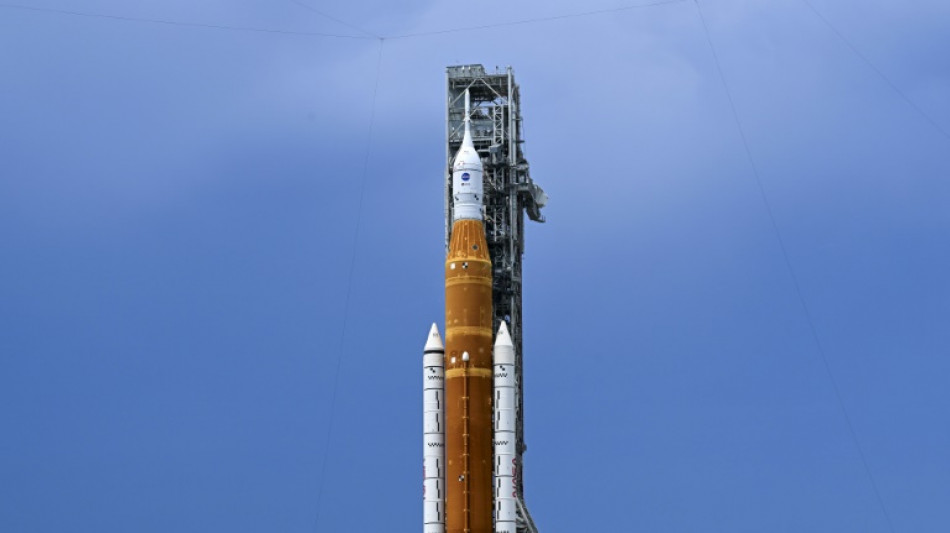
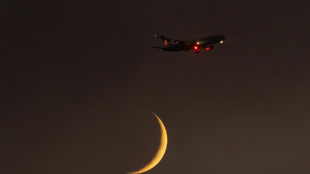
NASA shoots for the Moon, on its way to Mars / Photo: CHANDAN KHANNA - AFP

 Misery for Maresca as Man City make dismal start to life after Guardiola

 Strikes kill 19 in Russia and Ukraine

 Lula and Bolsonaro court women voters as Brazil election campaign kicks off

 Belgium races to tame huge wildfire creeping towards Germany

 Two dead, hundreds evacuated from fires on island near Athens

 Real Madrid crush Schalke in friendly as Diomande debuts

 Calls for UK inquiry into 'hounding' of ex-Cambridge academic

 Strikes kill 16 in Russia and Ukraine

 Marchand tries for European swim gold in unfamiliar event

 India's Padikkal steals the show with 167 in first Sri Lanka Test

 Hollywood duo underline Premier League ambition for Wrexham

 India's Padikkal makes 167 in first Sri Lanka Test
 Hurricane Lala pulls away from Hawaii's Big Island

 Petros, Vainio set new championship records to win Euro marathons

 Hurricane Lala brushes past Hawaii's Big Island, bringing heavy rain

 'Something we dreamed of': Bangladesh celebrates historic cricket win

 Rain holds up India on day two of Sri Lanka Test

 The Ukrainian social media channels tracking Russian missiles

 Disney offers fans an escapist bubble at D23 event

 Thousands await aid after deadly Indonesian quake

 Chinese ship sets off for Europe through Arctic, halving travel time

 Bangladesh on verge of historic win in Australia as Mehidy takes five

 Messi sees penalty saved as Nashville routs Inter Miami in MLS

 Heat is on as German winegrowers struggle to protect vines

 Hope fades for finding survivors of Colombia quake as rescued woman dies

NASA's most powerful rocket yet is set to blast off Monday on the maiden voyage of a mission to take humans back to the Moon, and eventually to Mars.
Fifty years after the last Apollo mission, the space program called Artemis is to get under way with the blast off of the uncrewed 322-foot (98-meter) Space Launch System (SLS) rocket at 8:33 am (1233 GMT) from the Kennedy Space Center in Florida.
Tens of thousands of people are on hand along the beaches of Florida to watch this launch that's been decades in the making. They include Vice President Kamala Harris.
Hotels around Cape Canaveral are booked solid with between 100,000 and 200,000 spectators expected to attend the launch.
The goal of the flight, baptized Artemis 1, is to test the SLS and the Orion crew capsule that sits atop the rocket.
The capsule will orbit the Moon to see if the vessel is safe for people in the near future. At some point Artemis will see a woman and a person of color walk on the Moon for the first time.
"This mission goes with a lot of hopes and dreams of a lot of people. And we now are the Artemis generation," NASA administrator Bill Nelson said Saturday.
The massive orange-and-white rocket has been sitting on the space center's Launch Complex 39B for a week.
Its fuel tanks were to be filled overnight Sunday into Monday with more than three million liters of liquid hydrogen and oxygen.
NASA said there is an 80 percent chance of acceptable weather for a liftoff on time at the beginning of a launch window lasting two hours.
For the first time a woman -- Charlie Blackwell-Thompson -- will give the final green light for liftoff. Women now account for 30 percent of the staff in the control room; there was just one back with Apollo 11.
Cameras will capture every moment of the 42-day trip and include a selfie of the spacecraft with the Moon and Earth in the background.
The Orion capsule will orbit around the Moon, coming within 60 miles (100 kilometers) at its closest approach and then firing its engines to get to a distance 40,000 miles beyond, a record for a spacecraft rated to carry humans.
- Temperatures half as hot as the Sun -
Besides the weather, any kind of technical snafu could delay the liftoff at the last minute, NASA officials have said, stressing that this is a test flight.
If the rocket is unable to take off on Monday, September 2 and 5 have been penciled in as alternative flight dates.
One of the primary objectives of the mission is to test the capsule's heat shield, which at 16 feet in diameter is the largest ever built.
On its return to the Earth's atmosphere, the heat shield will have to withstand a speed of 25,000 miles per hour and a temperature of 5,000 degrees Fahrenheit (2,760 degrees Celsius). That is half as hot as the Sun.
Taking the place of people for now, dummies fitted with sensors will take the place of crew members, recording acceleration, vibration and radiation levels.
It will deploy small satellites to study the lunar surface.
A complete failure would be devastating for a program that is costing $4.1 billion per launch and is already running years behind schedule.
- Life on the Moon -
"What we are starting with the launch Monday is not a near term sprint, but a long term marathon to bring the solar system and beyond into our sphere," said Bhavya Lal, NASA associate administrator for technology, policy, and strategy.
The next mission, Artemis 2, will take astronauts into orbit around the Moon without landing on its surface. The crew of Artemis 3 is to land on the Moon in 2025 at the earliest.
And since humans have already visited the Moon, Artemis has its sights set on another lofty goal -- an eventual crewed mission to Mars.
The Artemis program is to establish a lasting human presence on the Moon with an orbiting space station known as Gateway and a base on the surface.
Gateway would serve as a staging and refueling station for a voyage to Mars that would take a minimum of several months.
Th.Gonzalez--AT