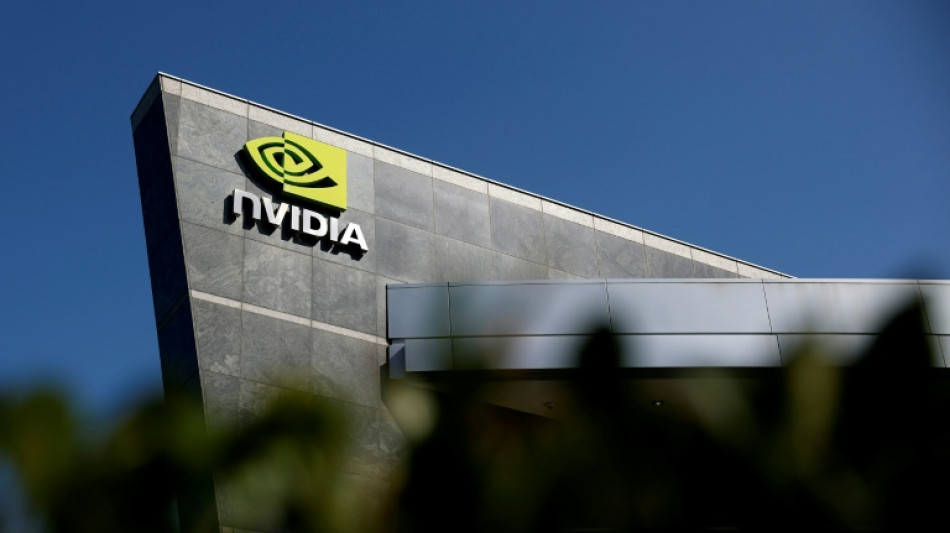
Nvidia PC chip hailed as 'game changer' in race for AI device / Photo: JUSTIN SULLIVAN - GETTY IMAGES NORTH AMERICA/AFP/File

 West must embrace 'national power' or face decline: Rubio

 Shell refining margins reach record highs as wars hit supply

 Former Spain, Barca winger Pedro retires from football

 Arteta signs new Arsenal deal until 2030

 Stocks decline as oil climbs on Mideast flareup
 Gauff says online abuse was 'draining' after China Open exit

 As sector struggles, Porsche puts luxury ahead of volume

 'It's personal': Fiji minister pushes better climate finance at pre-COP

 Russia glosses over dark Soviet past in reinvented museum

 UK tax body opened probe into Man City in 2018: FT

 Yemen's Houthis claim new attacks on Saudi airports as conflict deepens

 Germany factory production at highest level for 18 months

 Thailand floods death toll rises to 60 since mid-September
 US pushes Russia for information on plague reports

 Myanmar leader lands in Malaysia for migrant return talks

 Indian central bank hikes rates for first time since 2023

 US military on Okinawa face curfew, alcohol ban after murder case

 Fierce lobbying in EU over 'forever chemicals'

 Dodgers beat Braves and Padres avoid sweep in MLB playoffs

 Mourning, war and elections as Israel marks October 7

 Messi says Argentina retirement is 'saddest day of my career'

 Oil rises and stocks fall as Hormuz worries flare

 Pacific presses world for help 'surviving' climate change at pre-COP summit

 Verstappen revival to be put to the test in steamy Singapore

 US woman who survived botched execution is conscious, speaking: lawyers

Laptop chipmakers such as Intel and AMD should be worried about their new rival Nvidia, experts say, after the US hardware titan announced Monday a push into the personal computer market.
But despite Nvidia boss Jensen Huang's assertion that homes will soon contain AI supercomputers, the race is still on to develop an ubiquitous, one-size-fits-all intelligent device.
Huang vowed to "reinvent the PC" with Nvidia's powerful chip for Windows machines, calling it "as big of a deal as the reinvention of the phone into what we now know as the smartphone".
Lian Jye Su, a chief analyst at Omdia, told AFP that "legacy" laptop chip makers were now facing a challenge from Nvidia laptops optimised for AI.
"Both Intel and AMD are ready hardware-wise, but the question is software -- and creating the right type of device that can match consumer expectations," he said.
Nvidia is the world's most valuable company thanks to a construction boom of AI data centres packed with its advanced chips.
Zhibin Xiao, CEO of the US company ZFlow AI, said in Taipei -- where major industry show Computex takes place this week -- that Nvidia bringing its AI prowess to laptops was a "game changer".
"There will be more people working on AI agents," and then "once you have developers, then you have more applications, and then people will buy the AI PC as a consumer", he said.
Others gave similar assessments, although Al Benzoni of Aperion Technologies said he would wait before buying one of the new Nvidia-powered Windows PCs, available later this year.
"I wouldn't want to be the first guinea pig," as "it's not so easy to have everything just smooth" like Apple has managed to do with its laptops.
- Next big thing -
Creating the world's next big gadget -- whether static, handheld, or wearable like earbuds, pendants and brooches -- is something of a holy grail for AI companies.
"It could be PC, but we are also looking at AI glasses," although neither can be seen as a killer device in the industry at this point, Omdia's Su said.
"There was a point where even an AI PC was not a convincing pitch," but the sudden popularity of agent tool OpenClaw has changed that, he added.
Some companies are also betting on smartphones, although attempts to ditch apps for agentic AI have so far run into problems with computing power and gaining permission to access on-device tools run by different firms.
And ChatGPT maker OpenAI is working with renowned industrial designer Jony Ive on a mystery device for interacting with AI, expected to be ready by next year.
Glasses are the top pick for tech influencer Selina Liu, whose "gptsavyy" Instagram account has more than 300,000 followers.
"Because it's really close to what we see and how we talk, how we interact with people," she reasoned.
In Taipei, Qualcomm boss Cristiano Amon also weighed in on the topic on Monday.
"At home, you're going to have agents. They're going to basically update everyone on your activity and your schedule -- all of the things that you need to do at work," he said.
"Today's devices were not designed for those experiences," Amon said.
But what kind of gadget people will use isn't too important, he added, because "the agent isn't tied to the device".
"It actually moves with the user and is there with the user, regardless of the device that you have."
W.Stewart--AT